November 2, 2026

Capitalizations Index – B ∞/21M

Cryptocurrency Traders Protest Poland’s Move to Tax All Transactions

Cryptocurrency traders protest poland’s move to tax all transactions

Cryptocurrency Traders Protest Poland’s Move to Tax All Transactions

Poland zloty bitcoin tax
Advertisement

Join our community of 10 000 traders on Hacked.com for just $39 per month.

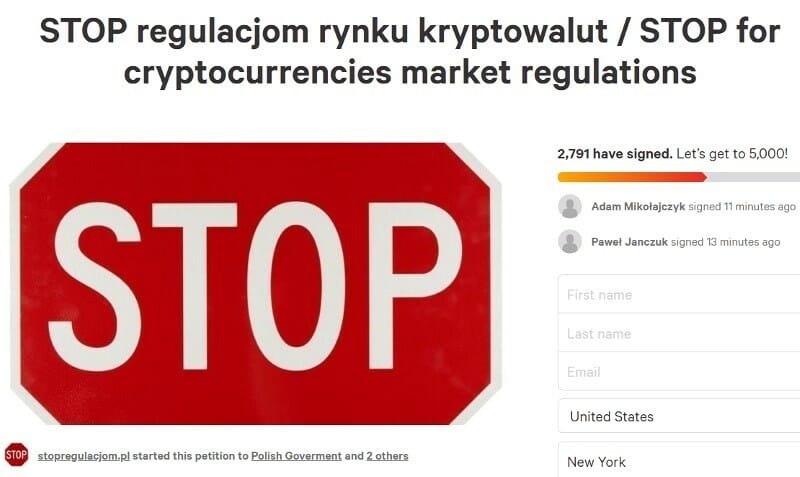
Cryptocurrency traders in Poland launched a petition to protest the government’s decision to tax all cryptocurrency transactions, even those that aren’t profitable.

“We are demanding the release of the blockchain technology market and the abolition of all taxes related to this industry,” according to the Change.org petition, which has already been signed by more than 2,700 people.

In the petition, Polish crypto traders say the new regulations mean that the money they had invested in bitcoin and other virtual currencies will effectively be taxed “hundreds or even a thousand times.”

The brouhaha erupted after Poland’s Finance Ministry published an interpretation of the country’s tax code last week. The Finance Ministry said all income from crypto transactions are subject to either an 18 percent or a 32 percent tax rate.
Cryptocurrency traders protest poland's move to tax all transactions

But what really rankled the crypto community was the government’s insistence that merely selling or buying virtual currencies is a “transfer of property” that is automatically subject to a 1 percent tax.

So in other words, you owe taxes on a crypto trade even when you lose money.

Polish PM: bitcoin Is a Ponzi Scheme

Poland’s growing cryptocurrency community say the government’s newly-imposed tax burdens will squelch the nascent market.

“The Government of the Republic of Poland restricted access of Poles to the constantly growing market of cryptocurrencies through tax regulations that were not consulted with any of the parties,” the Change.org petition reads. “As a result of these regulations, many people lost, or in the near future, [will] lose their capital, which was taxed a hundred or even a thousand times.”

Polish prime minister Mateusz Morawiecki has tried to deter Poles from participating in the mushrooming crypto market by slamming bitcoin and other virtual currencies as “Ponzi schemes.”

However, the government concedes that blockchain — the technology undergirding bitcoin — can be a useful innovation with the potential for broad applications in the banking industry.

Tom Lee: bitcoin Prices Will Climb After Tax Day

There’s a growing movement in other large cryptocurrency markets to tax bitcoin transactions. In the United States, the IRS issued a note reminding Americans that their capital gains on crypto transactions will be subject to taxation.

And in South Korea, the government plans to unveil a cryptocurrency taxation framework by June 2018.

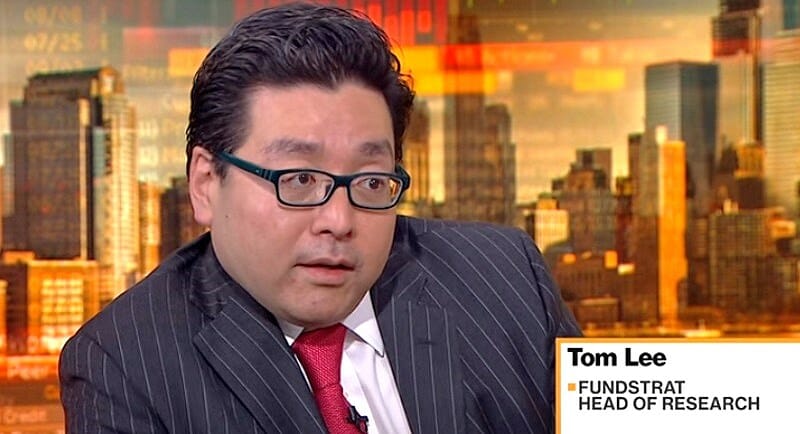
Meanwhile, Fundstrat co-founder Tom Lee predicts bitcoin prices will rise after Tax Day passes in the United States later this month.
Fundstrat tom lee bitcoin
Fundstrat’s Tom Lee to bitcoin investors: HODL. (YouTube)

Lee attributed bitcoin’s recent price slump to investors selling off their crypto holdings in order to avoid capital-gains taxes. He estimates that U.S. bitcoin investors owe $25 billion in capital-gains taxes for 2017, thanks to bitcoin’s skyrocketing prices last year.

“The $25 billion would represent 20% of capital gain tax receipts (payments) to Treasury, which explains why the IRS cares so much about collecting crypto taxes,” Lee said. “Total receipts for capital gains should hit a record $168 billion (for income tax year 2017), exceeding the $137 billion of receipts in 2007.”

Featured image from Shutterstock.

Follow us on Telegram.
Advertisement

Published at Tue, 10 Apr 2018 16:00:07 +0000

News
Previous Article

Promoted: Smart Startup Token Brings Blockchain Security to Small Business Legal Transactions

Next Article

GameLeagueCoin (GML) Price Alert, Chart & News on BitScreener.com

You might be interested in …

Op-ed: Bitcoin Is Not a Bubble; It's in an S-Curve and It's Just Getting Started

Op-ed: Bitcoin Is Not a Bubble; It's in an S-Curve and It's Just Getting Started

One of the most intriguing stories underpinning the recent rise of bitcoin prices is how financial institutions will interact with the currency.

The upcoming CBOE futures market is going to open the door for Wall Street giants to participate in the market. That could spell moon or doom for bitcoin, and everyone is speculating on what may happen next.

It is this Wall Street/BTC interaction (phenomenon) that may be driving the unbelievable price spike of the past few days — at least partially.

On the macro scale, however, we may be witnessing a more grand pattern forming; a price-correlated S-curve.

The S-curve is the classic adoption curve applied to the advent of new technologies. As a percentage of the population, adoption looks like a lag phase where the technology is utilized by the innovators of said technology, followed by an early adoption phase led by people who often take risks in order to be the first movers in a space. After the early adopter phase (~16% of the population is now participating), there comes a great “tipping point” where the wide use of the technology seems inevitable. The tipping point gives rise to the “Early Majority” joining in on the fun, followed by the late majority and, finally, the holdouts who allow the top of the S to asymptotically approach total adoption. The curve, as a factor of time and adoption, looks sort of like the following:

Screen_Shot_2017-12-08_at_9.56.44_AM.png

This curve correlates nicely with adoption of some of the greatest technological innovations in our recent history:

Screen_Shot_2017-12-08_at_9.57.15_AM.png

Some important things to note is that this is just U.S. adoption. Much of the world lagged behind the U.S. in the consumer appliance boom of the 1900s. All of these curves, however steep, do follow the same S-curve trend fairly nicely.

So what could that mean for bitcoin? It’s difficult to choose a metric to define bitcoin adoption, and, in fact, there are disputes about if one metric accurately captures it. However, for simplicity I’ll highlight Google searches for bitcoin and Coinbase user count as microcosms of the global adoption trend.

google search

Screen_Shot_2017-12-08_at_9.58.02_AM.png(from CNBC)

This seems to show a very similar pattern to what could be the transitional phase between “innovators” and “Early Adopters.” Just to harken back to the earlier statement though — it’s very difficult to put a number on bitcoin adoption.

So why is this remarkable? bitcoin may be the first “buyable” S-curve. Because this is a capped-supply currency, more users adopting and using it necessitates an increase in price. Whether that correlation is even reflective of the current price action is a practically unanswerable question, and the obvious leaning would be towards there being a speculative additional value. However, with an increase in adoption, there seems to be a floor rising up to catch whatever “bubble burst” might occur, if and when it happens.

https://platform.twitter.com/widgets.js

“Eternal September” is the phrase used to describe September of 1993, when widespread internet adoption began to look inevitable. It occured after AOL began a mailing campaign offering free trials of its internet service, leading to an influx of internet users that has since never ended. Hence “Eternal September.”

https://platform.twitter.com/widgets.js

To compare bitcoin’s adoption to its complement — the internet — this may very well be the “Eternal September” episode for bitcoin.

If the S-curve adoption theory applies to bitcoin, then buckle up. I won’t pretend to be able to predict a spot price, but I will say I think we may be sitting close to another order of magnitude this time next year.

See y’all on the moon.

Corollary: Bulls sound smart in bull markets. We may look back and laugh at this thought, or it may hold true for years to come. Time will tell. ‘Til then, buy bitcoin.

Trading and investing in digital assets like bitcoin and ether is highly speculative and comes with many risks. This analysis is for informational purposes and should not be considered investment advice. Statements and financial information on bitcoin Magazine and BTC Media related sites do not necessarily reflect the opinion of BTC Media and should not be construed as an endorsement or recommendation to buy, sell or hold. Past performance is not necessarily indicative of future results.


The post Op-ed: Bitcoin Is Not a Bubble; It's in an S-Curve and It's Just Getting Started appeared first on Bitcoin Magazine.