May 3, 2026

Capitalizations Index – B ∞/21M

Cryptocurrency Prices Soar on News Coinbase Is ‘Exploring’ Adding Five New Assets

Cryptocurrency prices soar on news coinbase is ‘exploring’ adding five new assets

Cryptocurrency Prices Soar on News Coinbase Is ‘Exploring’ Adding Five New Assets


Cryptocurrency
Advertisement

The cryptocurrency market experienced a slight bump on Friday, but five altcoins managed to break away from the pack, bolstered by the announcement that cryptocurrency exchange and brokerage giant Coinbase is “exploring” adding support for them to its several platforms.

Earlier today, the San Francisco-based Coinbase announced that it is engaging with discussions with banks and regulators in a variety of jurisdictions about adding support for five new cryptocurrency tokens: cardano (ADA), basic attention token (BAT), stellar (XLM), zcash (ZEC) and 0x (ZRX).

Having learned from past listing fiascos, the firm chose to make the announcement both internally and externally at the same time to reduce its impact on the market and protect itself from allegations of insider trading.

Coinbase also stressed that there is no timeline for when these assets will be listed, as well as the fact that some may ultimately have limited support or none at all, particularly in more-restrictive jurisdictions.

Unsurprisingly though, the five assets in question saw their prices begin to soar immediately following the announcement. Among top 100-cryptocurrencies, these assets rank as five of the day’s seven best performing tokens.
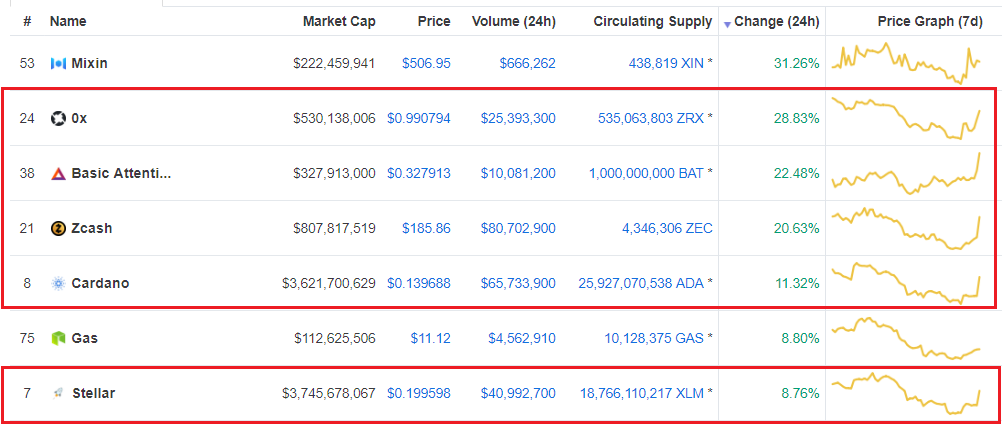
Cryptocurrency prices
Source: coinmarketcap

The top performer in the group was 0x, which is currently up nearly 29 percent for the day to just over $0.99. BAT, the native asset of the Brave ecosystem, has seen its price soar by more than 22 percent to $0.33, while the zcash price is nipping at its heels with a 21 percent surge to $186.

Cardano and stellar posted smaller gains, rising 11 percent and nine percent to $0.14 and $0.20, respectively. This is not surprising, though, since they are the only two coins in the group with market caps above $3 billion. Zcash, the next-largest cryptocurrency, has just an $807 million valuation.

It’s notable that Coinbase continues to hold this much sway over cryptocurrency prices, even as the company adds more assets to its platform. As CCN reported, Coinbase — which has already listed bitcoin, ethereum, bitcoin cash, and litecoin — has also said that it plans to support ethereum classic and ERC-20 tokens (of which BAT and 0x would be the first). The company has also stated its intent to acquire the licenses necessary to list assets classified as securities by U.S. regulators.

Featured Image from Shutterstock

Follow us on Telegram or subscribe to our newsletter here.
Join CCN’s crypto community for $9.99 per month, click here.
Want exclusive analysis and crypto insights from Hacked.com? Click here.
Open Positions at CCN: Full Time and Part Time Journalists Wanted.

Advertisement


Published at Fri, 13 Jul 2018 21:25:55 +0000

Altcoin Analysis
Previous Article

Cryptocurrency Prices Soar on News Coinbase Is ‘Exploring’ Adding Five New Assets

Next Article

Orbis crowdsale announced

You might be interested in …

Scaling Bitcoin Releases This Year’s Program and Announces a New Developer Bootcamp

Scaling Bitcoin Just Released This Year’s Program and a New Developer Bootcamp

Today, Scaling Bitcoin, the international engineering conference focused on bitcoin and blockchain research, released its program for the 2017 edition. The conference, to be held in Stanford, California, in the first weekend of November, will also introduce a new side event this year: Bitcoin Edge, a bootcamp for starting bitcoin developers.

“The program is extremely interesting because it delivers cutting edge research on different blockchain scalability approaches, fungibility, consensus, data propagation, alternative techniques for handling blockchains and many other topics,” said Anton Yemelyanov, chair of the Scaling bitcoin Planning Committee.

Scaling bitcoin Stanford

After events in Montreal, Hong Kong and Milan, the fourth edition of the Scaling bitcoin conference is taking place at Stanford University on November 4 and 5 of this year.

Where the first two editions of Scaling bitcoin were mainly focused on scaling and scalability, the third edition broadened the scope of the conference to include a more diverse set of topics. This trend will continue in Stanford, where talks will range from highly technical topics concerning privacy and fungibility, to fee markets and fee estimation, censorship resistance and more.

bitcoin is the origin of all distributed ledger technology,” said Yemelyanov. “Scaling bitcoin has been fortunate to act as a vehicle for bringing the audience technologies such as Segregated Witness and MimbleWimble, all of which have been adopted or incorporated into various blockchain projects. We hope that other material presented by our participants will be of similar value and help the industry advance the research and development of blockchains.”

Yemelyanov added that another key goal for Scaling bitcoin conferences is to bring engineers and other technical minds together in a physical space where they can discuss their work in person.

“It is through collaboration where a lot of ideas are born and have potential of becoming reality,” he said.

bitcoin Edge Dev++

In addition to the conference itself, Scaling bitcoin is also introducing a two-day technical bootcamp for experienced developers getting into bitcoin: bitcoin Edge.

This nonprofit initiative is an effort to help scale the development capacity of the industry, Yemelyanov explained:

“One of the approaches of helping the industry scale is to scale the much needed development capacity of the industry. There is a clear talent deficit and we are trying to help all industry participants by running a nonprofit workshop that will allow developers to gain complete understanding of primitives that comprise bitcoin and blockchains in general and be able to start working in this field.”

bitcoin Edge will be led by well-known bitcoin developers and academics Anditto Heristyo, Ethan Heilman, John Newbery, Karl-Johan Alm, Nicolas Dorier, Thaddeus Dryja and Jimmy Song. They’ll introduce participants to a range of technical bitcoin-related topics, including Elliptic Curve cryptography, transaction structures, difficulty calculation and adjustments, and much more.

This workshop will take place on the November 2 and 3. For more information on the bitcoin Edge initiative, visit bitcoinedge.org.

See here for the full Scaling bitcoin Stanford program.

The post Scaling Bitcoin Releases This Year’s Program and Announces a New Developer Bootcamp appeared first on Bitcoin Magazine.

The Large Numbers Effect: Cryptofunds Are Spreading

People have already made fortunes from crypto fever and cryptofunds, and many more will make money as well. But not everyone.


The Cryptofund Lifeline

Like any rapidly developing market, the cryptocurrency industry provides opportunities, but there are only a few who can really use them. A significant share of the cryptocurrency market is owned by the those who mined it but have no idea how to handle it. Almost all of these people are at risk of ultimately losing their bitcoin or Ethereum.

Cryptofunds help people survive in this market. For a Blockchain neophyte, such institutions are a throwback. Today, a company doesn’t need any ‘linings’ to raise money transparently and distribute profit.

Indeed, the structure of these kind of organizations is reminiscent of conventional venture funds. But they do work and are indispensable for the new economy.

The Cryptofund Lifeline

Financial Bridges

Market expertise is the main product of any cryptofund. Funds form a team of professional traders and analysts, i.e. of those who are considered useless by the majority of Blockchain partisans in new economy.

Blockchain is characterized by transparent transactions, but it doesn’t necessarily mean the same for a business owner or a business model. Only experienced professionals can separate the wheat from the chaff and find reliable tools in a stack of hollow shells.

Cryptofunds play an important role in the cryptoeconomy. Among other things, they support new projects that create products and develop a Blockchain ecosystem. They also provide money to those who would probably never get a bank loan or investments from venture funds. It’s not necessarily because their projects are bad, but because neither banks nor VCs know how to work with blockchain projects and it’s doubtful that they’ll learn to do so anytime in the near future.

Meanwhile, a cryptofund’s global role is to raise money within the unregulated economy; it’s a bridge for institutional investors.

Explosive cryptocurrency growth attracts investors longing for risk, but it doesn’t mean they have enough money, and institutional investors will never take a risk without funds’ expertise. Truly large-scale projects can’t survive without big money and long-term finance, and the cryptoeconomy isn’t yet able to set up a strong bond with the conventional economy.

I would emphasize that we’re talking about the future. Right now, the market is still too small for major investors, but current growth rates will not keep them away for long. And until then, individual investors are the main source of money along with growing cryptocurrency rates which inflate funds’ value with no external sources.

Financial Bridges

Strong And Weak Spots

There are several other growth drivers for cryptofunds, apart from the desire of cryptocurrency owners to make their money work:

Low setup and management costs. The difference from conventional funds is immense. Executives can easily take all the profit, while the cryptoeconomy has avoided this for the moment.

Near-instant entry and exit. Thus, many players buy discounted tokens at pre-sales and then sell part of them on the stock market after fund’s listing. There’s nothing wrong with that – it’s standard behavior for speculators and long-term investors.

Openness, transparency and tokenization of cryptofunds are their integral features as explained by technology platforms. No auditor or disclosure could give you such transparency and publicity.

It may seem that this way money flow should be unstoppable and without any restrictions (shutupandtakemymoney!). ICO evangelists think the same way, but in real life, there are some restrictions that hamper the development of cryptofunds and cryptotools.

Lack of trust in the system. Technology transparency means nothing if you don’t understand its principles. Many find it hard to believe that some ephemeral 0 and 1 somewhere on the internet can guarantee something. In several years people will still have no good understanding of the basics of the cryptoeconomy, but they’ll get used to it. And that’s already something.

There is no legal bridge to the traditional economy. Major players are simply afraid to enter the sphere with a legal gray area. It’s also a question of time – state grindstones run slow but hard.

Limited access to liquidity. Due to the legal vacuum, there are no reliable cryptocurrency exchanges at the moment. The existing ones are dangerous, slow and have almost no obligation to their clients. And reputation doesn’t seem to matter a lot in the cryptoeconomy yet.

Technical issues of tokenization. A platform defines cyber resilience, security and productivity. It’s essential to choose the right one, even though this is really difficult.

Smart contracts. Smart contracts can either lead to success or ruin the whole business. In this sphere, developers are in high demand, and as a result, they are overloaded with work, extremely expensive and work very slowly.

Strong And Weak Spots

In Need Of Change

The first three problems are long term one and will be resolved as the cryptoeconomy develops. But the latter ones can be tackled by active players.

The market desperately needs a simple, legal, technology-based and out-of-the-box solution for cryptofunds. The company that can deliver it will not only have a chance to beat out the competition but to boost the development of the cryptoeconomy, producing benefits for everyone involved as well.

This article was written by Vladimir Smerkis, Co-founder of Tokenbox and Token Fund.

What do you think about cryptofunds and the cryptoinvesting process in 2017? Let us know in the comments below!


Images courtesy of Shutterstock, Pexels

The post The Large Numbers Effect: Cryptofunds Are Spreading appeared first on Bitcoinist.com.