May 16, 2026

Capitalizations Index – B ∞/21M

Cryptocurrency Mining Causing GPU Price Gouging, Even in Bundles

Cryptocurrency mining causing gpu price gouging, even in bundles

Cryptocurrency Mining Causing GPU Price Gouging, Even in Bundles

Adam James · February 9, 2018 · 1:30 am

You think bitcoin miners are hurting these days? Ask PC gamers how they’re feeling!


Buying in Bulk

PC gaming enthusiasts looking to purchase top-tier GPUs to power their 4K and high frame-rate gaming experiences are quickly finding their dollars don’t quite stretch as far as they once didGPU prices have skyrocketed well above their manufacturer’s suggested retail price — and it’s all thanks to cryptocurrency mining.

Mining bitcoin and other cryptocurrencies is an incredibly taxing process, with increasingly complex computations needed to successfully mine one single block of bitcoin, the dominant cryptocurrency. Thus, miners have long been turning to top-of-the-line gaming GPUs to help them meet their needs.

To capitalize on the demand for increasingly scarce GPUs, however, vendors are selling GPUs in bundles – sold at a premium – and PC cases are being made to house upwards of 19 graphics cards.
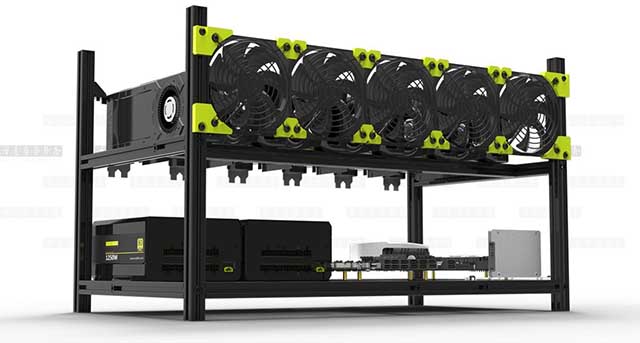
Open air gpu case - amazon

GPUs Cost How Much?!

Regardless of which graphics card you’re looking to purchase for either gaming or mining, you can bet your bitcoin it’s going to be marked up. As noted by Gamespot:

A 6GB GTX 1060 six-pack (Founder’s Edition or EVGA) is going for $3,780, while a pack of MSI Aero ITX OC GTX 1060 cards is listed for $3,465. The high-end GTX 1080 has a six-pack is priced at $6,300 as well–the GTX 1080 Ti is nowhere to be found, though. On the AMD side, the OEM 4GB RX 580 six-pack is at $3,600, and the MSI Armor 8GB RX 580 bundle is going for $3,990. Even bundles for the RX 570 are marked up as high as the slightly faster RX 580.

Even for those wealthy enough to buy six high-end cards in one go, buying your GPUs in bulk barely carries any economic benefit. Even when bundled in a pack of six, the GTX 1080 Founder’s Edition costs $1,050 per card — which is nearly double the MSRP of $550 per card.            

For miners, however, buying six-packs of graphics cards isn’t so much about getting a good deal as it is securing bulk orders on a typically limited product. Normally, the scarcity of graphics cards causes retailers to limit the amount which can be purchased by one customer — bundles from vendors help circumvent that miners-only issue.

Interestingly, strict pricing guidelines prevent many companies from raising the price of their pre-built PCs, so it’s actually more economically feasible to buy a pre-built rig, remove the GPU, and then sell the rest of the parts for cash. As noted by Gamespot, a GTX 1080 costs about $1050, but an Alienware Aurora PC with the exact same graphics card costs $1260 after a promotional discount.

Of course, a standard PC case isn’t really made to accommodate family-sized bundles of video cards. Thus, manufacturers are now creating open-air cases capable of housing upwards of 19 video cards. (How many frames per second do you think 19 GTX 1080s can push?)

With that level of price gouging, the PC master race might actually turn to consoles!

What do you think of the rapidly rising cost of GPUs? Are you a PC gamer who’s feeling the burn, or do you mine crypto to cover the costs? Let us know in the comments below!


Images courtesy of Shutterstock, Amazon

bitcoin miningcryptocurrency miningGPU MiningGPUsprice gouging Show comments

Published at Fri, 09 Feb 2018 06:30:08 +0000

Altcoin News

Previous Article

Where's Greg? Maxwell Eyes New Bitcoin Projects After Blockstream

Next Article

Deutsche Bank Sends in the Bitcoin FUD-busters

You might be interested in …

White Hats Step In to Save Funds from Vulnerable Ether Wallets

White Hats Step In to Save Funds from Vulnerable Etherscan Wallets

At 11:30 a.m. (CDT) on July 19, 2017, a hacker managed to steal 153,000 ETH (approximately $32 million at the time) from three Ethereum wallets by exploiting a vulnerability within the wallets’ multi-signature verification. The affected wallets include the ones using Parity client version 1.5 or later.

According to a tweet by Project Lead Manuel Aráoz, the three multisig wallets first targeted by the hack were using Parity client version 1.5 or later, and included Edgeless Casino, Swarm City and Æternity Blockchain. However, Project Blocktix also reported a loss totaling 3,916 ETH. According to ETHNews, Blocktix.io was hit by a second attacker who exploited the same vulnerability.

A Swarm City blog post revealed that a group of white hat hackers managed to secure the remaining funds from the affected ETH wallets using the same exploit. The swift response of the white hat hackers allowed them to secure the funds of other vulnerable projects. Unfortunately, funds in the wallets of Edgeless Casino, Swarm City and Æternity Blockchain are completely lost, though the “white hat response team” managed to secure 6,272 of 10,188 ETH at Blocktix.io.

The White Hat Group announced on Reddit that they will create “another multisig for you [the affected users] that has the same settings as your [the users’] old multisig but with the vulnerability removed and we will return your [the users’] funds to you [the users].” The response team warned the Reddit community to be careful with donation addresses below their post since there are “a lot of phishers in the community right now.”

On July 19, Parity Technologies published a critical security alert stating there was a vulnerability connected to Parity Wallets. The users affected by the vulnerability included “any user with assets in a multi-sig wallet created in Parity Wallet prior to 19/07/17 23:14:56 CEST.” The company urged users to move all assets from the multisig wallets to a secure address. Wallets seemingly unaffected by the breach include Geth, MyEtherWallet and single-user accounts created on Parity.

Parity updated its post as of today stating that future versions of their multisig wallets are secure:

“Future multi-sig wallets created by versions of Parity are secure (Fix in the code is https://github.com/paritytech/parity/pull/6103 and the newly registered code is https://etherscan.io/tx/0x5f0846ccef8946d47f85715b7eea8fb69d3a9b9ef2d2b8abcf83983fb8d94f5f).”

Swarm City also posted information for users affected by the hack:

“If you do have funds in the multisig contract: carefully move your funds to a new account ASAP. If your funds are no longer in your multisig, please check the Black hat and White hat addresses. They might have been saved by the White hat group.”

To check on funds held by either the black hat or the white hat hackers, see the ETH addresses below:

White Hat Group’s wallet: 0x1DBA1131000664b884A1Ba238464159892252D3a
First hacker’s wallet: 0xB3764761E297D6f121e79C32A65829Cd1dDb4D32
Second attacker’s wallet: 0x1Ff21eCa1c3ba96ed53783aB9C92FfbF77862584

The hacks have not only affected the wallets of the victims but also the overall price of ether. According to Coin Market Cap’s stats, the price experienced a 15 percent drop from $234.94 (at 0:04, July 19) to $199.70 at the end of the day. However, ETH has since recovered to around $227 today.

The post White Hats Step In to Save Funds from Vulnerable Ether Wallets appeared first on Bitcoin Magazine.