
September 12, 2026

Capitalizations Index – B ∞/21M

Cryptocurrency Market Gains $10 Billion; EOS Surges 16%, Bitcoin Price at $7,650

Cryptocurrency market gains $10 billion; eos surges 16%, bitcoin price at $7,650

Cryptocurrency Market Gains $10 Billion; EOS Surges 16%, Bitcoin Price at $7,650


Cryptocurrency market gains $10 billion; eos surges 16%, bitcoin price at $7,650
Advertisement

Get exclusive analysis and cryptocurrency insights on Hacked.com for just $39 per month.

The cryptocurrency market has increased by around $10 billion over the past 24 hours, as major cryptocurrencies including bitcoin, Ripple, EOS, Stellar, and Tron surged in the range of 2 to 16 percent. EOS was the strongest performer today, recording a gain of 16.24 percent subsequent to its mainnet launch.
Cryptocurrency market gains $10 billion; eos surges 16%, bitcoin price at $7,650

No Major Movement Over the Past 7 Days

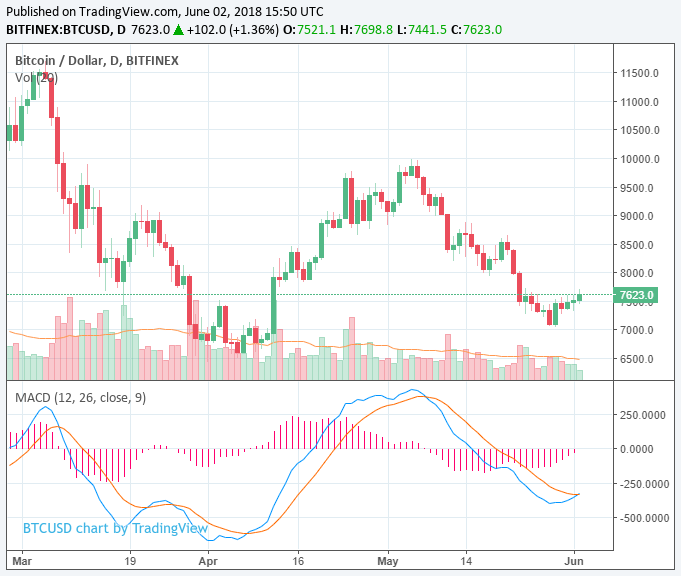
Although it seems as if the market has recovered by large margins and bitcoin has rebounded from its previous dip, BTC has remained in the same region over the past seven days. Last week, on May 27, exactly seven days ago, the price of BTC was $7,560. As of June 2, the price of BTC remains just over $7,600, less than 1 percent higher than its position on May 27.

On May 27, analysts predicted a downward trajectory for BTC and a possible drop below the $7,000 mark. BTC did drop to $7,040, but recovered relatively quickly back to $7,500, as bulls refused to allow bitcoin to drop below a key resistance level at $7,000, which could have led BTC to enter the higher end of $5,000.

The descending trendline from May 6 to June 2, covering two corrective rallies on May 11 and May 21, demonstrate that BTC has the potential to regain momentum at its current level, establishing $7,040 as the bottom.

However, BTC has also replicated the head and shoulders top that was formed throughout May 15 to May 20, which ultimately led BTC to fall from $8,500 to $7,040.

In order for BTC to initiate a short to mid-term rally in the upcoming days, similar to the corrective rally on April 11 that allowed BTC To rise from $6,950 to $8,000 within a one-hour period, BTC would need to experience a significant surge in volume, achieving $8,000 in the next 24 to 48 hours. If BTC fails to sustain momentum at its current level, it could drop back down to the $6,000 region and eye a potential movement to $5,000, as cryptocurrency researcher Willy Woo hinted previously.

“So in summary my best guess… slowish bleed down to $6800… then a steeper slide to $5700, then a levelling out of the drop… then a flat zone. This is an educated guess based on volume profile and fundamental data framing the rate of movement,” Woo said on May 25.

Performance of Tokens

Tokens such as Ontology, ICON, WanChain, Theta, and others recorded a surge in volume and price over past few days, benefiting from the short-term recovery of BTC. Because tokens tend to decline and increase in value with larger margins in comparison to BTC, tokens usually provide high-risk and high-return trading opportunities.

EOS recorded a 16 percent increase in price, as CCN reported, as traders and investors have started to anticipate the performance of EOS post-mainnet launch. Some analysts and traders have claimed that the performance of EOS is not organic and it will likely fall in value in the upcoming days.

Other tokens such as Tron have also experienced an increase in value due to their mainnet launches, but quite often, a price spike triggered by a certain event or a single factor is vulnerable to a short-term correction.

Featured image from Shutterstock.

Follow us on Telegram.
Advertisement

Published at Sat, 02 Jun 2018 15:54:10 +0000

Altcoin Analysis

Previous Article

Flip a Coin

Next Article

SPOTS, CYSTIC ACNE AND BLACKHEADS REMOVAL ACNE TREATMENT 191212!

You might be interested in …

Trustlessness in Action: Particl's Model

Particl Thumb 5

“Trustlessness” is a term often
quoted as a feature of blockchain technology but what does that mean and is absolute
zero trust a myth or really true? Praised as one of the characteristics that
make the blockchain so revolutionary, a trustless system is one where two peers
can enter a virtual hand shake agreement, i.e.  smart contract, without relying on a
trusted third party to facilitate.


Blockchains are good at being
permissionless and having decentralized tasks that are recorded on an auditable
ledger, yet not all blockchains are completely trustless, and achieving full
trustlessness is challenging if not impossible.
Even
an open-source project like bitcoin that is constantly being reviewed can have
trust issues, not from the code but by the developers and reviewers of the
code. So trustlessness is more of a term describing an ideal state on the
blockchain where code is law with the caveat that humans write code and to err
is human.


Before looking at how a fully
trustless blockchain can be implemented by privacy advocates like Particl — an open-source project that is building
a decentralized ecommerce application on the blockchain — let’s look at the
obstacles standing in the way.


I Trust
You, Until I Don’t


We’re conditioned to think of
trust as a good thing. Traditionally, positive human relationships have
required a level of trust.
From an economic perspective, however, trust has significant
downsides.


The greatest drawback is that trust
can be broken. When you engage in a transaction with someone you believe to be
trustworthy, but then they fail to deliver the promised goods or services, you
suffer.
In
addition, trust is not efficient. It has to be cultivated and you have to
invest time in evaluating how much another party can be trusted before you
engage in a trade.


Blockchain technology can be
leveraged to overcome the risks and inefficiencies that are associated with
trust.
With
the right approach, it’s possible to make reliable transactions on the
blockchain without knowing or trusting the person or group you are dealing with.
That is because the blockchain can be used to enforce good behavior.


In Particl’s case, by creating
a simple smart contract, you can ensure that if one party in a transaction
fails to uphold their end of a deal, the blockchain can automatically cancel
the transaction or punish the misbehaving party in another way. In effect, this
feature makes it impossible for a malicious user to profit by taking advantage
of the trust that another user places in them without inflicting harm on
themselves as well.


The
Trustless Challenge


If you buy or sell something
using bitcoin, you don’t automatically gain protection against being cheated: default
bitcoin transactions are non-reversible. The ability of the blockchain to
enable transactions that are both trustless and reliable is difficult because
it needs to be done without the intervention of a third party. In conventional
trading contexts, transactions are typically policed by a central authority that
evaluates claims about broken trust and responds accordingly. For example, if a
seller cheats you on eBay, you can complain to eBay and request a refund. These
authorities also charge fees or percentages of sales revenue whether they are
used or not.


The downside to this approach
is that it compromises privacy. In order to provide this protection against
broken trust, a platform like eBay oversees transactions. It knows what buyers
and sellers are doing.
With a two-person trustless escrow, in contrast, reliable
transactions can be implemented without the oversight of a third party. You
don’t have to lose privacy to gain reliability.


The tricky thing about
achieving true trustlessness on a privacy-focused blockchain is that it doesn’t
happen by default. Although multiple times more efficient than building trust
in public, smart contracts still need to be signed and the exchange of goods or
services still needs to happen. The beauty is that an agreement can be made and
successfully carried out even if one or both parties don’t fully trust each
other.


A Trustless
Solution


Particl leverages bitcoin as
the underlying blockchain protocol, but adds privacy enhancements that make it
possible for users to perform transactions that are trustless, reliable and
private. In an innovative development, PART transactions do not require users
to write smart contracts themselves. Instead, this feature is built into the
platform.


Central to Particl’s approach
to trustless transactions is mutually assured destruction (MAD) escrow. MAD
escrow
is a special type of smart contract that prevents either party from
profiting in the event that one cheats during a transaction.


In addition, because the smart
contract is enforced automatically via the blockchain, Particl developers play
no role in overseeing transactions. Their platform guarantees privacy while
achieving trustlessness at the same time. Two people from anywhere in the world
can enter into a binding agreement that is only finalized when both agree it is
completed.


Blockchain technology’s promise
is that users are no longer bound by the inefficiencies and risks associated
with trust in order to make transactions. Most blockchains, however, do not yet
implement truly trustless transactions. Particl is an exception, as it was developed
with trustlessness at its core from the start. Particl developers aim to “square
the circle” by delivering trustless ecommerce without compromising reliability
or privacy.

The post Trustlessness in Action: Particl's Model appeared first on Bitcoin Magazine.