February 26, 2026

Capitalizations Index – B ∞/21M

Crypto Prizes On The Rise, Magical Marketing Or Another Scam?

Crypto prizes on the rise, magical marketing or another scam?

Crypto Prizes On The Rise, Magical Marketing Or Another Scam?

Crypto prizes on the rise, magical marketing or another scam?

The art world, the gaming world, and even a few app developers are jumping onto the trend that is cryptocurrencies, seeing them as a perfect prize to tantilize and attract people to their work. But what is the end goal for these people and companies?

There is of course a lot of free marketing that comes up when ever cryptocurrencies are tied to something – the real estate sector has felt that – but, for an abstract artist like Andy Bauch, it adds another layer of intrigue and interest to his work.

Gaming companies have also found a technological link to the digital currency, setting it up as a prize for a global market. They too can benefit from the hype, but can also entice a bigger audience with a collectively attractive prize.

Why are these cropping up?

Prizes are nothing new, especially when it comes to games, or even sporting events. However, the allure of bitcoin is starting to spread to the likes of puzzles and paintings too. What is the appeal of attaching a bitcoin-based prize to a game that someone can beat, or a puzzle that someone can solve in a painting?

One of the biggest reasons for this has to be that generally, bitcoin media comes with a lot of hype and free publicity. There have been many instances where pretty mundane occurrences, like selling a house, have suddenly garnered a lot of attention because of a Bitcoin price.

The real estate market was a prime example of this as a £17 mln mansion in Notting Hill, UK saw unprecedented interest since it went on sale in October last year.

Saurabh Saxena, founder of property firm Houzenhas said of bitcoin marketing in the real estate sector:

“I sincerely believe that bitcoin as a currency or exchange medium is not sustainable. It’s purely a marketing gimmick.”

The same could be said about this latest trend of bitcoin prizes for solving puzzles and games.

Everyone knows what it means to be a struggling artist, with little to no recognition of fame – see Vincent van Gogh – but, by incorporating a bitcoin puzzle, suddenly the news is all over the internet and the name achieves a level of fame.

The Legend of Satoshi Nakamoto

Artist Marguerite deCourcelle has, on three occasions, hidden bitcoin prizes in digital paintings for the public to unearth.

The bitcoin puzzle series, “The Legend of Satoshi Nakamoto”, has been going on for a long time. It took nearly three years for the third puzzle in the series, “TORCHED H34R7S”, to be solved – recently by an anonymous winner.

When DeCourcelle and her team originally placed the key to the bitcoin wallet into the digital painting, the wallet contained 4.87 Bitcoins – which was, at the time, worth about $1,400.

DeCourcelle explained Cointelegraph how she got into cryptocurrency and why she thought this would be a good idea to merge this with cryptic puzzles:

“In 2013, I was reading books such as Diamond Age, Snowcrash, Ready Player One, Daemon and Freedom which all share an underlying theme: a metaverse with currency that is valuable in both real world and virtual world. I was just learning about bitcoin around this time, and bitcoin immediately stood out to me as something that crosses these barriers. I realized that I could break down “money” into a string of information and encode it visually with patterns or layered strategy to encode the information in a more dynamic way – in other words, using game play to unlock a sequence that would otherwise be hidden.”

“Blockchain is a treasure trove of unexplored potential for how information transcends a virtual existence and can be simultaneously rooted in the real world. In the early days of bitcoin, artists were asked to “show” the Blockchain through conceptual art. This was really hard to do. People also wanted to ‘see’ a bitcoin – it was hard to accept that money wasn’t tangible. So a natural bridge to this for me was to ‘show’ people bitcoin using art as the gateway.”

New money

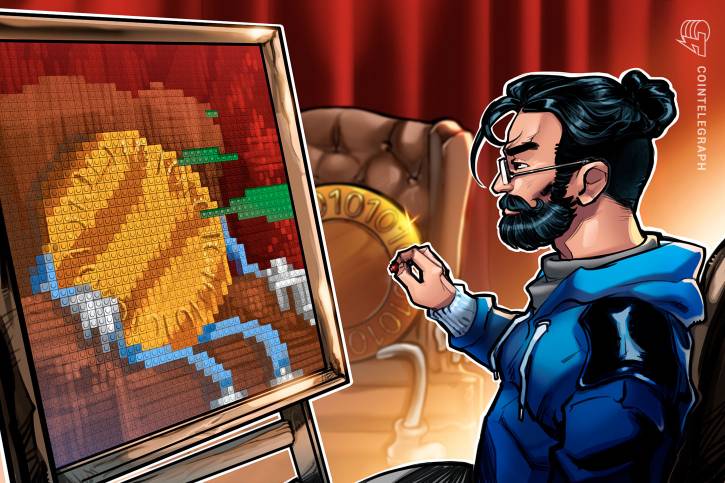
Artist Andy Bauch’s new painting series “New Money” combines art and cryptocurrencies by hiding abstract codes in his Lego artwork. The paintings represent the private keys to wallets containing as much as $9,000 worth of cryptocurrencies each.

Again, Bauch has been given a free bout of publicity for combining the two worlds of art and cryptocurrency, leveraging the fact that cryptocurrencies being ferocious for any news that emanates from society.

However, it would appear that Bauch is not only doing this for the fame as his abstract pieces obviously have a narrative behind them, especially with the exhibition be labeled ‘New Money.’

A gaming gift

As well as artists, gaming companies are also hiding cryptocurrency in their games for those who reach the end first. Montecrypto: The Bitcoin Enigma is a game that will feature an digital world players navigate in the first person, solving 24 ‘enigmas’ in order to claim the ultimate prize of 1 full bitcoin.

The developers have remained anonymous, with their wish to remain as such until the prize is claimed, but they have mentioned in the game’s FAQ’s that:

“We are not here to advertise bitcoin. We think it can be fun to have a bitcoin as a prize for our game.”

Neon District is another game that is launching soon that will have a crypto prize at the end, this time 15 Ethereum (ETH). This game comes from the same team that is behind the digital painting series; they clearly believe this is a good tool for marketing.

Is there a chance to be scammed?

DeCourcelle spoke to Cointelegraph about trust, and its importance, as she came to realise that in the cryptocurrency space, there is a lot of space for people to be trusted, and for that to be abused.

“I think people are absolutely wary of being scammed. I’ve found that my puzzles or my endorsement of a puzzle has given people confidence to pursue a contest. Similarly anyone in the space who is ‘trusted’ also brings legitimacy to projects. But it doesn’t take much to shake that trust, so we hold it close to our chest and do our best to not lead people astray.”

With the third puzzle being solved only last month in DeCourcelle’s series, she and her team have built up a decent reputation in regards to this tiny, but growing, facet of cryptocurrency. However, she admits that regardless of whether a company or person is offering bitcoin prizes, or initial coin offerings (ICOs), trust and reputation is paramount.

“I think even in the ICO space, people are launching projects who have no business doing so as they’ve never had a proven product. Why would people throw time or money at anything that may never come to fruition? Trust and the ability to carry projects across a finish line means everything to a community who is backing a project,” she told Cointelegraph.

“We’re working on trustless systems that still rely heavily on trusting people based on social merit or reputation-based systems. Most ‘giveaways’ these days do not turn heads. In the old days, you could tweet – “1 bitcoin for one lucky follower” and include a fancy gif. This doesn’t work anymore.”

“The current approach to marketing in crypto is becoming building trusted brands that people can feel confident to stand behind. People also want quality, delivering an educational experience where they are building relationships, making personal progress, and not wasting their time. It’s not really about the money, the money is a perk.”

Published at Sun, 01 Apr 2018 22:24:13 +0000

bitcoin[wpr5_ebay kw=”bitcoin” num=”1″ ebcat=”” cid=”5338043562″ lang=”en-US” country=”0″ sort=”bestmatch”]


Previous Article

03 Blockchain overview

Next Article

Kazakhstan Looks to Ban Cryptocurrency, While Remaining Firmly Corrupt

You might be interested in …

New zealand terrorist claims he made money from bitconnect

New Zealand Terrorist Claims He Made Money From BitConnect

New Zealand Terrorist Claims He Made Money From BitConnect The perpetrator of the mass killings at New Zealand mosque appears to have funded his life with investments he made in defunct cryptocurrency BitConnect. Tarrant Used […]

Do A.I. and Cryptocurrency Work Well Together?

Just because Grindelwald and Dumbledore had a deadly brawl during their quest to revolutionize magic doesn’t mean two great powers cannot be used in concert to change the world.

By Marcie Terman, founding director of XBT Corp Sarl


This could be the worst way to start an important conversation about financial technology, but stick with me, it gets more interesting. We are speaking about the world-altering technology of Artificial Intelligence as the first superpower coupled with the financial system disruptive technology of cryptocurrency — a decentralized payment system that circumvents government manipulation of currency and is forcing us to redefine the concept of money. The question is: Can these two technologies be used together to change the way ordinary people like you and me invest our money — without expiring in a shower of blue sparks? “Avada Kedavra!”

Avada Kedavra

But first, let’s take a step back and look into them as individual concepts, with respect to their relationships to investment and trading.

Artificial Intelligence

Artificial Intelligence (AI) means software that after its initial programming continues to improve its performance based on its experience of the environment it has been set to ‘learn.’ Unlike in movies, where AI is characteristically portrayed as menacing, human-destroying droids, AI software has actually bettered our lives in fields as diverse as healthcare, education, safety, transportation, and entertainment. In the field of financial trading, AI has been clandestinely used for two decades to generate profits for hedge funds, banks, and other large trading companies.

In its early days, AI trading systems relied on human intervention to provide trade execution but since the rise of electronic exchanges, AI trading has probably changed the character of the world’s markets without the general public’s knowledge.

Today, it is the hedge funds, banks and major international corporations like Goldman Sachs that are reaping the benefits from AI-based trading of forex and stock markets. These companies harness “deep learning” — evolving mathematical and statistical models of prediction and probability — to forecast the short-and-long term outcomes of various financial markets. These models, because of their nature, should be able to track the changes in market condition and therefore continue to improve their performance over time.

I Robot

Deep learning models aren’t concerned with the fundamentals of the underlying market. They work through pattern recognition, and like their human quantitative analyst counterparts seek the relationships between chart patterns and expected outcomes to generate a return. However, even the most disciplined human trader can be influenced by the fear of loss or greed which may change their trading behavior.

AI Bots, however, execute trades consistently without emotion at lightning speed directly onto the exchange, placing and closing trades on behalf of their clients. They stick faithfully to limits, never lose discipline or waver from their assigned course based on the idiosyncrasies of emotion.

Cryptocurrency Trading

Cryptocurrency trading, which until recently has been mostly centered on bitcoin, has gained momentum in recent years. Since Feb 2011, when bitcoin stood at parity with the US dollar, bitcoin has risen to where it is trading now some six years later at prices between $1,200 and $1,425. The reasons behind bitcoin’s success are many.

Coupled with its decentralized nature which protects it from all good and bad government policies; bitcoin is beginning to be seen as a viable alternative in certain countries where hyperinflation or lack of confidence in government has rendered the local currency a less attractive alternative. bitcoin is also becoming easier to manage, simpler to use, safer than carrying paper money and cheap enough to transact and carry, without needing an intermediary.

Despite the last 6 month’s remarkable price increase, bitcoin as an asset class has its share of ills, including periods of extreme market volatility. bitcoin’s limited supply coupled with the inability of governments to intervene to counteract market forces means that bitcoin reacts quickly to market bias. Take for example, the very recent bitcoin ETF buzz: bitcoin’s price trended northward comfortably ahead of the SEC’s ETF ruling amid growing optimism, hitting a peak of $1,327 a coin. But after the SEC shot down both the Gemini and SolidX bitcoin ETF projects, the price nosedived 20% before rallying within the month back to similar levels.

In addition, shorter-term fluctuations can be seen if one looks at intraday bitcoin charts. On an average BTC/USD chart, bitcoin’s value fluctuates between 10 and 15 USD every 4 hours and sometimes quite a bit higher. For many investors, such fluctuations make bitcoin an uncomfortable investment choice. However, there are day traders who use this volatility to take tidy profits out of the market on a daily basis. These are the traders who are fixed, glued to their computer monitors and mobile screens all day long, tracking the market to enter and exit positions.

intraday bitcoin charts

So we return to the original question: “Can a market as young and volatile as cryptocurrency be successfully partnered with Artificial Intelligence to produce a profitable outcome?”

With market capitalizations in the low millions up to low billions, cryptocurrency markets present too small an opportunity to interest most trading banks and hedge funds. They use the power of their deep pockets coupled with AI to generate massive profits from high-frequency trading where a few millisecond advantage over competitors can generate big returns.

This means that there is room while cryptocurrency markets are still in their infancy for AI developers to create systems that learn to identify profit opportunities in these young, highly volatile markets. And while a Goldman Sachs may snort at a market cap of 20 billion dollars, investors like you or me would be delighted with this kind of profit.

We are starting to see young talent, like the people running the Our AI Bot blog out of the UK. These types of cryptocurrency enthusiasts are coupling their Deep Learning System knowledge with innovation, imagination and an understanding of the inputs that are relevant to predicting digital currency market movement to yield what look like fairly outstanding results.

But many within the cryptocurrency space feel the markets are moving towards mainstream and already there are players like Pantera Capital and banks like Santander and Citibank that are looking at how to generate profits from the cryptocurrency markets. So the window of opportunity for individuals to benefit from what AI can do in digital currency trading is probably limited. The time to look at this opportunity is now – “Expecto Patronum!”

What do you think? Can A.I. and cryptocurrency work well together? Let us know in the comments below.


Images courtesy of Warner Bros Productions, Twentieth Century Fox Film Corporation, CryptoCompare, AdobeStock

The post Do A.I. and Cryptocurrency Work Well Together? appeared first on Bitcoinist.com.