June 16, 2026

Capitalizations Index – B ∞/21M

Crypto Markets Show No Friday 13th Fear as Assets U-Turn on Previous Losses

Crypto markets show no friday 13th fear as assets u-turn on previous losses

Crypto Markets Show No Friday 13th Fear as Assets U-Turn on Previous Losses

Cryptocurrency markets staged a modest comeback Friday, July 13, following a week in which Bitcoin (BTC) lost over 5 percent against the dollar and Ethereum (ETH) over 7 percent.

Data from Cointelegraph’s price indices and Coin360 show a rebound from weekly lows of $6,180 for bitcoin, which had hit highs of $6,792 July 8.

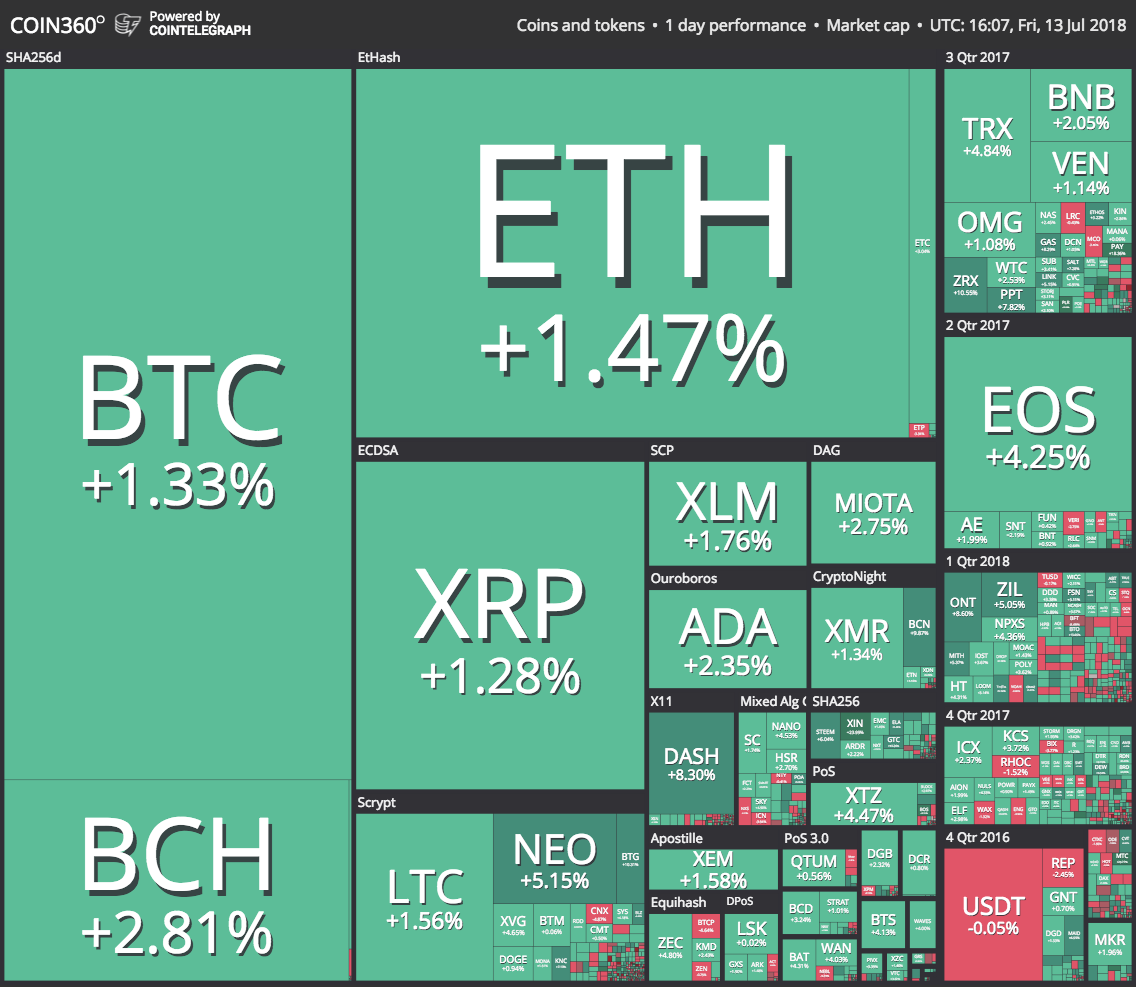
Market visualization

Market visualization from Coin360

At press time Friday, BTC/USD is trading around $6,250 up just about one percent on the day, this week’s downward momentum failing to crack support around the $6,000 barrier.

bitcoin’s general price pattern continues to reflect a curious pattern of sudden losses followed by de facto flat performance, a cycle which commentators have failed to fully explain.

Accusations of market manipulation by actors ranging from whales to Tether token production have not seen sufficient evidence, with recent research denying theories major bagholders are dictating market performance.
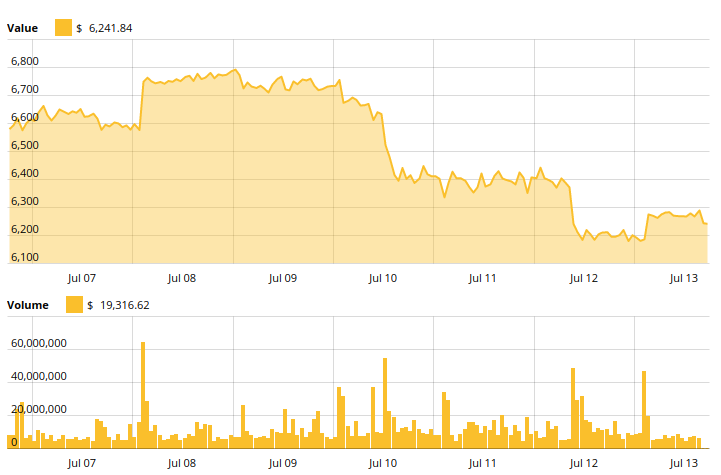
Bitcoin price chart

bitcoin price chart. Source: Cointelegraph Bitcoin Price Index

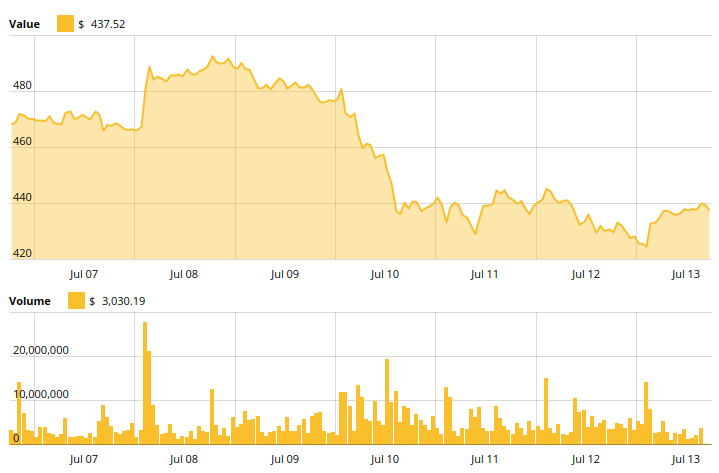
For Ethereum, prices have continued to broadly fluctuate around bitcoin, Friday’s reversal also seeing about one percent gains against a broader weekly decline around 6.2 percent. At press time, ETH/USD is circling $437.

Ethereum price chart

Ethereum price chart. Source: Cointelegraph Ethereum Price Index

The return to form of the two largest cryptocurrencies has in turn produced copycat behavior from the majority of the top 50 cryptoassets, with most seeing 1-4 percent gains today. EOS rose over 4 percent Friday, while Dash is up a notable 8.4 percent, leading the top 25 coins.

Bancor’s BNT token, which lost around one third of its value this week after its issuer reported a hack, has so far failed to reverse its losses, up a modest 0.8 percent today.

As Cointelegraph continues to report, many commentators from the cryptocurrency industry and beyond continue to hold a bullish stance on prices in the medium term.

A report last month by Chinese exchange Huobi saw the majority of respondents to its survey forecast a “substantial” increase by the end of the year, 71 percent believing markets will expand by over 30 percent of current levels.

TenX’s Julian Hosp went further, this week committing to a bitcoin price target of $60,000 by the start of 2019.

Published at Fri, 13 Jul 2018 16:35:00 +0000

bitcoin[wpr5_ebay kw=”bitcoin” num=”1″ ebcat=”” cid=”5338043562″ lang=”en-US” country=”0″ sort=”bestmatch”]

Previous Article

Activists Shine Bitcoin Logo on Slovakia’s Central Bank to Protest Hostile Regulations

Next Article

Crypto Markets Show No Friday 13th Fear as Assets U-Turn on Previous Losses

You might be interested in …

More Dangerous Than The NSA? The Massive Spy Agency You Haven’t Heard Of

zerohedge.com / by Tyler Durden / Mar 31, 2017 5:57 PM

Authored by Alice Salles via TheAntiMedia.org,

If you’re one of the countless Americans who was distraught to learn of the revelations made by former National Security Agency (NSA) contractor Edward Snowden, the mere idea that there might be yet another agency out there – perhaps just as powerful and much more intrusive –  should give you goosebumps.

Foreign Policy reports that the National Geospatial-Intelligence Agency, or NGA, is an obscure spy agency former President Barack Obama had a hard time wrapping his mind around back in 2009. But as the president grew fond of drone warfare, finding a way to launch wars without having to go through Congress for the proper authorization, the NGA also became more relevant. Now, President Donald Trump is expected to further explore the multibillion-dollar surveillance network.

Like the Central Intelligence Agency (CIA) and the National Security Agency (NSA), the NGA is an intelligence agency, but it also serves as a combat support institution that functions under the U.S. Department of Defense (DOD).

With headquarters bigger than the CIA’s, the building cost $1.4 billion to be completed in 2011. In 2016, the NGA bought an extra 99 acres in St. Louis, building additional structures that cost taxpayers an extra $1.75 billion.

Enjoying the extra budget Obama threw at them, the NGA became one of the most obscure intelligence agencies precisely because it relies on the work of drones.

As a body of government that has only one task — to analyze images and videos captured by drones in the Middle East — the NGA is mighty powerful. So why haven’t we heard of it before?

The Shadow Agency That Sees It All

Prior to Trump’s inauguration, the NGA only targeted the Middle East or whatever spy satellites orbiting the globe captured. As far as most of us knew, the agency refrained from pointing its ultra-high-resolution cameras toward the United States. That alone may be why the NGA has been able to stay out of scandals for the most part.

READ MORE

The post More Dangerous Than The NSA? The Massive Spy Agency You Haven’t Heard Of appeared first on Silver For The People.