September 11, 2026

Capitalizations Index – B ∞/21M

Crypto Market Wrap: $32 Billion Gone In Biggest Dump of The Year

Crypto market wrap: $32 billion gone in biggest dump of the year

Crypto Market Wrap: $32 Billion Gone In Biggest Dump of The Year

Crypto markets in massive correction; XRP, Stellar, Cardano, bitcoin Cash, BSV and Tron getting smashed. 

Market Wrap

A crypto correction has been on the cards for some time and it has finally arrived this morning. bitcoin dumped almost a thousand bucks and total market capitalization shrunk by $32 billion in a matter of hours.

After spending most of the day trading in the $8,000 range bitcoin plunged to a low of $7,175 in less than an hour. The ten percent dump triggered a market wide selloff with altcoins getting hit harder as usual. At the time of writing BTC had recovered a little to $7,300 but further losses are expected. Analysts are eyeing the $6,400 level as support and a new buying zone.

Ethereum slid back to $240 in a 7 percent slide which was not as severe as many of the others. Over the week ETH is still in a strong position having passed $200 for the first time since November last year. Such a rapid surge is always followed by a pullback which is what we are seeing today.

The top ten is awash with red at the moment as all of the altcoins come crashing back down. Many are getting hit hard including XRP, Stellar and Cardano dumping 14 percent each. Also in bad shape are bitcoin Cash, Litecoin, EOS and Binance Coin all dropping over 10 percent a piece.

Losses are even more severe in the top twenty where bitcoin SV has been smashed 18 percent. Tron is also in pain with a 16 percent dump while Monero, Dash, IOTA and NEO have all lost over 10 percent on the day. Only Tezos has survived as it actually adds a little today while all around it have collapsed.

FOMO: Chainlink Alone in The Green

Only one altcoin is bucking the trend today and making a gain. Chainlink has added 7 percent on the day to reach $0.884. The mainnet launch on Ethereum on May 30 appears to be the only thing driving momentum for LINK at the moment. The only other cryptos in the green right now are stablecoins as everyone is dumping their alts.

There are too many double digit dumpers to mention but those getting hurt the most are IOST, Golem, Pundi X and Ontology.
Crypto market wrap: $32 billion gone in biggest dump of the year

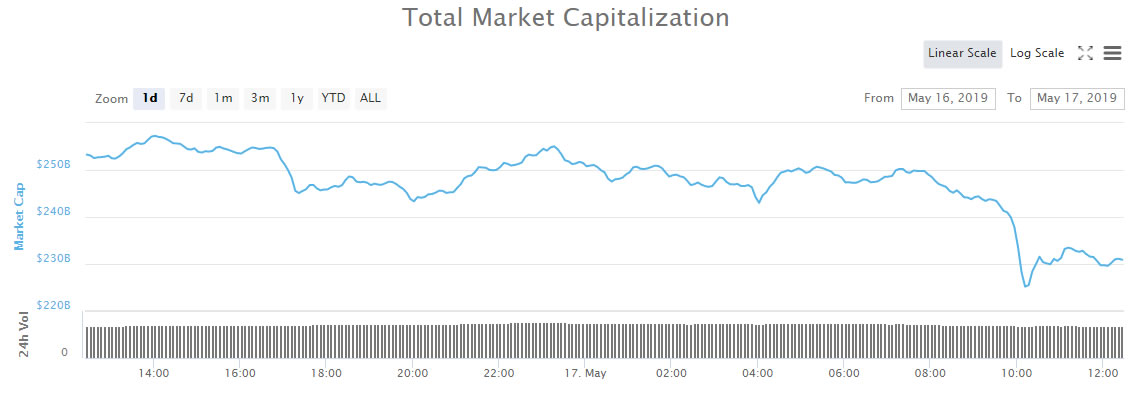
Total market capitalization 24 hours. Coinmarketcap.com

A whopping $32 billion has been dumped out of crypto markets as they fell back to $225 billion a few hours ago. The epic 12 percent slide is one of the largest dumps of the year but it has not been entirely unexpected. At the time of writing markets had recovered back to $230 billion which is still 20 percent higher than this time last Friday.

Market Wrap is a section that takes a daily look at the top cryptocurrencies during the current trading session and analyses the best-performing ones, looking for trends and possible fundamentals.

Published at Fri, 17 May 2019 07:00:48 +0000

Previous Article

Bitcoin Price ‘Flash Crashes’ To $6.1K – Here’s The Likely Reason Why

Next Article

Bitcoin Price ‘Flash Crashes’ To $6.1K

You might be interested in …

Segwit Activated: How it Works & What’s Next for Bitcoin

Segregated Witness, or Segwit, has finally been activated by a super majority of the current hashpower on the bitcoin network. Segwit fixes many bugs currently in the protocol, and allows for some scaling using an effective blocksize increase.


Almost two years of debate

In December of 2015, the source code for Segregated Witness (Segwit) was released. It was meant as a fix for the ever-problematic transaction malleability bug, which allowed for someone to change one or two characters of a transaction’s ID before it was cemented into the blockchain. Along with that, it provided a method of scaling bitcoin. Doing away with the concept of a blocksize, a new metric was made called blockweight.

For years the software was not added to the bitcoin protocol as it never garnered the necessary 95% of the hashpower needed to activate. It was to be implemented though means of a softfork, which meant it would comply with all currently consensus rules and be backwards compatible with those running old software and did not wish to upgrade.

Whether you believe that Segwit was a direct result of the grassroot approach of BIP148 forced miners to finally activate it after all this time, or the New York Agreement was the reason everyone came together to signal for Segwit, it is finally here.

A second BIP was released weeks ago to lower the activation threshold to 80% of the hashpower, but even with the lowered bar Segwit still achieved around 97% signaling and locked in during the beginning of August.

After the official lock-in period, the network allowed for two weeks to provide grade period of sorts for people to upgrade their software to work with Segwit.

How Segwit Works

There has been a ton of misinformation about Segwit, so this article will hopefully clear some things up of how it actually works. As stated earlier the whole idea of a blocksize has been gotten rid of. Instead, the network will now use blockweight.

There’s two types of data that are contained in a transaction. Firstly, there is actual transaction data, such as the address the coins are being sent to. Then there is the witness data, which is all the information that is only needed when the transaction is confirmed, and then that data is essentially never used again.

Segwit provides a “discount” to the witness data, and once committed to the blockchain it gets pruned. These 1000 1KB transactions would obviously fill the current blocksize of 1MB, but remember blocksize isn’t even a metric any more. It’s been replaced by blockweight, the new limit of which will be set at 4,000,000 “units.”

The way the new unit system works is the number of units in a transaction is simply the number of bytes of transaction data multiplied by four. Witness data is, as said before, discounted. The bytes of the witness data are essentially a direct translation to units at a 1:1 rate.

So, for example, let’s say there’s 1000 transactions in the mempool, all at 1KB of data. Now let’s say in each of the transactions, 400 bytes is witness data and the other 600 bytes is transaction data. The 600 bytes for transaction data is now worth 2,400 units, while the witness data is now worth 400 units giving the whole transaction a weight of 2,800 units. All of these transactions together will only take up 2,800,000 of the 4,000,000 units, leaving room for more transactions.

Once the transaction is confirmed by the network, the not needed witness data will be pruned off the blockchain, to save storage space and decrease bandwidth use.

How Do I Actually Use SegWit?

For those of you expecting an immediate sign that Segwit is helping everything, I’m sorry to let you down. In reality, it could be weeks or even months before Segwit really starts to have widespread adoption.

Segwit transactions can only be sent from Segwit addresses. So, every single address that currently contains coins would have to send them to a Segwit address before we see the full effect of the upgrade. And even then, there could be a decent chunk of users who still don’t trust Segwit and don’t want to use it. Which is perfectly fine, that’s the point of a softfork. It doesn’t force users who don’t agree to it to upgrade to it.

For you to use segwit and send segwit transactions, you’ll need to send your coins to wallet that generates Segwit addresses. Otherwise, it will just be a normal transaction.

Moving forward, Segwit was an important setup to the upgrading and scaling of the bitcoin network, which has been woefully overloaded in the past several months. Segwit opens the door to better implementation of the lightning network, which can allow for transactions to be sent off chain for pennies.

Coming in November, the second half of the New York Agreement is set to take place calling for a doubling of the blockweight to even further scale the network though means of a hardfork.

Will you be using segwit from here on in? How do you think this will effect the network? Let us know in the comments below!


Images courtesy of Shutterstock, Segwit.co

The post Segwit Activated: How it Works & What’s Next for Bitcoin appeared first on Bitcoinist.com.

When bubbles pop: an infographic

When Bubbles Pop: An Infographic

When Bubbles Pop: An Infographic When the bubble pops, people don’t realize it at first. When the bubble pops, it’s always just another volatile day. “It’s just a correction. A road bump on the way […]