April 7, 2026

Capitalizations Index – B ∞/21M

Crypto Market Could Bounce Back: Bitcoin Cash, Litecoin (LTC), EOS, XLM Analysis

Crypto market could bounce back: bitcoin cash, litecoin (ltc), eos, xlm analysis

Crypto Market Could Bounce Back: Bitcoin Cash, Litecoin (LTC), EOS, XLM Analysis

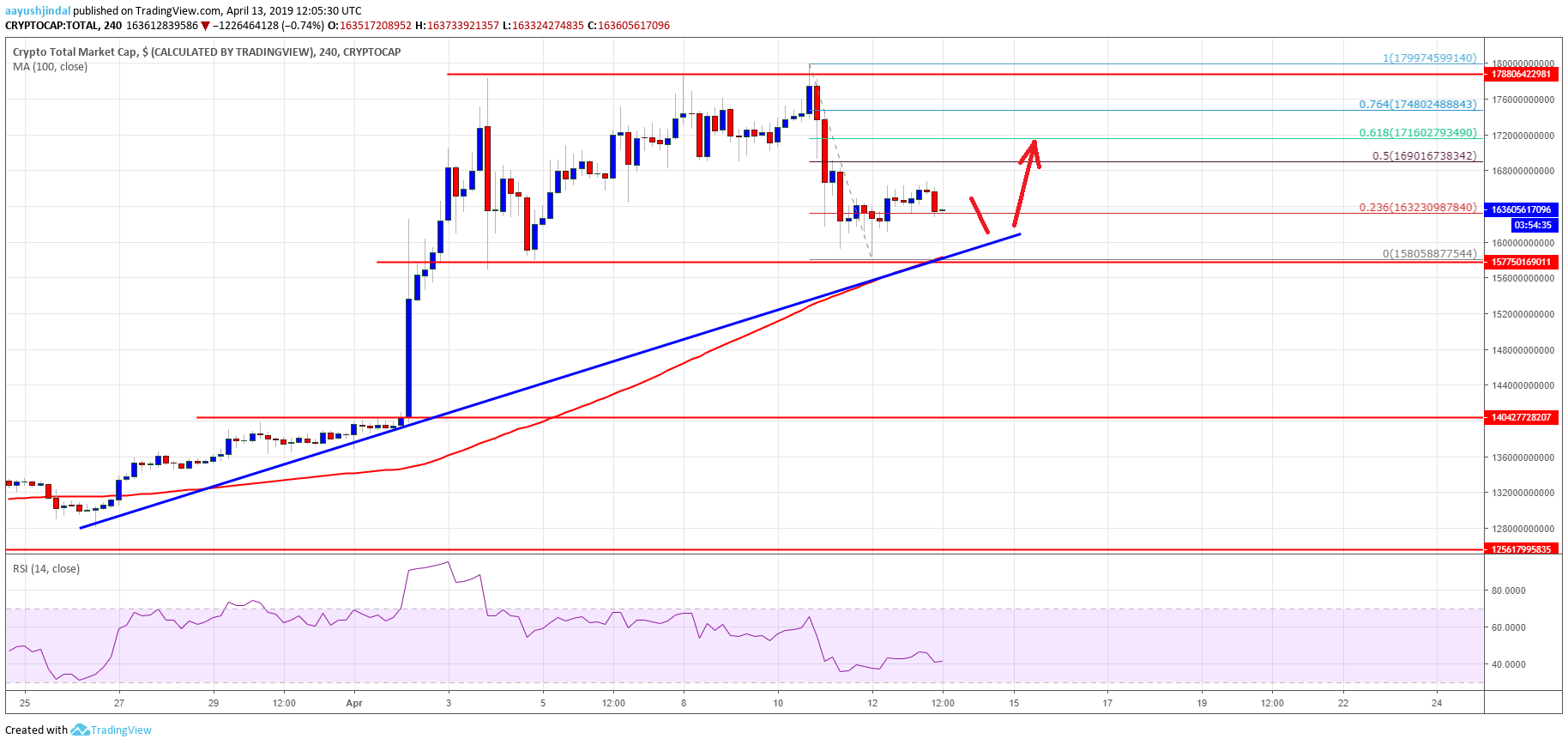
  • The total crypto market cap is currently above the key $158.0B support area.
  • Litecoin (LTC) price declined below the $80.00 support, but it could find support near $75.00.
  • bitcoin cash price is facing a strong resistance near the $280 and $285 levels.
  • EOS price is still consolidating above the $5.20 support area.
  • Stellar (XLM) price is slowly moving lower towards the key $0.1100 support area.

The crypto market could bounce back since bitcoin (BTC) and Ethereum (ETH) are holding key supports. There could be a decent rebound in litecoin, ripple, bitcoin cash, EOS, tron (TRX), stellar (XLM), and other altcoins.

bitcoin Cash Price Analysis

bitcoin cash price started a major downside correction below the $300 support area against the US Dollar. The BCH/USD pair declined below the $285 and $280 support levels. The price tested the $260 support area and it is currently correcting higher.

However, the previous support levels at $285 and $280 are acting as resistances. Above these, the price is likely to revisit the $300 resistance area. On the downside, the main supports are $270 and $260.

Litecoin (LTC), EOS and Stellar (XLM) Price Analysis

Litecoin price failed to stay above the key $82 and $80 support levels. LTC traded close to the $75 support area and it is currently consolidating gains. It must move back above the $82 and $85 levels to start a fresh upward move. On the downside, a break below $75 may push the price towards the $70 level.

EOS price broke the $5.50 support area and declined sharply towards the $5.00 support. Later, it recovered and it is currently consolidating above the $5.20 support levels. On the upside, there are many resistances near the $5.35 and $5.40 levels. On the downside, the price might revisit the $5.00 support if it fails to stay above $5.20.

Stellar price moved into a short term bearish zone, with a close below the $0.1200 support level. XLM price is trading below the $0.1150 and it seems like it may continue to move down towards the $0.1100 support area.
Crypto market cap bitcoin cash bch ltc eos xlm

Looking at the total cryptocurrency market cap hourly chart, there was a sharp decline from the $180.0B resistance area. The market cap broke the $170.0B support area and tested the $158.0B support area. There is also a connecting bullish trend line in place with current support near the $160.0B level on the same chart. Therefore, as long as the market cap is above the $160.0B and $158.0B support levels, it is likely to bounce back. If not, there could be an extended decline below the recent lows in bitcoin, Ethereum, EOS, litecoin, ripple, XLM, BCH, BNB, TRX and other altcoins in the coming sessions.

Published at Sat, 13 Apr 2019 14:08:03 +0000

Previous Article

Why Should You Use A Dedicated IP VPN For Secure PayPal Transactions?

Next Article

Smart contract d’une clause pénale – Abdoulaye Diallo – Medium

You might be interested in …

After Second Hack This Year, South Korean Exchange Youbit Closes Down

After Second Hack This Year, South Korean Exchange Youbit Closes Down

South Korean exchange Youbit announced on its website today that it is closing down after a hack early Tuesday, December 19, 2017, that resulted in the loss of 17 percent of its assets.

The exchange, previously known as Yapizon, did not indicate how many bitcoins or other cryptocurrencies were stolen or what the total fiat value of the attack amounted to, but it was enough to lead to bankruptcy.

This was the second hack the exchange suffered this year. A prior attack in April 2017, resulted in the loss of 3,816 bitcoins, worth around $5 million at the time.

Youbit said hackers broke into its hot wallet, the online account used to pay out cryptocurrencies instantly. While hot wallets offer greater convenience, they also put funds at greater risk because they are connected to the internet.

The remaining coins were kept offline in a cold wallet, the exchange said, resulting in no additional losses. The exchange indicated that customers could withdraw up to 75 percent of their balances, and the rest would be tallied out after the final settlement.

Korea Internet & Security Agency (KISA), the state agency that responds to cyberattacks, is investigating the incident, as reported in Reuters. KISA has maintained that North Korean hackers were behind the first hack.

Chris Doman, threat engineer at software security company AlienVault, told bitcoin Magazine, he suspects BlueNoroff, a subgroup of North Korea’s cyber crime group Lazarus is responsible for the second Youbit attack. Lazarus is known for the November 2014 hack on Sony Pictures Entertainment, one of the biggest corporate breaches in history.

While attacks by Lazarus have mainly been aimed at social disruption, recent reports indicate the group is increasingly going after money. With the value of bitcoin surging to all-time highs, exchanges are becoming a lucrative target.

“The first time I saw them target a bitcoin company was in May this year — the same month they unleashed WannaCry,” Doman said in a statement shared with bitcoin Magazine.

The exchange that Doman was refering to is South Korean bitcoin exchange Bithumb. Around that same time, WannaCry ransomware attacks were encrypting user’s computers and offering to de-encrypt them in exchange for bitcoin. Analysis of the techniques used in the WannaCry attacks show strong links to Lazarus.  

Doman added, “They’ve also used related malware to opportunistically mine Monero coins on compromised servers. Clearly they have a large interest in cryptocurrencies as an easy method for economic gain, as well as an opportunity to economically weaken their enemies.”

Although Youbit is one of the smaller bitcoin exchanges, the hack underscores the risk involved in leaving funds on an exchange, where control of those funds is handed over to a third party and is only as safe as whatever security measures that exchange chooses to use.

Throughout the history of bitcoin, hacks have amounted to painful losses. When bitcoin exchange Mt. Gox began liquidation proceedings in April 2014, the company announced that approximately 850,000 bitcoins were missing, an amount valued at more than $450 million at the time. In August 2016, the bitcoin exchange Bitfinex announced hackers stole approximately 120,000 BTC, worth $72 million at the time.

The post After Second Hack This Year, South Korean Exchange Youbit Closes Down appeared first on Bitcoin Magazine.