Some cryptocurrency hedge funds appear to be unaffected by the decline in the since the start of 2018. In fact, a couple of these firms have even posted profits thereby reinforcing the idea that can thrive in both bull and bear markets.
2018 has mostly been a with an average of about 40 percent in losses. Despite this, some virtual currency market making and arbitrage strategy firms have managed to record first-quarter profits. The first quarter performance of crypto hedge funds is a striking reversal from 2017 when crypto hedge funds, despite making gains, lagged behind the more bullish market participants by a considerable margin.
Crypto Exposure without Volatility
Source:
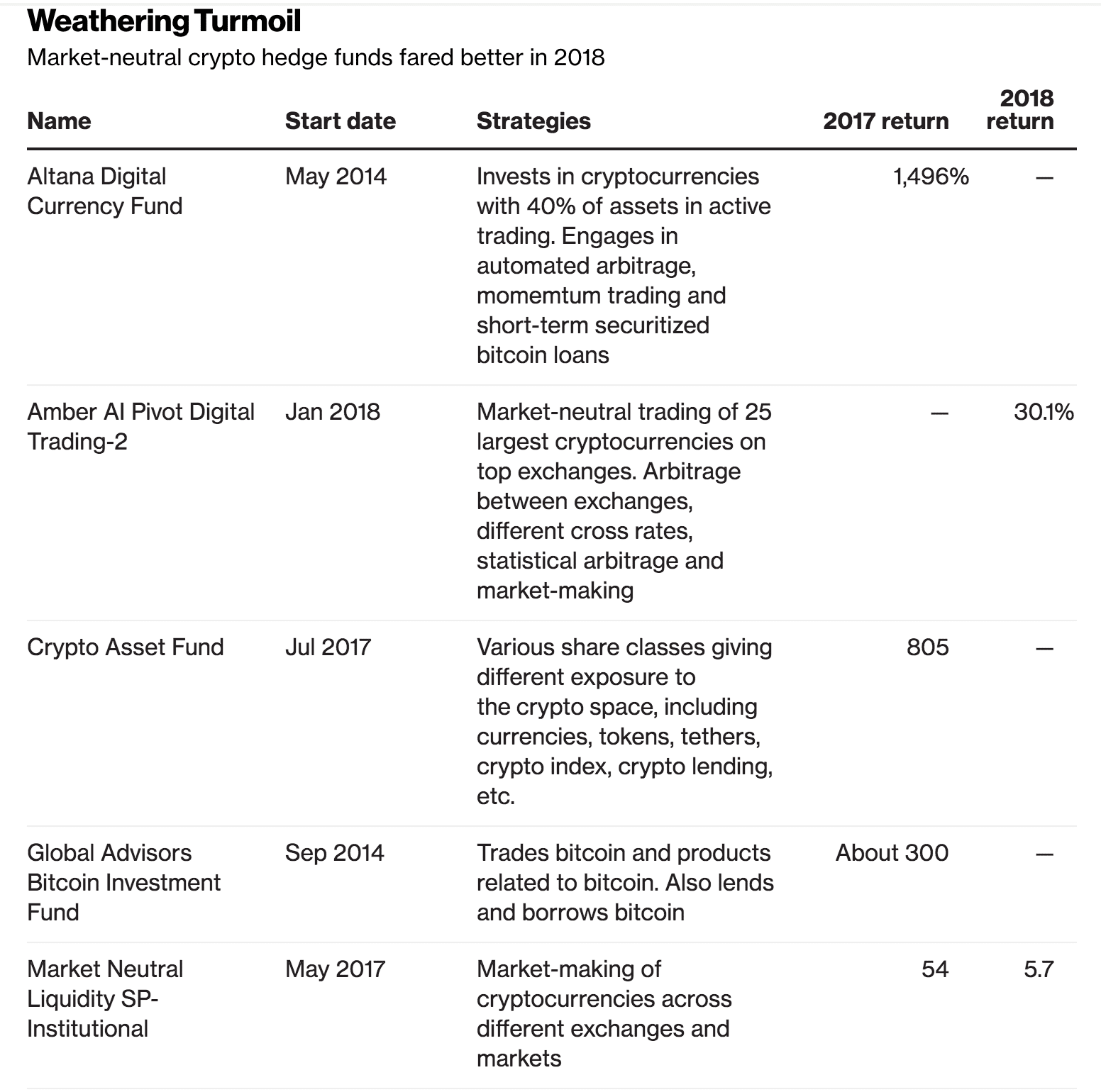
Market neutral hedge funds seem to be finding ways to make a profit from the despite the wild price swings. Part of this is because they don’t place bets on whether prices rise or fall. This means that their investments in the crypto market are to a certain degree, free from the extreme volatility of the market. Such an investment strategy is likely to appeal to institutional investors who want to get into the market without having to be on the receiving end of wild price swings.
According to Cedric Jeanson of , the fund manager of the crypto portfolio, the fund recorded a 5.6 percent profit in the first quarter of 2018. Market Neutral Liquidity SP-Institutional is based in the Cayman Islands. Pivot Digital Trading-2 (PDT2) is another crypto hedge fund that has recorded a profit so far in 2018. The fund which is managed by rose by 4.3 percent in March to bring its first-quarter profit to 30 percent. The fund is reported to be the most profitable for the year 2018 so far.
Market Neutral Liquidity SP-Institutional has an asset management portfolio that is worth $100 million. The hedge fund makes markets for bitcoin, ether, and ripple. PDT2 trades the top 25 cryptocurrencies on many of the largest cryptocurrency exchange platforms such as OKEx, Huobi, Kraken, and Binance. According to Tiantian Kullander, one of the co-founders of the firm, the fund began in early 2018 with an initial asset portfolio of $25 million. The fund focuses on market-making, trend following and arbitrage trading (exploiting price discrepancies of cryptos in different exchanges).
Crypto Hedge Fund Losses in 2018
It has not, however, seeing as they are still correlated to the market. Thus, the hedge funds that place directional bets on the market have been negatively affected by the crypto market slump.
Silver 8 Partners, one of the funds that have recorded a loss, dropped 25 percent in March to bring its first-quarter loss to 32 percent. The negative result was made known in a correspondence sent to the fund’s investors. Silver 8 has investments in blockchain startups, machine learning firms, as well as some fintech and cryptocurrency companies.
The post appeared first on .
A new post by cofounder on has unveiled his plans for a ‘’ project. Published on April 8, 2018, Buterin said that it is aimed at developers who wish to begin working on but are uncertain about the final version of the protocol.
Sharding as a Scaling Solution
The number of transactions on the Ethereum has increased significantly in the past couple of years. Consequently, the blockchain has struggled to handle the influx of new transactions causing transfer . In response, developers on-chain and off-chain scaling models, with sharding being one of the approaches chosen by the Ethereum Foundation.
Off-chain scaling models involve settling some transactions off the blockchain and only sending the net balance to the main chain. On the other hand, the concept of is an example of on-chain scaling. At present, all transactions are processed in a serially sequential manner by miners. Furthermore, they must also be verified by all nodes in the network before being approved.
Since this approach increases the time required for validating transactions, developers came up with the idea of splitting the blockchain into smaller segments, called ‘shards.’ These shards would then approve transactions in a parallel manner, allowing new transactions to be localized one shard only.
With development on blockchain sharding , Vitalik Buterin also described how developers could create their DApps and use the feature without worrying whether or not the final prototype will undo their efforts or not.
Minimal Sharding Protocol
It is clear that Buterin’s proposal for a ‘minimal sharding protocol’ is inspired by the common development term ‘minimum viable product,’ often used to describe a prototype in the software industry.
Under Buterin’s system, any new transaction that enters the chain can propose a . The proposer then contends that the related transactional data must be present in the next update.
The protocol also has a provision for the concept of ‘notaries.’ These are essentially nodes in the network that have been given the power to check and verify whether the block data is correct or not. If approved, the block is added to the next collation, a term synonymous with blocks on a traditional blockchain.
The process of selecting a shard is repeated for every collation. However, only one of them can be added to the blockchain at any given point in time. The important condition is that as long as more than 75 percent of notaries accept a header before it expires, the transaction will be recorded and transmitted to all nodes.
Development of Sharding
As reported by a renowned news-portal on January 26, 2018, Vitalik said that the first phase of the development of Sharding was complete and would be put to the test on the real ethereum blockchain soon. “It seems like part one of phase one is getting something like being already done,” he had remarked.
While a prototype of the Sharding Solution has been in development all this time, it is needless to say that the final product developed to work on the Ethereum blockchain will be more significantly more complicated than what Buterin described. Nevertheless, the final protocol will have the same basic underlying principles and functioning as outlined.
The post appeared first on .

There is not a lot of comedy to be found in the cryptocurrency space. At least not since Dogecoin somehow sponsored a freaking NASCAR driver and covered his car in Doge memes. But that was way back in 2014. Remember when magical internet money used to be fun? I think it is time we all […]
The post appeared first on .


