Crypto Financial Services Firm to Offer Crypto Insurance Through Lloyd’s of London
More info at http://bit.ly/2Gvc2z2
Crypto Financial Services Firm to Offer Crypto Insurance Through Lloyd’s of London
Blockchain security firm and crypto wallet service BitGo has revealed plans to offer crypto insurance through Lloyd’s of London, according to a press release on Feb. 19.
BitGo Business Wallet clients will be able to acquire insurance for their digital assets held on BitGo’s Business Wallet service and Custodial offering
Assets held by either BitGo or BitGo Trust Company can insured for up to $100 million by global insurance and reinsurance market Lloyd’s, the release says. Lloyd’s had nearly $43.8 billion in gross written premiums in 2017, and has insured such eccentric items as Rolling Stones guitarist Keith Richard’s hands.
BitGo crypto insurance can be paid out following the loss of private keys caused by a hack or a theft by third parties or insiders, or in the case of physical loss or damage of private keys, the press release notes.
BitGo Business Wallet clients will be able to purchase theft insurance and key recovery service called Lost Key Cover through Digital Asset Services, an insurance provider operating under the purview of the Financial Conduct Authority (FCA), the United Kingdom’s financial services regulator. The Lost Key Cover service will reportedly be available for purchase on an annual subscription basis, or at the time when needed, the release says.
On Feb. 1, Canadian crypto exchange QuadrigaCX filed for creditor protection when it was revealed that it had lost the keys for cold wallets holding $145 million in digital assets. The exchange’s founder Gerry Cotten, who was purportedly the sole controller of the wallets and corresponding keys, passed away suddenly in December on a trip to India. Following his death, neither officials, Cotten’s wife nor the court-ordered monitor — Big Four audit company Ernst & Young — have been able to locate the keys.
Earlier in January, BitGo partnered with bitcoin (BTC) over-the-counter (OTC) trading platform Genesis Global Trading to provide clients with an option to trade crypto directly from BitGo custody.
Disclaimer: Price articles and markets updates are intended for informational purposes only and should not to be considered as trading advice. Neither OhioBitcoin.com nor the author is responsible for any losses or gains, as the ultimate decision to conduct a trade is made by the reader. Always remember that only those in possession of their own private keys are in control of their own “money.”
If you enjoy this type of content please click the like and subscribe buttons below it helps us to get more views.
Thanks again. See you with more bitcoin headline news and analysis soon!
A new documentary film called The Blockchain and Us was released last week exploring how Blockchain technology can change the world in a meaningful way.
Documentary: ‘The Blockchain and Us’
A documentary film dubbed “” by Manuel Stagars has been released last week. The 8-part documentary focuses on what blockchain technology is and the social and economic impact it can have in the world, if its potential is successfully harnessed.
The preview description reads:
Economist and filmmaker Manuel Stagars portrays this exciting technology in interviews with software developers, cryptologists, researchers, entrepreneurs, consultants, VCs, authors, politicians, and futurists from the United States, Canada, Switzerland, the UK, and Australia.
The 30-minute long documentary features cuts from several interviews with industry leaders like Christian Decker from Blockstream, Perianne Boring Founder & President at the , Taylor Gerring Co-Founder at , Matthew Roszak Co-Founder & Chairman of , and many more.
The documentary does not focus on the technical aspects of blockchain technology and should not be viewed as an introductory video. Instead, the film seeks to give a high-level view of the blockchain “far from ” and “starts a conversation about its wider implications” in several aspects of our society.
Chapter 1: First Contact With The Blockchain
In the first segment, the interviewees describe their first contact with blockchain technology. An experience that has changed many lives but usually starts off with a pinch of disbelief. Most people were quick to dismiss bitcoin and the blockchain once they run into it for the first time, but many return to it after understanding how it works and the potential it has to change the world.
Matthew Roszak Co-Founder & Chairman of Bloq, shared his experience:
I did what most people do the first moment they are exposed to bitcoin. I discounted it. I thought this was silly internet money, you could mine it, it’s like a golden goose and it took me about an year to really re-explore the technology…
Chapter 2: Blockchain Technology
Here, the documentary delves into a high-level explanation of what blockchain technology is and what makes it tick, and what we can do with it.
R. Jesse McWaters Financial Innovation Lead at the World Economic Forum, explained:
You have the ability to create records that are indelible. You have the ability to transfer value by making updates to those records. And you have the ability to automate updates to the records through these things called smart contracts. That means potentially that you could transform the structure of financial services.
Chapter 3: Influence Of The Blockchain
This chapter focuses on how blockchain technology can influence various industries and aspects of our society like financial inclusion, identity, and IoT.
Rik Willard, Founder & Managing Director at Agentic Group, said:
As the blockchain became more influential in our thinking we began to realize that it was a profound shift in how the Internet could be used to create new forms of value and how it could be used to enfranchise and include people in global finance.
Chapter 4: New Business Opportunities
Chapter 4 talks about the infrastructure that is being built around blockchain technology, the business opportunities that arise from it and how traditional industries are dealing with and adapting to this disruptive new technology.
Paul Meeusen, Head Finance and Treasury Services at Swiss Re, stated:
We are all, also in the financial services industry trying to recognize that we don’t have to be defensive but we rather have to embrace not just this technology but this enabler that it brings us to access a vastly underutilized or undiscovered market that we have to do business with on an eye-to-eye level.
Chapter 5: The Blockchain and Banks
This segment explores how big financial institutions will implement blockchain technology through slow upgrade processes and how some of these institutions are reluctant to accept this technological shift, while others are actively researching and testing the technology to stay ahead of the curve.
Caitlin Long, Chairman of the Board & President at Symbiont.io, explained:
I know how big financial institutions work. They’re not going to do something reckless with technology. This is people’s money and livelihood they’re working with.These are slow upgrade processes. These systems, once they get implemented, will run in parallel with the old systems for a while before you have a switch over to the new one. That’s standard in technology upgrade. knew this was going to take time. But there are antagonists, players who are threatened. It’s the AT&T/Verizon/Kodak analogy again. Their business model is threatened by this and they’re going to do things to slow down and water down the transformational networks. There is a game theory approach to how the technology is being rolled out in the markets, for sure.
Chapter 6: The Blockchain And Financial Inclusion
An estimated 74% of the world population (according to the World Bank) do not have access to basic financial services provided by Banks. Chapter 6 explores how Blockchain technology can drastically change the financial inclusion landscape and allow people to interact with the world economy in a much more meaningful way than micro-finance institutions and other alternatives.
Eric Van der Kleij, Founder OF Adeptra, London Tech City, Level39 and adviser to the UKGovernment expressed his opinion on the subject:
I don’t like to think that we’re creating so much prosperity for the less than one percent. I like to think of purpose-led businesses. By the way, that’s the trick, I think, for large corporations: to understand that the cost/efficiency of embracing this new technology will potentially widen their accessible markets at a cost, that’s reasonable. That in itself will create prosperity in different areas. Something that we should think about.
Chapter 7: The Real Revolution
Blockchain technology can be considered the fourth technological revolution. With it come the same concerns, which is the loss of jobs due to automation. Blockchain technology has the power to cut out institutions that act as intermediaries or “middlemen”, including banks themselves.
This chapter delves into this concern and how various people perceive it. Dolfi Müller, Mayor of the City of Zug stated:
It’s called the ‘fourth technological revolution’ and I think we are at the beginning of such a revolution just now. That’s why we don’t close our eyes. Some people say ‘There will be much trouble, people will lose their work,’ and so on. I’m sure it will happen but it’s better we face it than deny it.
Chapter 8: The Blockchain and Us
In the eighth and final chapter of the Blockchain and Us documentary, interviewees express their thoughts on how blockchain technology can be implemented on a larger scale and how it can affect our lives. From an idea to a full-scale revolution, blockchain technology is here to stay and has the potential to change the world in a meaningful way.
Guido Rudolphi, Founder of Cryptocash:
Everything will change. In my opinion, the possibilities are endless.
The documentary can be seen .
Full interviews can be seen .
Do you think Blockchain can truly change the world for the better? Share your thoughts below!
Images courtesy of Angel.co, Linkedin, Blockchain-newyork.com, Caitlin-long.com, Twitter, Shutterstock
With Litecoin’s price rallying and SegWit activation around the corner, bitcoin’s baby brother may soon be added to Coinbase.
Litecoin on Coinbase
is the currently on the center stage of the blockchain sphere as the activation of SegWit becomes imminent and the price rallies to heights not seen since 2014. Now, it seems like Litecoin may become the second alternative cryptocurrency to be added to , following Ethereum.
A recent Twitter conversation between Charlie Lee, founder of Litecoin and Brian Armstrong, co-founder and CEO of Coinbase, reveals that both want to see Litecoin added to Coinbase so that users can easily buy the altcoin with national currencies.
Although Litecoin trades on the GDAX exchange which belongs to Coinbase, adding it to the main Coinbase platform is a much more relevant step for LTC given that Coinbase is meant for the mainstream audience that is now entering the cryptocurrency scene, while GDAX is a platform for experienced traders. The addition of Litecoin to Coinbase will, as so, make it much easier for users to acquire it with fiat currencies.
Earlier this month, Coinbase received an by the Securities and Exchange Commission (SEC) to offer its customers the option of trading both Litecoin and Ether, making it the first NY-based exchange to offer both Litecoin and Ethereum markets.
SegWit may be coming for Litecoin
The argument used by Charlie Lee to get Litecoin into Coinbase is that Litecoin’s trading volume in GDAX was above $10M for the day, which was caused by the rally experienced yesterday in which Litecoin gained over 20% in value, going as high as $12.70.
The reason for the surge in value is connected to the imminent activation of SegWit. went as high as 65% yesterday (on the last 576 blocks at the time) and it’s currently sitting at 68%.
Once (if) the 75% mining approval threshold for SegWit activation is reached, miner approval will need to stay above this figure for two weeks (8064 blocks) in order to be activated. If SegWit is in fact activated in Litecoin, the following days/weeks could prove crucial for bitcoin’s future, as Litecoin leads the way as a scalability for bitcoin. If the price increases tremendously, miners may be tempted to support SegWit with an increase in the mining revenue in mind.
Who is and Isn’t Signaling SegWit?
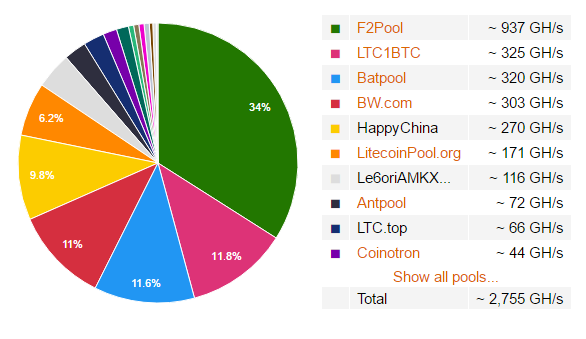
While some of the biggest Litecoin mining pools are signaling their support for SegWit, like F2Pool (34%), Batpool (11.6%), HappyChina (9.8%) and others, some refuse to change their position. Most notably, LTC1BTC which is the second biggest Litecoin mining pool in the market.
Jiang Zhuoer, founder of LTC1BTC said in an interview that LTC1BTC would not signal SegWit approval and he added that no other primary Litecoin pool would, which turned out to be incorrect.
Currently, only LTC1BTC (11.8%),BW (11%), Antpool (2.6%), LTC.top (2.4%) and Prohashing (1.4%) are not signaling for SegWit. It seems unlikely that Antpool and Prohashing will change to support SegWit, given their to SegWit and for bitcoin Unlimited.
Now, it all comes down to BW. Although it’s unclear what BW’s position on the matter is, we can expect an update to be released according to a recent tweet by the pool:
this is currently under consideration. An update will be announced in the near future. Thanks for your interest in BW.
With BW’s 11% share of the Litecoin mining network, SegWit will most likely be activated.
Will BW move to activate SegWit, allowing Litecoin to be the first SegWit-enabled cryptocurrency? Would this help bitcoin’s case for SegWit? Let us know what you think in the comment section.
Images courtesy of CryptoCompare, Segwit.co, Litecoinpool, Shutterstock
YouTube: bitcoinbitcoin Disrupts Gold – bitcoin (BTC) price to $50000 on store of value story bitcoin (BTC) disrupts gold as a store of value. If bitcoin takes 10% market share from Gold for store […]