July 7, 2026

Capitalizations Index – B ∞/21M

Constantinople Delay Makes A Dent In Ethereum’s Price

Constantinople delay makes a dent in ethereum’s price

Constantinople Delay Makes A Dent In Ethereum’s Price

Constantinople delay makes a dent in ethereum’s price

Since Sunday, January 20, $6 billion has been wiped from the cryptocurrency markets as bitcoin is trading lower and dragging altcoins with it. The recent delay to Ethereum’s Constantinople hard fork brought further dismay and dragged the coin’s price lower, which also allowed Ripple’s XRP to widen the volume gap between the two digital assets.

Currently, there’s an almost $1 billion gap between XRP and ETH, with the former sitting at a 2nd place, just below bitcoin and the latter occupying 3rd place, having dropped into technical support.

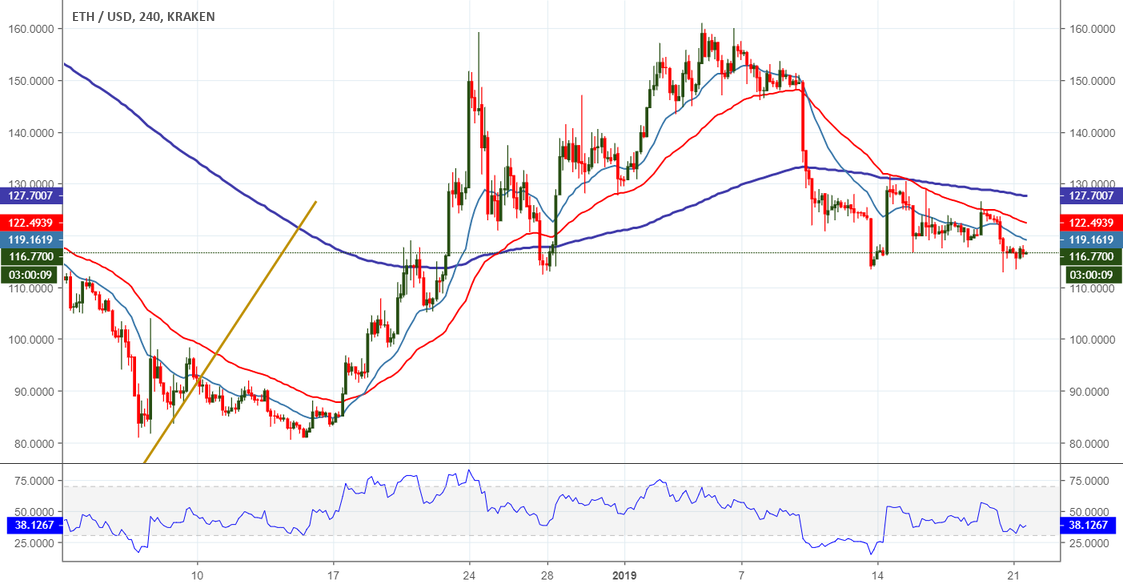
At the time of writing Ethereum was down more than 5% in the last 24 hours, trading around 117 against the US Dollar and testing a key technical support level . In recent past, the pair has hit 117 twice and each time, it was rejected higher with force. This successfully established a double bottom price pattern, which is, in essence, a bullish formation, even more so when it occurs at the (potential) bottom of a downtrend.

It is important to note that now price is testing said level for the third time, so it can create a triple bottom, which would be an even stronger indication that a move up will follow. As a side note, the spike below 117 (a red candle with long lower wick) is just a result of market inconsistencies because it is not present on most other exchanges apart from Bitfinex.

If the pair cannot form the triple bottom, hence meaning that we are dealing with a break of the double bottom , the outlook will become strongly bearish because usually, a break of a strong formation gives way to extended moves.

Support zone: 117 – 115, 100
Resistance zone: 200 EMA (4-hour charts) and 134
Most likely scenario: high-risk trading, unclear until a bounce or break is obvious
Alternate scenario: timid upside movement based on RSI showing bullish divergence

Published at Mon, 21 Jan 2019 16:59:53 +0000

Previous Article

WHAT IS BITCOIN [BTC] AND BITCOIN [BTC] MINING? | BTC SPECIAL | MVP EP #2 – MICHAEL VALMONT PODCAST

Next Article

Coinstar KYC Hurdles Are Hurting BTC User Experience

You might be interested in …

Japan’s New Bitcoin Law Could Do More Damage Than NY BitLicense

According to IndieSquare Co-founder Koji Higashi, new regulations in Japan, which will make bitcoin an official form of payment (starting today April 1), may do more harm than good for the fledgling industry in the country.


Japan to Introduce Own ‘Bitlicense’

Following the disastrous demise of the infamous Japanese exchange, Mt. Gox and the arrest of its CEO Mark Karpelès, regulators in the country decided to introduce regulations for bitcoin.

Bitcoinist_Mt. Gox

The regulatory framework has been in the works for over two years. The first bill was submitted to the Diet in Japan (the legislature consisting of the Lower and the Upper Houses) last March, and the Payment Services Act and the Act on Preventing of Transfer of Criminal Proceeds were amended in May 2016. Now, new drafts for detailed regulations and guidelines have been approved.

The new law, which is now in place starting today (April 1), is meant to protect consumers and to help them distinguish safe, i.e. approved exchanges, from fraudulent operations.

The law also recognizes approved cryptocurrencies as a legal method of payment in Japan, preventing users from investing in so-called scam coins, fake digital assets, and IOU tokens.

Although praised by western and Japanese media alike, the new regulatory framework may pose serious problems for the Japanese bitcoin community, according to Koji Higashi, Co-Founder of IndieSquare and Community Director at the Counterparty Foundation.

profile-pic

In a blog post, Higashi outlines the major issues with what he calls “Japan’s Bitlicense” due to the similarities found between the two, saying:

I’d actually argue that this law may turn out to be more damaging to the Japanese industry in the long run than what Bitlicense has been to NY.

Why It Could Be Worse Than NY’s

The Bitlicense introduced in New York has been widely perceived by the community as damaging for bitcoin startups in the region due to the bureaucracy and high entry barriers for small startups. It resulted in several startups like ShapeShift and LocalBitcoins halting services for NY-based customers.

Now, Japan is doing the same, explains Higashi. “If you are not a fan of the excessive cost for legal and compliance fee for bitcoin startups, however, the new law in Japan is certainly not exciting news for you,” he notes. 

bitlicense

Among others, the requirements involve the submission of a 3-year business plan, segregated fund management, KYC/AML requirements, segregated fund management, frequent reporting to authority, and external audits.

Some experts estimate that the costs involved with becoming a compliant exchange could be as high as $300,000-$500,000 USD. Moreover, additional fees and paperwork will also apply to companies beyond trading platforms and will affect P2P decentralized exchanges as well.

Higashi:

It’s hard to say whether the regulation in Japan is more costly than the Bitlicense but I can say it’s expensive enough to put serious financial pressure on startups and may force them to go out of business completely in some cases.

Another issue with the new regulatory framework is that it will require virtual currencies to be accepted into an official list of approved coins. Although this system may protect users from being scammed out of their savings, it may end up damaging the reputation of coins that don’t make it to the list, which will most likely be a conservative one at best.

bitcoin in Japan

The new regulations may affect bitcoin startups negatively but are also likely to push adoption forward and to create a sense of trust for new users in the virtual currency space. Japan is the fastest growing country in the bitcoin market. For example, trading volume in Japan has recently surpassed that of China and the U.S.

bitcoinist_jpy_volume_09_feb

The country is experiencing growing interest in bitcoin from users, investors, and merchants. Blockchain is also a technological focus point both for companies and the government. The Japanese community is also one of the biggest investors in crypto-related crowdfunding campaigns and Initial Coin Offerings, according to Higashi. 

[Note: This article was originally published on February 9, 2017. It has been updated as today (April 1) is the first day Japan’s new cryptocurrency law comes into effect.]

Will the new regulations drive companies away from Japan? Or will it usher a new age for cryptocurrency adoption in the country?


Images courtesy of CryptoCompare, Shutterstock, Counterparty.io

The post Japan’s New Bitcoin Law Could Do More Damage Than NY BitLicense appeared first on Bitcoinist.com.

IPCHAIN Database Revolutionizing the Protection of IP

Crypto Coin Updates IPCHAIN Database Revolutionizing the Protection of IP IPCHAIN Database Changing the Security of IP bitcoin News Release: IPChain Data Source-– Protect, safely share and move all types of intellectual property consisting of […]