With more and more digital assets incrementing the offerings of crypto-exchange, has all the chances to beat its competitors ultimately conquering rigid dominance over the industry.
Today the ambitious exchange indulges wide swaths of passionate adopters with an additional portion of good news. Following three months since the exchange listing, Coinbase Wallet finally adds support for Ethereum Classic (ETC).
ETC Wallet Expansion
Ethereum Classic has a market capitalization of $533M, and a 24-hour trading volume of $230M. At the moment it is trading at $5.02, with a circulating supply of 106,343,805 ETC, according to CoinMarketCap.
In the official , the developers of Coinbase Wallet cheer up the exchange community with an upcoming upgrade that is going to enable the wallet holders to store, send and receive Ethereum Classic (ETC) as well as the rest of ERC20 tokens, which exist in the Ethereum blockchain.
However, the users have to wait a couple of days before the promising features will be put into action, as an upgrade is to be completed before the wallet starts to support ETC storing.
Notably, that for existing Coinbase Wallet users the ETC address won’t be different from their current Ethereum (ETH) address, so any ETC sent to Coinbase Wallet ETH address in the past will now show up after the update.
Continuous Spread-out of Coinbase Platform
It seems that Coinbase is truly devoted to the promise made to its global community. The exchange is gradually expanding the offerings with new digital coins.
Earlier this month Coinspeaker that Coinbase had started trading the Basic Attention Token (BAT) on its platform, nevertheless as it was recently disclosed both the Android and iOS apps were excluded from the BAT coverage. The decision followed Coinbase announcement of the wallet’s for Internxt native tokens (INXT).
However, not everyone can reap the benefits from the Coinbase crypto-exchange since the platform declared limited coins availability for New York residents and traders from the United Kindom.
According to Coinbase, these jurisdictions will be halted from both BAT and 0x trading at the platform. The same destiny awaits recently added ZRX coin. The statement revealed that Coinbase allows to trade ZRX in most jurisdictions, but it will not initially be available for residents of the United Kingdom or the state of New York.
Operating in full compliance with the U.S. law, the Coinbase offerings list only tokens that SEC has proved to be neither assets nor securities. That is why such a promising XRP token so far has failed to be added to the exchange.
Previously Coinspeaker about potential Coinbase additions. We have even composed the list of top 5 digital coins that are likely to be added to Coinbase next, focusing on Cardano, Stellar and Zcash.
It seems that amidst most participants of today’s financial market, crypto-exchanges know security best because its infant nature makes cryptocurrency sphere especially vulnerable to cyber scams. The results of these infamous heists usually grab headlines while wiping out millions in crypto-investment.
A Series of Crypto Misfortunes
Cleary the biggest trading platforms, as well as the entire crypto-community, were very concerned about augmenting frequency of hacker attacks. The more crypto-exchanges continue to lose money falling victims to such nefarious schemes, the more potential investors wave away from cryptocurrencies.
Besides, a financial watchdog keeps peddling about malicious activities pertaining to crypto-practices. So far crypto-holders have been accused of money laundering, terror funding and arms trafficking.
Looking back at everything that was mentioned, crypto-trading platforms have to admit — the time for advanced security measures as well as surveillance system has come.
Bitstamp Deploys Irisium Monitoring System
Currently, Bitstamp’s headquarters in Luxembourg supports trading for bitcoin (BTC), bitcoin Cash (BCH), Ethereum (ETH), Ripple (XRP), Litecoin (LTC), U.S. dollars and euro.
Having reached the biggest market volume in Europe, cryptocurrency exchange pioneers to step up on the path of additional security starting from its recent partnership with a tech company Cinnober.
Today the exchange announced another significant collaboration with Irisium, a technical firm partially founded by Cinnober. In accordance to the signed agreement, Bitstamp will gain an access to Irisium Surveillance platform designed to monitor and detect suspicious activity and market manipulation.
Irisium will offer the analytical and technical support to Bitstamp to help it bridge the between traditional finance and digital money. The exchange will utilize Irisium’s data to monitor the market and alert its users on trading activity.
As usual, both companies express mutual excitement about their partnership. In the statement, Bitstamp’s CEO and founder Nejc Kodric said:
“Our desire is to guarantee a fair and orderly market which reflects genuine supply and demand. Exploring new frontiers in preventing market manipulation is essential for the industry to mature.”
In the meantime Alastair Goodwin, CEO of Irisium praised Bitstamp’s pro-active adoption of Irisium, saying that the exchange willingness to implement such coherent security system once again proves Bitstamp’s commitment to the major pillars of crypto-community — transparency, integrity and security.
The Irisium adherence to European regulatory requirements is of particular interest. The toolkit provided by the company allows monitoring compliance with Integrity and Transparency (REMIT) and Markets in Financial Instruments Directive (MiFID).
Through data provided by Irisium, Bitstamp will be sure that its clientele is receiving valid and accurate data to help them make trade decisions.
Moreover, the trading platform will have strong consumer protection and increased market liquidity through greater adoption of cryptocurrencies. The exchange will have a community of transparent and confident crypto traders.

It’s been two weeks since the bitcoin Cash (BCH) hard fork that upgraded the BCH chain and resulted in a blockchain split. But although many people have been focusing on the birth of bitcoin SV, a number of BCH proponents are already moving forward and discussing the network’s latest upgrades, as well as the next hard fork scheduled for May.
Also Read:
BCH Chain Upgrades
 The bitcoin Cash (BCH) blockchain has split and many supporters are ready to move on, as the hash war is said to be over because the bitcoin SV developers have revealed that they will add replay protection. But with all the focus on the emergence of a new chain, many people haven’t even noticed that the BCH software has been . For instance, new protocol changes have been applied to the blockchain, including a clean stack for more efficient script evaluation, (CTOR), an enforced minimum transaction size, push-only for scriptsig, and the addition of the .
The Most Discussed Additions to the BCH Chain
The two recent fork additions, OP_Checkdatasig and CTOR, have been the topic of intense discussion over the past few weeks. With CTOR, transactions within a block are sorted differently, while removing the limits of topological transaction ordering (TTOR). Developers believe CTOR removes a lot of the complexity of block template creation time. When coupled with the Graphene protocol, the chain could see a more efficient method of broadcasting blocks as well.
BCH developer and cryptocurrency miner Jonathan Toomin has published a , while blockchain researcher Joannes Vermorel has also in great detail. And Bitcoincash.org explains that bitcoin ABC developers believe CTOR “will have huge payoffs for the future of bitcoin Cash.”
 OP_Checkdatasig and CTOR are the most discussed upgrades to the BCH chain.
The other widely discussed addition to the bitcoin Cash protocol was re-enabling the old opcode OP_Checkdatasig to improve the BCH script language. Basically, when someone uses the opcode OP_Checkdatasig, it calculates the hash within a transaction and checks the signature against that data set, which essentially validates or invalidates the signature in an autonomous fashion. Proponents of OP_Checkdatasig believe the script language can allow many different contract-like concepts, including permissionless cross-chain atomic swaps, and . bitcoin ABC developer Mengerian has written a of OP_Checkdatasig, in which he explains how the opcode could allow many types of decision-based transactions and smart contracts.
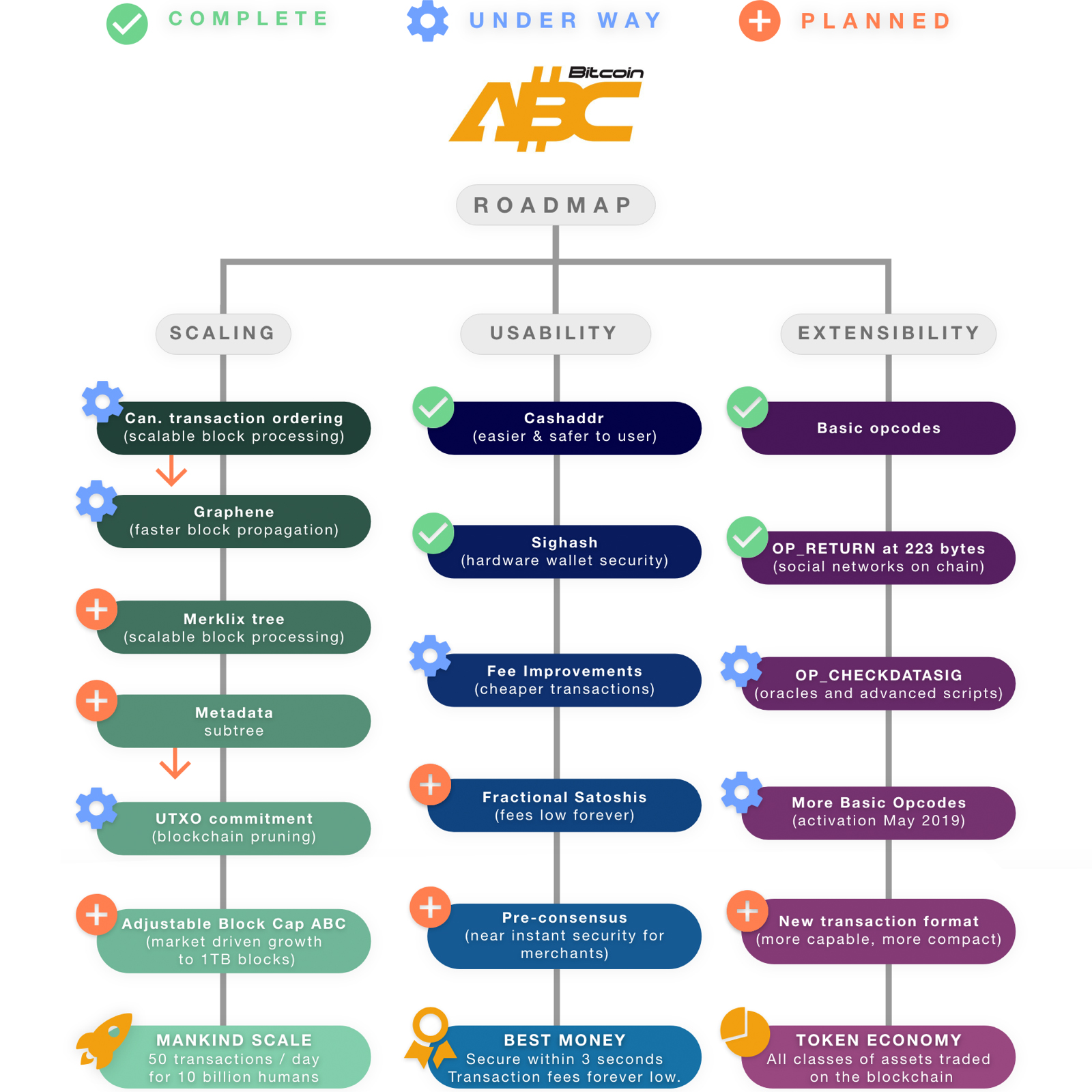 for bitcoin Cash technical engineering going forward.
New Opcodes and Schnorr Signatures
Now that these new features have been added to the BCH chain, many are wondering what’s coming in the next hard fork, scheduled for May 2019. The ABC development roadmap published last August shows there are many different features planned for future software. Back in October, bitcoin Cash developer Shammah Chancellor (Micropresident) also published a suggested specification for the May fork, so developers could discuss the proposal. Over the last few weeks, BCH developers such as Mark Lundeberg, Awemany, Andrew Stone, Mengerian and Jason Cox have been discussing the proposed specifications in great detail.
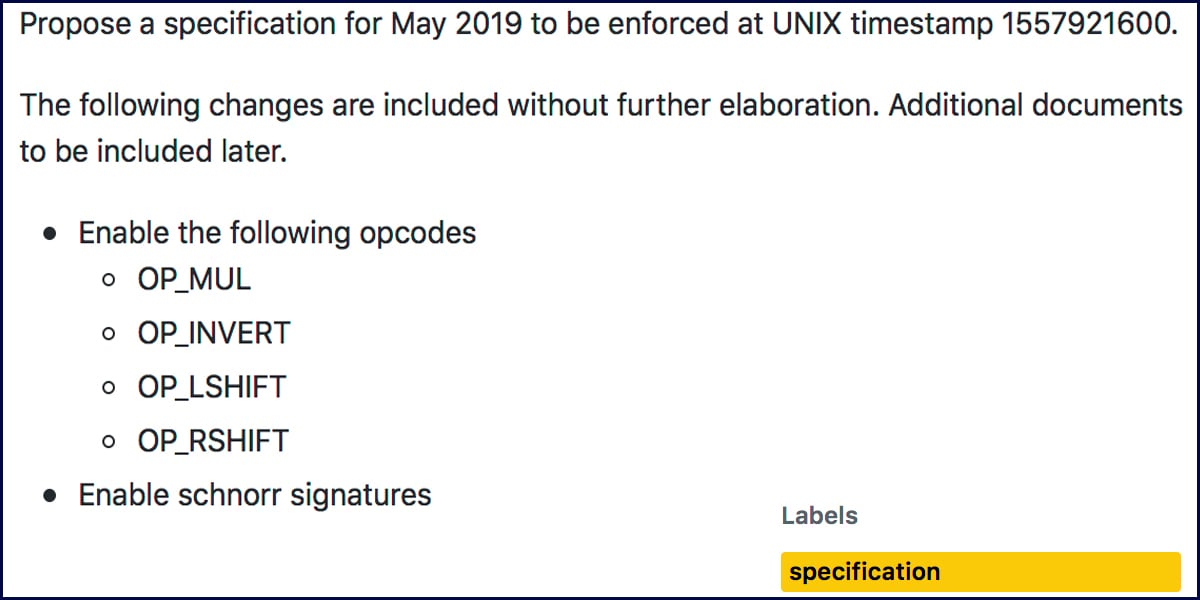
The specifications under discussion include re-enabling the following opcodes: OP_Mul, OP_Invert, OP_Lshift and OP_Rshift. These specific opcodes are the same ones that were recently implemented on the BSV chain and they could add various scripting abilities and possibly allow for concepts such as . The other specification listed on the proposal is enabling Schnorr signatures on the BCH chain.
The benefits of has been discussed in great length within the cryptocurrency community and the signature algorithm could theoretically advance scaling by reducing bandwidth and storage by 25 percent. The Schnorr scheme also offers privacy benefits if the protocol is coupled with concepts like transaction tumblers. Essentially transaction signatures could be obfuscated by tweaking shuffling software in the same fashion as mixing the inputs and outputs of combined BCH values.
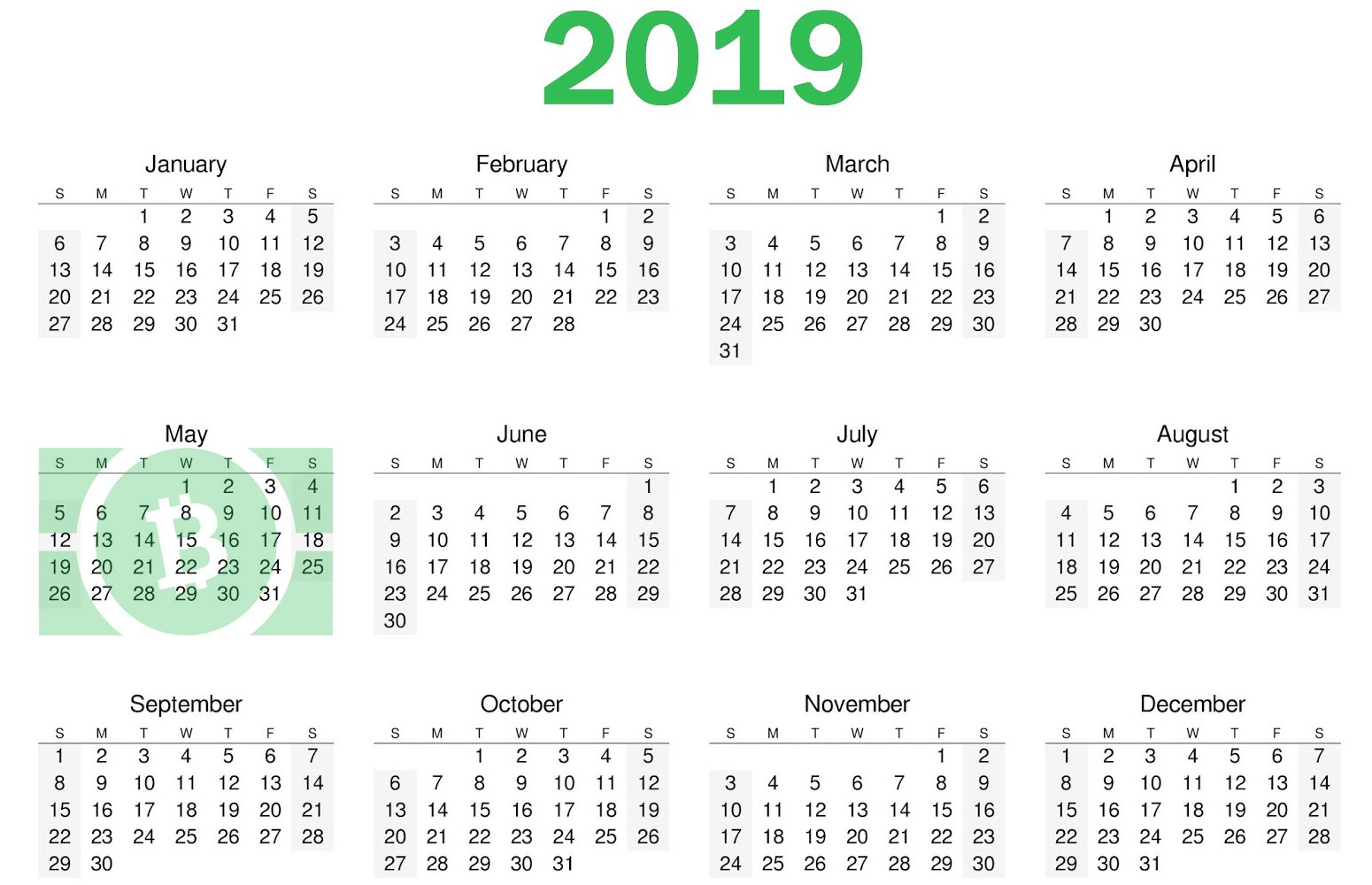 There’s still a lot of time for the community and developers to discuss the next upgrade.
6 Months to Discuss
BCH proponents on the subreddit r/btc have also the developer’s documentation, with one person that they appreciated that the development has been “progressing normally.” Other BCH enthusiasts in the r/btc conversation started asking when the next block size increase would take place. The well-known BCH community member Homopit has already provided a response, that “The limit is now 500x above demand — Developers are working on more important things — 40-minute propagation for the 64MB block on BSV chain. Remember?”
Of course, the proposed specifications are only on the table for discussion at the moment, but it’s good for BCH proponents to get a glimpse of possible development plans. There’s also six months left and plenty of time for debate about the consensus changes slated for next spring.
What do you think about the recent additions to the bitcoin Cash blockchain and the proposal for the upcoming May 2019 hard fork? Let us know what you think in the comments section below.
Images via Shutterstock, Pixabay, and Github.
Express yourself freely at bitcoin.com’s user forums. We don’t censor on political grounds. Check .bitcoin.com.
The post appeared first on .