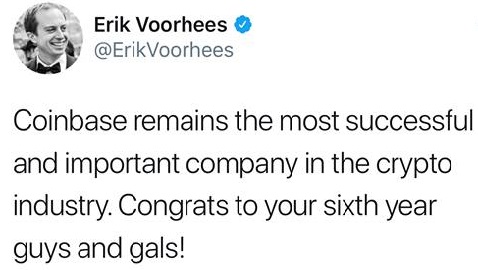
On its 6th birthday, Coinbase received high praise from Shapeshift’s Erik Voorhees. He Tweeted, “Coinbase remains the most successful and important company in the crypto industry.” Arguably, that is very much the case. The San Francisco-based cryptocurrency exchange with its barebone menu of offerings, combined with its easy user-interface and relatively smooth onboarding (almost no upfront deposit needed), provide an envious business model. That’s not to write the company is without faults, as it has many. It might not even be the future of retail crypto access, and perhaps it shouldn’t.
Also read:
Coinbase is Easy, Light, Feisty
“Today is Coinbase’s sixth anniversary,” wrote COO Asiff Hirji. “We’re celebrating six incredible years working toward our mission to help create a more open financial system for the world! […] We are in the early days of our mission and there is still so much to do […] Have to know when to follow the rules, when to bend them and when to push to change them. Breaking them is neither ethical nor sustainable.”
It’s probably less of an exchange proper and more of a conservative cryptocurrency bank. It might be fair to simply label it a broker (without bids, asks, limit orders, margin trading, etc). Coinbase, founded six years ago this week, is arguably the most important company, regardless of its technical classification, within the space. It alone is responsible for introducing millions and millions of Americans to the wild phenomenon that is decentralized currency speculation.
Offering bitcoin core (BTC), bitcoin cash (BCH), ether (ETH), and litecoin (LTC), its sparse choices work to underwhelm those new to speculating on cryptocurrency. The format is light and only requires a linked bank account. Without the bother of having to hold and maintain decentralized currency, users can simply use the Coinbase client and trade for fractions, sometimes as low as $2.00. Fees, of course, apply.
At the time of available statistics, the Northern California broker had something like 13 million users (Altana Digital Currency Fund), some days back in 2017 clocking them at 100,000 new sign ups every twenty four hours. For a little while there, Coinbase was a top ten downloaded application in the Apple Store. Its yearly revenue eclipsed venerable legacy houses such as Charles Schwab.
Embarrassment of Riches
It continues to nab top professional financial sector talent such as Asiff Hirji from TD Ameritrade; to that end, it poached Facebook Messenger’s David Marcus to join its Board, and the two are exploring ways to exploit the social media platform’s giant user base in terms of blockchain technology (probably a proprietary token is in the works, but that’s a guess). Heck, even its alumni go on to do big things: Charlie Lee of Litecoin fame was a former director of engineering.
Merchants Dell and Expedia use it as a point of sale processor. For trading professionals, its Coinbase Exchange was rebranded to Global Digital Asset Exchange (GDAX), becoming one of the earliest to offer ether to financial pros.
 Brian Armstrong
For better or worse, Coinbase is the most prominent version of mainstreaming the crypto revolution. It’s young (CEO, Brian Armstrong, is barely in his mid 30s), feisty, ambitious, cocky, and sporting for market share. Its flounders are largely an embarrassment of riches: demand so great the company’s system crashed a few times during the runups of 2017, and its customer inquiries languished at times in ten day backlogs. Mr. Armstrong fired back, “There’s so many people rushing into the space, if it’s a bit of speculation, I’m O.K. with that. But we can’t guarantee the website’s going to be up exactly when you need it. Everyone needs to take a deep breath.”
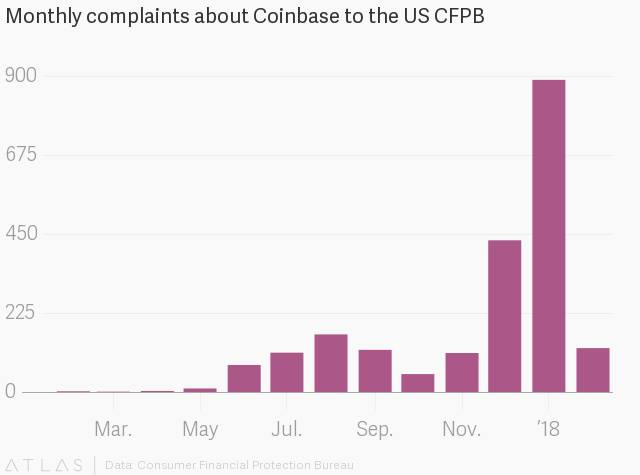
That particular hiccup hasn’t been put away altogether just yet, as in January of this year alone formal complaints to the Consumer Financial Protection Bureau rocketed by more than 100%. Almost half were filed regarding “money not available when promised,” which is no small matter.
Peril’s of Centralization
In the scaling debate, Mr. Armstrong came firmly down on the side of big blockers, and, according to various sources, holds most of his crypto wealth in ether. Under his leadership, the company embraced economic reality, choosing when to fight on principle and where to give-in. For example, it was one of the notable in its class to snag a controversial Bitlicense from New York. Howls of sell out and capitulation could be heard far and wide. But this move signaled to potential investors and the broader financial community the company was less strident and more pragmatic in the all-important ‘business sense.’
It would regain some of its punkier credibility, at least for a time, when the United States’ taxman came calling. The Internal Revenue Service (IRS) evidently can read eye-popping price headlines. As market leaders such as BTC rose exponentially, so did United States citizens’ tax obligations. Yet nearly no one was complying. History will show the company did fight back, but history will also show it lost, having to hand over customer information for those who moved more than $20K in crypto (small percentage of its users).
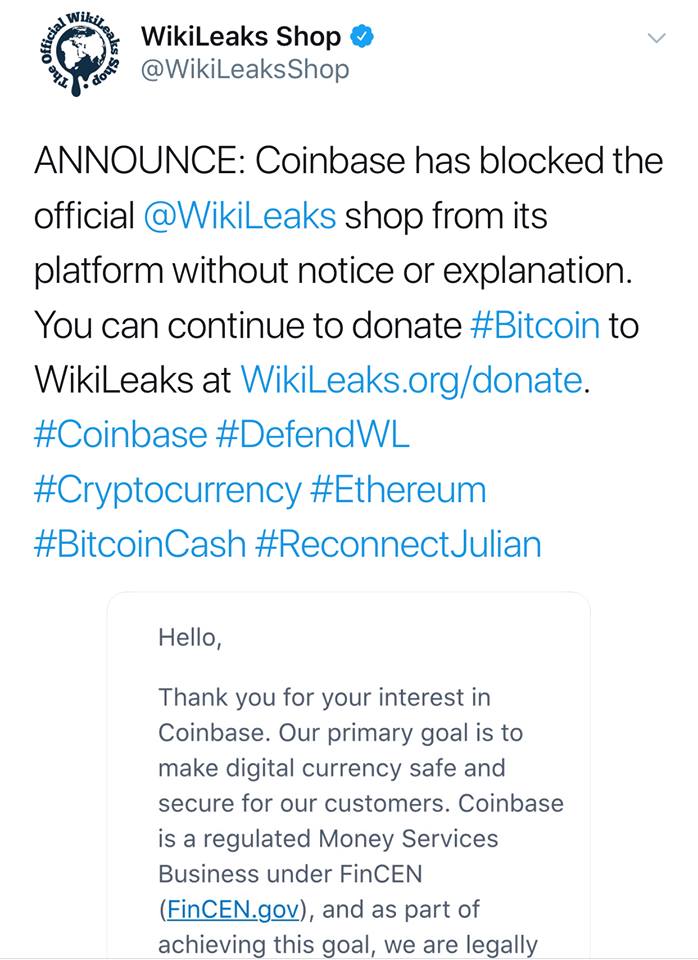
Then again, when New York’s top cop poked and prodded at exchanges, asking they account for this and that, Coinbase jumped as high as asked, issuing a very detailed letter. Kraken, on the other hand, went sideways at the presumption and hubris of such an invasion. The contrast could not be starker, and the more principled in the community noticed … as it did when it shut off access for Wikileaks, a seemingly purposeful separation from crypto’s anarchic roots. Such are the perils of centralization in the sense there are doors to kickdown, masters to please other than market demand.
For the more cypherpunk among us, it is critical to acknowledge the truth. Coinbase is good people, but Coinbase is also in bed with the same folks who prompted crypto’s birth. That won’t do, and won’t do by a lot. If censorship resistance and decentralization are fundamental pillars, then we should look for exchanges in those images. Leave traditional banking schemes itching to please governments to their future: slow death.
Is Coinbase an overall positive or negative in the crypto community? Tell us in the comments below!
Images courtesy of Shutterstock, Coinbase, Twitter.
Need to calculate your bitcoin holdings? Check our section.
This is an Op-ed article. The opinions expressed in this article are the author’s own. bitcoin.com does not endorse nor support views, opinions or conclusions drawn in this post. bitcoin.com is not responsible for or liable for any content, accuracy or quality within the Op-ed article. Readers should do their own due diligence before taking any actions related to the content. bitcoin.com is not responsible, directly or indirectly, for any damage or loss caused or alleged to be caused by or in connection with the use of or reliance on any information in this Op-ed article.
The post appeared first on .

Seminole County Tax Collector Joel M. Greenberg has announced that his office will begin accepting bitcoin and bitcoin Cash through for payment for various services starting this summer. Until now, paying taxes by credit or debit card has meant using a third-party processor with heavy fees. The blockchain allows the Seminole County Tax Collector to eliminate much of those fees while improving payment accuracy, transparency and efficiency, which ultimately benefits Seminole County tax payers.
Greenberg commented: “We live in a world where technology has made access to services on demand, with same-day delivery and the expectation of highly efficient customer service and we should expect the same from our government. The aim of my tenure in office is to make our customer experience faster, smarter, and more efficient, and to bring government services from the 18th century into the 21st century and one way is the addition of cryptocurrency to our payment options.”
BitPay enables the Seminole County Tax Collector to accept bitcoin and bitcoin cash for services including property tax, driver license and ID card fee, tags and titles. Using the global blockchain payments provider, the Seminole County Tax Collector receives settlement the next business day directly to its bank account in US. dollars. There is no price volatility or risk to the County. As a push transaction, the user sends the exact amount of bitcoin or bitcoin cash needed to pay the bill. This eliminates traditional credit card fraud and identity theft risks associated with credit cards. Unlike the high cost of credit cards, BitPay charges 1% to approve the bitcoin or bitcoin cash transaction and settlement. BitPay enables transactions from any computer or mobile device making it easy and convenient for Seminole County residents.
Head of Compliance at BitPay, Jeremie Beaudry remarked: “BitPay was started because we recognized the potential for blockchain to revolutionize the financial industry, making payments faster, more secure, and less expensive on a global scale. With the Seminole County Tax Collector’s office, we have engaged our first government agency to accept bitcoin and bitcoin cash by making it easy and seamless for them.”
Major advantages that blockchain provides for these kinds of uses is transactional transparency and the impossibility to use the blockchain for fraud as every transaction is verified, recorded and stored. One of the most critical elements about the blockchain technology is that when the transaction has been reported in the ledger, it cannot be changed. This process creates highly efficient services and an overall better experience for Seminole County residents.
The Seminole County Tax Collector is responsible for the collection of all ad valorem and non-ad valorem taxes, DMV services including tag, title and registration, driver’s license and identification cards, birth certificates, hunting and fishing license and concealed weapon permits.
Greenberg was elected Tax Collector in November 2016 and took office in January 2017. Since taking office as Tax Collector, he has directed the office to introduce new technologies, including artificial intelligence, improved infrastructures, and streamlined and improved customer service. His new modernization plan includes the adoption of blockchain technology.

A week into token sale, moved forward and inked its partnership, which sees Zahid Rashid Mir join on board as Hada DBank’s latest advisor in events and investor relations.
Mir, Founder & Director at Vostad commented: “We at Vostad believes the potential of Hada DBank and its dynamic business module. The team behind the development of the project are very ambitious with high determination to push forward the project globally and we intent to support this. Vostad and Hada DBank will work hand in hand to ensure quality innovative products and services be made available to public.”
READ
In 2017, there was an in losses from tech support scams from 2016. These criminals are persistent. They post phone numbers on message boards and purchase ads to boost the phone number’s place in search results. They may call you directly. They will pressure you to act quickly.
You as a user play an integral role in protecting your account. The security of your devices, passwords and two factor authentication codes is your responsibility. It’s extremely important that you take measures to keep your information safe.
Here are examples of specific Coinbase phone support scam approaches that we have observed that we want our customers to be aware of. In this scam, cybercriminals pretend to be from Coinbase Support.
TIP 1: If you are trying to reach Coinbase Support, the only Coinbase phone number is 1 (888) 908–7930. Any other phone number you find online is a scam.
These scammers are trying to steal your digital currency. And unlike fiat currency, digital currency transactions are irrevocable, and the blockchain does not contain enough information to identify an owner’s address.
If you dial into a number posted online that a scammer owns, the scammers may ask for your password or two factor authentication codes, and they may direct you to download software or go to a website so they can remotely access your computer.
TIP 2: Refuse when someone asks for remote access to your computer.
Coinbase Support will never ask to remotely access your computer, nor will we ask for your private information like your password or two factor authentication codes.
Once a cybercriminal has remote access to your computer, they can transfer digital currency out of your Coinbase account or other wallets, access your online bank accounts, and any other information you’ve stored on your computer.
TIP 3: All support communications with Coinbase must be initiated by you. Coinbase does not make outgoing calls.
Coinbase phone support does not make outgoing calls. Scammers may spoof the caller ID of Coinbase’s real support phone number and call you directly with what appears to be our number. If someone calls you claiming to be from Coinbase Support, even if it’s from our legitimate number, they are spoofing the phone number and are trying to scam you.
It is unfortunately common that a fraudster claiming to be from Coinbase would know some of your information, but this is not evidence that he or she represents us. Cybercriminals share information online, and yours may have been part of a data breach unrelated to Coinbase. You can check on haveibeenpwned.com to see if your email was leaked as part of a prior data breach. If your email has been compromised, we strongly suggest that you change the email address on your Coinbase account to a new email address.
TIP 4: Never give out private information like your password or 2FA codes to anyone. This information can be used to steal your digital currency.
This type of information includes your Coinbase or email password, TOTP secret seed, two factor authentication code received via text, and API keys. You should not share this information with anyone, and especially not with someone claiming to be from Support.
If you have been a victim of a phone support scam:Report the theft to and to the Run a malware scan on your computer. Consider consulting a security expert to ensure the security of your devicesChange the password of your Coinbase account, and any other online account that shares this password. TIP: Use a password manager to help you manage unique passwords across all sites.If your email has been compromised, change the email associated with your Coinbase account.Add time-based one time password (TOTP) — such as Google Authenticator — as your 2FA method to both your Coinbase and email accounts. Phone numbers can be ported and stolen.Recap:Do not call any phone number you find online claiming to be Coinbase Support that is different from the one on our website. These are cyber-criminals trying to steal your digital currency. An easy way of doing this is to bookmark our website and use that website to find the number.Do not allow remote access to your computer from someone claiming to be from Coinbase Support. Coinbase Support will never ask to remotely take over your computer.Do not discuss details of your account with anyone who reaches out to you unsolicited, claiming to be from Coinbase Support. This is a scammer!Do not share or tell anyone your passwords, two factor authentication codes, or TOTP secret seed.
was originally published in on Medium, where people are continuing the conversation by highlighting and responding to this story.