April 18, 2026

Capitalizations Index – B ∞/21M

Coinbase Engages SEC about Turning into a Regulated Brokerage: Report

Coinbase engages sec about turning into a regulated brokerage: report

Coinbase Engages SEC about Turning into a Regulated Brokerage: Report

Coinbase engages sec about turning into a regulated brokerage: report
Advertisement

Join our community of 10 000 traders on Hacked.com for just $39 per month.

The San Francisco-based cryptocurrency exchange is reportedly in talks with the US Securities and Exchange Commission (SEC) about becoming a regulated brokerage firm and trading platform. According to The Wall Street Journal, Coinbase reached out to regulators about the getting licensed even as the SEC moves closer to crafting some regulatory framework by which exchanges and other market players would operate.

bitcoin exchanges have been feeling increased pressure from the Wall Street regulator of late, as evidenced by the SEC launching an investigation into ICOs and putting exchanges on notice that they were on the radar, too. While SEC Chairman Jay Clayton recently stated that not all ICOs are fraudulent, the regulatory agency has also made it clear that security tokens must be traded on licensed exchanges.

According to the WSJ story, Coinbase may look to become licensed by the SEC as an exchange but at the same time register as a broker-dealer, the latter of which face less stringent rules. But it would also mean the securities regulator would have carte blanche access to buy and sell transaction records.

Licensing Opens the Door to More Altcoins

At the moment, Coinbase only supports bitcoin, bitcoin Cash, Ethereum and Litecoin.
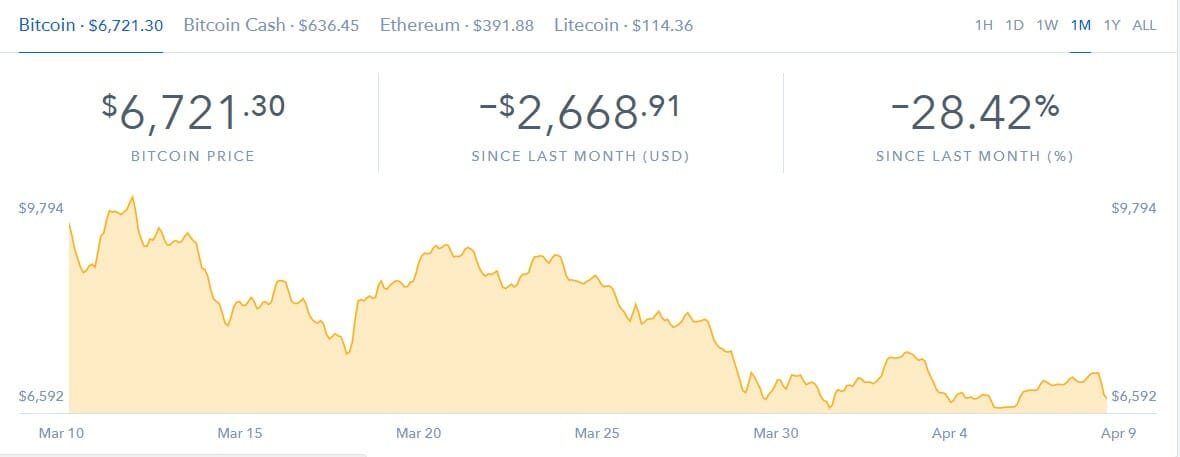
Coinbase engages sec about turning into a regulated brokerage: report
Courtesy: coinbase

Becoming licensed could potentially open the door to the exchange supporting more altcoins, including those that US regulators deem securities, the WSJ story suggests. It could also explain why Coinbase has been reluctant to add more coins, such as Ripple’s XRP, till now. As CCN previously reported, Ripple was willing to pay for a listing on top cryptocurrency exchange Coinbase.

Coinbase’s President Asiff Hirji told CNBC a few days ago:

“We are on the right side of where the regualtions are,” said Hirji on CNBC, adding: “You cannot then list things for which there are regul uncertainty because that dosen’t fit with our mission. The assets that we do list have all had some amount of regulatory certainty. As soon as there is more regulatory clarity than there currently is you would expect us to start listing more assets.”

If Coinbase becomes licensed by the US SEC, it could set a precedent for other trading platforms to do the same. An attorney is quoted in the WSJ story as saying:

“It’s an early phase where the industry leaders understand they have to live within a highly regulated environment. They have to deal with the SEC.” – Richard Levin in the WSJ

US-based Gemini is currently regulated by the New York State Department of Financial Services. Meanwhile, in Japan, Monex Group, a regulated business, recently announced its plans to acquire the beleaguered Coincheck in a $33.5 million transaction.

GDAX, which is run by Coinbase, is currently the No. 9 cryptocurrency trading platform based on volume over the past 24-hour period.
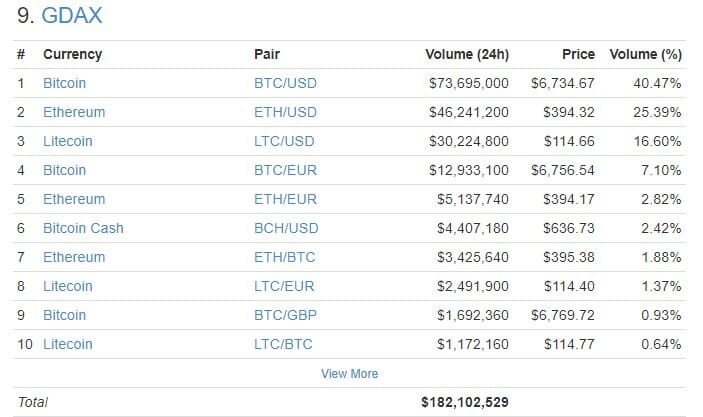
Coinbase engages sec about turning into a regulated brokerage: report
Courtesy: coin market cap

“Misimpression to Investors”

The SEC last month distinguished between cryptocurrency exchanges and trading platforms, saying a company that says it’s an exchange “could give misimpression to investors that they are regulated or meet the regulatory standards of a national securities exchange.”

Featured image from Shutterstock.

Follow us on Telegram.
Advertisement

Published at Tue, 10 Apr 2018 13:01:22 +0000

bitcoin Exchange

Previous Article

Singapore Looks To Foster Blockchain Throughout Southeast Asia

Next Article

How exchange listings affect cryptocurrency prices

You might be interested in …

Factom Harmony Takes On the Mortgage Industry

Factom Harmony Takes On the Mortgage Industry

Already working with the Department of Homeland Security and the Bill & Melinda Gates Foundation to secure records on their blockchain, Factom has now set its sights on the trillion-dollar mortgage industry. Having launched its new Factom Harmony solution in March, the company hopes to attract big banks and host their sensitive mortgage data. By increasing the efficiency of document management, Harmony will allow a seamless transaction process between lenders and brokers, without them having to worry about lost documents, altered agreements or incomplete records.

Built on the Factom Apollo data management solution, which allows users to store and create immutable digital records, Harmony “works with existing imaging or document management solutions to create secure, transparent, unalterable records for final loan documents.” In the process, every file is secured within a blockchain container, locking in the order of the final documentation, recording each person who accesses files and rejecting duplicate documents.

Factom refers to this system as “a perfected digital audit vault” for each specific loan. Thus the core product behind Factom Harmony is called Digital Vault, which locks into time the most important closing documents and gives a complete history of every file from origination to close.

As an all-inclusive solution, Factom Harmony

  • creates a permanent record and index of final loan documents, making audits smooth by reducing quality control, due diligence and review time;

  • reduces costs by creating a single source that organizes the final documentation and provides cryptographic truth that each document is an authentic copy;

  • provides access control to multiple parties that can collaborate under audit conditions and exceptions, and includes an immutable audit trail of all actions on each document in real-time, giving a true history of every loan;

  • opens a secure audit room or due diligence deal room that can be tracked on the Factom blockchain.

According to Peter Kirby, CEO of Factom Inc., “The Harmony solution and the underlying Factom blockchain provide lenders with something that was fundamentally missing from the industry. With Harmony, a lender is able to create a final set of documents for each closed loan.”

Right now, origination of a loan has underlying costs of about $7,500 per loan — up from approximately $2,500 per loan in 2006. The costs have tripled over the last few years as banks have been forced to step up their efforts to be in compliance with new laws.

Factom Harmony addresses many of the redundancy issues associated with these efforts by permanently documenting the process from the moment documents are first created, and then allowing that data to be quickly shared and verified digitally. Having digital records that can be securely shared and verified also speeds up financial institutions’ ability to settle transaction among themselves. Factom does not claim to move money faster, but it does attempt to allow others to have the confidence in the data they are reviewing and thus speed up the processes.

According to Factom, Harmony is the first practical and effective deployment of blockchain technology in the mortgage industry. Through combining blockchain technology, advanced cryptography tools and a digital fingerprint for each document or data file, lenders can securely store and expose individual loan files or documents to various third parties.

“This technology dramatically changes the approach and reduces the costs for audits, third-party reviews, litigation costs and due diligence costs,” Jason Nadeau, executive vice president of Factom, said in a statement. “The combination of blockchain and digital signature technology within Factom’s solution creates a solution where the benefits of digital signatures and electronic vaulting are now available for all documents without having to deploy any eMortgage or eClosing technology.”

Toni Moss is the founder and CEO of AmeriCatalyst LLC, an advisory firm located in Austin, Texas, specializing in corporate strategy, business development, market intelligence and market positioning for companies engaged in all sectors of the residential real-estate and housing finance industry in the North American market. Moss has advised clients including Citigroup, Goldman Sachs, Deutsche Bank, the European Commission and the Kingdom of Saudi Arabia. Well-known in the U.S. mortgage industry, she is a big fan of Factom Harmony, and had this to say about the blockchain-based solution:

“The industry remains disparate and fractured with regard to the acquisition, management, distribution and protection of data, with a wide variety of third-party providers, proprietary platforms and programming languages. It’s just a matter of time before mortgage data is aggregated into a secure and centralized industry utility — and blockchain [technology] is the most promising catalyst to enable it,” Moss said to bitcoin Magazine.

“As data becomes more plentiful, accurate, accessible and immutable, investors will have the confidence to return to the mortgage market; processing, servicing and transactional costs (should) decrease; and the market itself will be far more secure and sustainable in the long-term.”

Factom has yet to announce any contracts or partnerships related to its mortgage solution, but the time is right for big banks to start utilizing blockchain technology. In a separate recent development for the company, the Factom blockchain was made accessible to Chinese developers through WanCloud, a product released by Wanxiang Blockchain Corporation to drive progress among Chinese enterprises.

The post Factom Harmony Takes On the Mortgage Industry appeared first on Bitcoin Magazine.