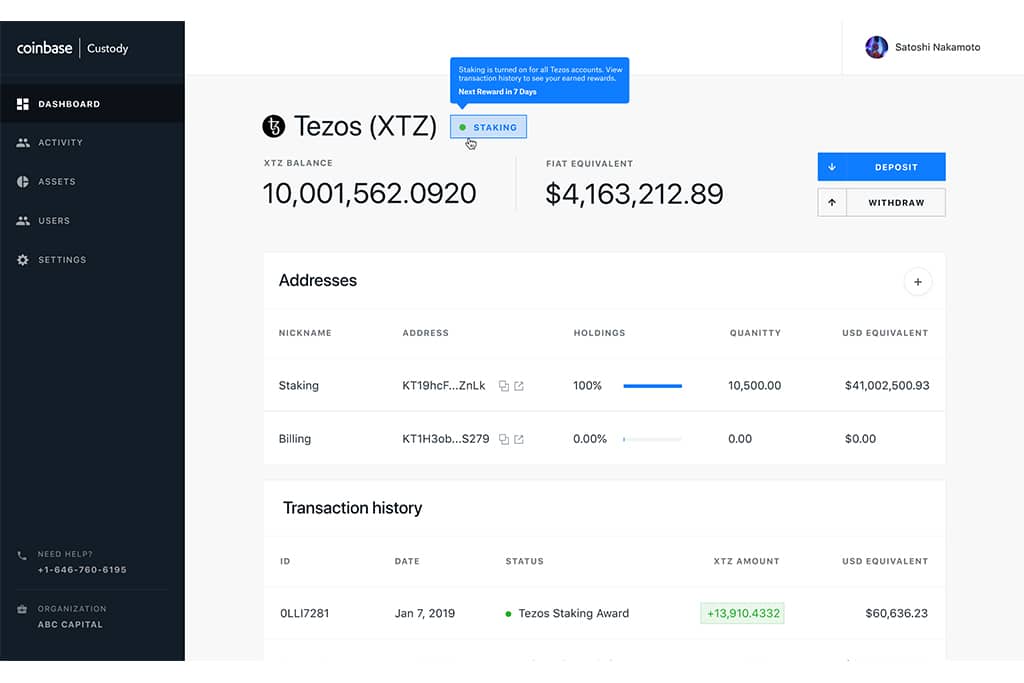
Photo: Custody
has been storing crypto for institutional hedge fund clients since 2017, but the new so-called “staking” services will allow those investors to offered by certain types of digital assets running on proof-of-stake networks.
They said that they chose as their first staking asset because of its DPOS architecture coupled with high demand from current clients. The Tezos design was thoughtful from the start about protecting delegated funds. The result is that they can keep client assets in segregated cold storage, where they’re never subject to more risk than non-DPOS assets (e.g., ).
In their blog post they :
“We’re proud to be the first full-service, regulated, comprehensively-insured, and 100% offline staking provider in crypto. In the coming weeks, we will add governance support for the protocol. We launched Custody with a simple thesis: institutions need a regulated and trusted partner to help them their crypto assets. That approach has helped us scale to more than 60 clients and $600 million in assets under custody. “
In staking protocols, investors can put up for bond to help run and secure the network. Those folks are rewarded with additional , allowing users to gain interest on their principal investment.
Custody will take about 20 percent from the current 8 percent yield, which means that clients will be able to earn around a little over 6 percent annually by staking Tezos.
The firm brought on Luke Youngblood to help spearhead its staking efforts. ’s custody business covers 60 clients and $600 in AuM.
One of the main issues that funds and investors in this space face is a dilemma of whether they should stake — with the responsibility of being fiduciaries to their LPs and the complications of supporting staking hanging over their heads. For this reason, many have stayed on the sidelines even though it is estimated that the current staking market represents at least $450M in annual rewards, experts say.
Most Custody clients are fund managers who act as fiduciaries to their investors.
Participating in POS networks has raised an interesting tension for them: to stake or not to stake? Staking avoids deflation, but products to date increased risk. Prior to today, the risk necessary to actively participate in staking has mostly outweighed the return. As a result, many institutional investors have elected to sit on the sidelines.
They said from the company:
“ Custody changes this calculus. No other staking provider has our track record of security and regulatory compliance, nor our comprehensive, best-in-class insurance coverage.”
Kathleen Breitman, co-founder of Tezos added:
“The launch of Tezos staking through Custody serves an acute need that existed up until now: a way for institutional participants who rely on a secure, offline custodian to take an active role in the network. Achieving our mission of creating a ‘digital commonwealth’ means facilitating participation for all, and that includes the institutional that Custody brings to the space.”
Sam McInvale, head of product at Custody said:
“One of the reasons we are starting with Tezos and then following on with other delegated PoS networks is specifically because we can keep our clients’ funds that we will be staking in cold storage at all times.”
Continuously On-Boarding World-Class Clients
Custody service was for all institutional players and businesses in July last year. The company then said that they will continue on-boarding a set of world-class clients that includes leading crypto hedge funds, exchanges and ICO teams.
As from the name it implies that the ‘ Custody’ service is basically a custodian solution for and safe and secure storage of the digital assets. The service is aimed at institutional hedge funds and other big institutional investors who are willing to invest n the crypto space in huge sums.
Already in October, said they will offer which has raised doubts whether the exchange is planning for a possible listing of the coin.
Until then Trust could provide custody services for (), (ETH), (LTC), (XRP), (ETC), and (BCH).
Published at Fri, 29 Mar 2019 11:00:04 +0000



![My biggest regret in cryptocurrency [bitcoin perspective]](https://ohiobitcoin.com/wp-content/uploads/2018/12/6vZ8SN.jpg "My biggest regret in cryptocurrency [bitcoin perspective]")