Transaction
Eventually, all bitcoins began with Reward from a special transaction called transaction.
As I explained in an earlier article, UTXO were made with previous UTXOs and therefore can be traced up to the beginning and the first usage is transaction. transaction is the reward given by the protocol. (I’ll refer to transaction as Tx)
Tx is a transaction made by “Miner” to “its own address” with the amount of that correspond to “Reward corresponding to the height of the block being mined + Sum of Fees in transactions which contained in the block.”
If the transaction is created by the miner himself and success in the block with that transaction inside, the reward and transaction fees will be obtained(since the Tx is confirmed). That is, in a decentralized environment, the process of rewards and fees given to the miner is through this process. (Make sure that reward and fees are not automatically obtained. It is by miner himself and confirmed by other nodes like normal transactions)
Interestingly, if a selfish miner sets the amount of in Tx higher than the exact reward given the height of the blocks actually being mined, the block will fail to be validated when the nodes verify the propagated block. On the contrary, tx which amount is set less than the actual reward does not have any penalty. In fact, we can see some Txs which didn’t issue the exact reward amount thereby forming the less total amount of in the than expected by Satoshi Nakamoto’s consideration of half-period.
Therefore, tx is a special transaction that is allowed by the protocol.
The UTXO model, in which transactions are formed by input and output, has always been a form of consumption through ‘transfer of ownership’. If so, the following questions may arise:
Whose ownership is Tx transferred?
Tx does not include ‘unlocking ownership’ which is a process putting ‘ScriptSig’ as input for ownership transfer. This means that the Tx input is empty. Tx will have a “” in this empty inputs.
CoinBase
is the input of the Tx
Through the , miners continued various activities.
1. The height of the block was encoded.
‘Height of the block’ was not stored in a specific field and only the ‘block header hash’ indicated a specific block. But later on, the height of the block started to be added in the .
2. Additional space for Nonce
In the process, additional space for Nonce was needed due to increased difficulty, and the miners used this as well.
3. Insert string (ASCII Transformation)
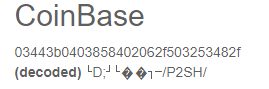
Let’s take a look at the of the actual 277316th block.
There were hexadecimal numbers in the which is 03443b0403858402062f503253482f
‘03’ means “Upload the next 3 bytes stack of the script .”
‘443b04’ is the “Encoded block height 277316”.
‘0385840206’ was used for “Additional Nonce space.”
So what string does the last ‘2f503253482f’ contain?
String insertion through is one of the interesting usages.
Miners used the space to vote on Changing protocols.
You can look at “/P2SH/” that have been decoded in the corresponding above picture. That is, 2f503253482f is the ASCII conversion of /P2SH/.
BIP0016 (BIP means Improvement Proposal) proposed the introduction of P2SH, one of the transaction script structures, and miners voted in the to approve the proposal. /P2SH/ indicates support for BIP0016 and the miners who supported BIP0017 put p2sh/CHV (CheckHashVery) in the . It is one of the structures that provide a glimpse into the “Governance of ”, which is participated by miners.
The vote proceeded for a week and P2SH was adopted since Feb. 15, 2012, following the confirmation of the results at Feb. 01, 2012.
The most interesting example of string insertion is that a string was encoded in the first when Satoshi Nakamoto actually created the first block, which is as follows:
The Times 03/Jan/2009 Chancellor on brink of second bailout for banks
It is the title of an article about the global financial crisis in The Times, which seems to imply the background of ’s birth against a trusted centralized party(the central bank).
If Tx is the beginning of UTXO, the beginning of Block is called “Genesis Block”. Looking at the Genesis block of is as follows.
Genesis Block
Published at Sat, 04 May 2019 01:40:35 +0000
