 article written by Matt Lockyer, Plazus CTO.
“Social mobility is defined as the movement of individuals, families, households, or other categories of people within or between layers or tiers in an open system of social stratification. Open stratification systems are those in which at least some value is given to achieved status characteristics in a society.”
Since the dawn of the internet we’ve gathered online based on our common interests. Early forums for cars, animals, cooking and other topics of entertainment and values sprung up almost instantly. As members became more active on these forums, they earned special privileges, making their way to becoming an admin. Admins of these online forums could police, share in business decisions, control advertising and choose sponsorship of the community. With the centralized networks of today, we have lost the ability to move up the ranks of power, influence and control. We have lost our online social mobility.
The command and control architecture of Facebook, Twitter and other social networks creates an “us vs. them” mentality; users are the product. With the help of machine learning and the almighty algorithm, we are being controlled. Removing mobility from online interest groups is a fundamental design flaw, one that pits the profit motives of the corporation against the interests of the user. We cannot achieve healthy lifestyles online if we are mere digital serfs tilling the Facebook lands. We need a new governance model for online interest groups.
What if users, influencers and brands inside Facebook, were able to govern themselves and their communities? These are all the “real” stakeholders that create value through discussing, creating and sharing content. The governance model would need to be quicker and more fluid, allowing for a rapid change of leadership, should the community choose to do so. This governance model is certainly not a corporate hierarchy, with the bloat of hiring, management and legal. It would also not be possible to use our existing governance structures, burdened by outdated rules and bureaucracy that does not reflect the power of today’s technology. We will need to encode governance into the protocol of the community itself, and seek models that directly reflect the common interests and operate in the open. We hypothesize that online interest based communities have much more in common with tribalism than corporations or governments.
In tribalism there is a strong social bond. A sense of belonging. An almost religious devotion to the social group one belongs to. There are also rules. Simple, clear and direct rules, leading to immediate action. While we do not favor the violence associated with tribalism, online actions can remain direct and pure without the need for heads to roll. Don’t like how the tribe is run? Start your own or apply to be a leader. Don’t like the current revenue sharing model? Vote to change it. These actions can have immediate effects online, leading to massive social mobility, social well being, a sense of achievement, productivity gains and value creation for online tribes.
At Plazus we are creating a protocol for online tribes. One where the users who contribute the most value to the network, have the most control over how that network is governed. We are building a clear and direct model for fluid and immediate governance. One where decision making leads to action and results. All revenues typically wasted supporting a bloated corporate or government bureaucracy, can now be shared by the tribe. Decisions around features, data storage, services and revenue generation, are made by tribe leaders, with truly democratic support. The Plazus protocol ensures the most active and respected from the community become leaders. A combination of tribalisms directness combined with fluid democracy and the transparency of blockchain.
Click to find out more about the Plazus Protocol.
Interested in getting involved in our token sale?contact us to receive our wp.
feel free to contact me directly: Galya [at] Plazus.com

In this post let’s see how to create, compile, deploy smart contracts using Solidity with Web3.js and interacting it with Angular 5 applications.
Important Blockchain Terminology
Blockchain is a decentralized and shared digital ledger that records business transactions in a public or private peer-to-peer network. It is cryptographically secure and immutable.
Ethereum is an open software platform based on blockchain technology that enables developers to write smart contracts, build and deploy decentralized applications.
Smart Contracts is a digitally self-executing contracts that run on the Ethereum blockchain. The business rules/terms that govern transactions are encoded in the smart contracts.
Solidity is a contract-oriented, high-level Ethereum’s programming language for developing the smart contracts.
Ether (ETH) is a type of cryptocurrency that is used for operating the Ethereum platform and it is used for paying transaction fees and computational tasks.
Gas is a measurement roughly equivalent to computational steps. Gas needs to be paid for every transaction made on an Ethereum blockchain.
Mining is the process by which transactions are verified and added to a blockchain.
EVM is the runtime environment used for smart contracts which runs on the Ethereum.
MetaMask is an Ethereum Browser and Ether wallet. It interacts with Ethereum Dapps through browser without running a full Ethereum node.
Web3.js is the official Ethereum Javascript API which can be used to interact with Ethereum smart contracts which is deployed on the blockchain.
Truffle-hdwallet-provider is a wallet-enabled Web3 provider. It is used to sign transactions for web3 wallet.
Wallet is a software which is used to store the private keys that is needed in order to access & spend cryptocurrencies.
A mnemonic seed is a list of 12 words key which stores all the information needed to recover a wallet.
Application Binary Interface (ABI) is a list of contract’s functions and arguments (in JSON format). It can be used to access the binary data in the contract.
Solc is a JavaScript library and command-line tool that is used to compile solidity files.
Remix is an integrated development environment (IDE) that Deploys smart contracts to the in browser virtual ethereum network.
Exhibition contract
The organizer can deploy the exhibition contract, choose a winner among all the participants, and send the prize amount to winner in Ether. Anyone can register for the exhibition contract with entry amount in Ether.
The followings are prerequisite:
· Node.js
· Node package manager (NPM)
. MetaMask chrome plugin (Check my old ‘Setup a MetaMask Ethereum Wallet and use it to Send and Receive Ether’.)
Make sure Node and NPM is installed on your system by typing the below command in a terminal/console window.
node –v
npm – v
Create a directory as Exhibition and change it to current directory.
mkdir Exhibition
cd Exhibition
Create a directory as SmartContracts under Exhibition directory and change it to current directory.
mkdir SmartContracts
cd SmartContracts
Create a package.json
npm init
This command prompts you for a number of things, such as the name and version of your application. For now, you can simply hit RETURN to accept the defaults for most of them.
Install web3.js beta version (1.0.0-beta.26). Do not install other version since this is the only version that works with Angular 5 without break.
npm install –save web3@1.0.0-beta.26
Install truffle-hdwallet-provider
npm install –save truffle-hdwallet-provider
Install solc
npm install –save solc@0.4.21
Create an another directory namely Contracts and Build, and change the current directory to Contracts.
mkdir Contracts
mkdir Build
cd Contracts
Create a exhibition.sol file under Contracts directory and paste the below code inside the file. The functionality of code is explained with inline comment.
The exhibition contract can be deployed in the browser virtual ethereum network using Remix solidity IDE but now let’s see how to deploy it to Rinkeby blockchain ethereum network using web3.js.
Create a compile.js file under SmartContract folder and paste the below code inside the file.
The above code read the contract file, compile it using solc compiler, and save the the output of contracts in the json file.
To deploy contracts, we will use Infura a 3rd party API. First let’s sign up the Infura API and get the API access token.
Open up a new browser window, navigate to , and click on ‘GET STARTED FOR FREE’ to sign up the infura. Upon sign up, different ethereum network API urls are displayed as below.
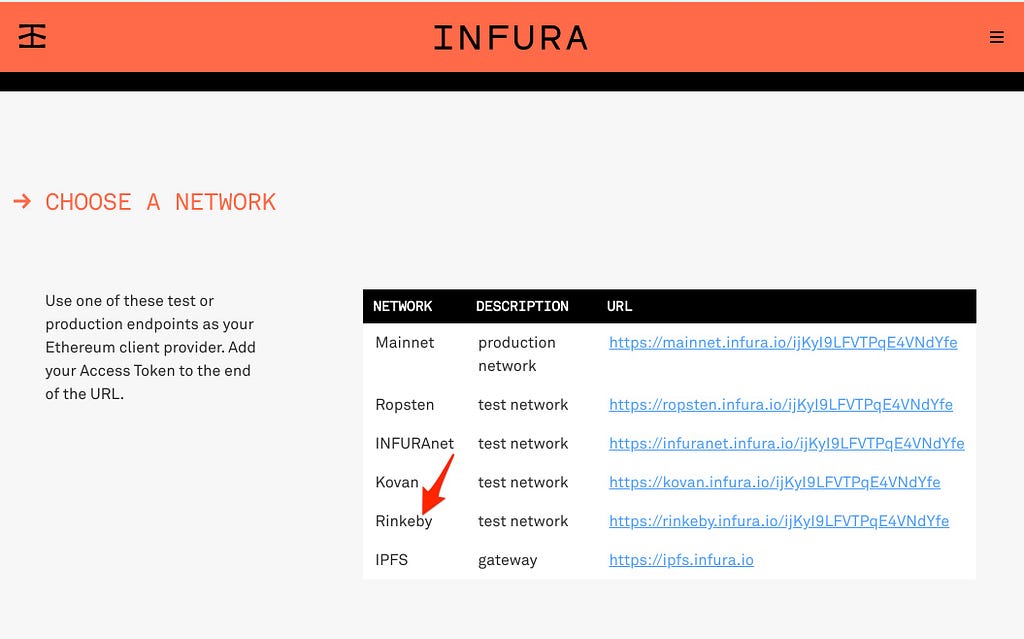
Then copy the Rinkeby test network url which can be used as accessToken when creating a wallet provider.
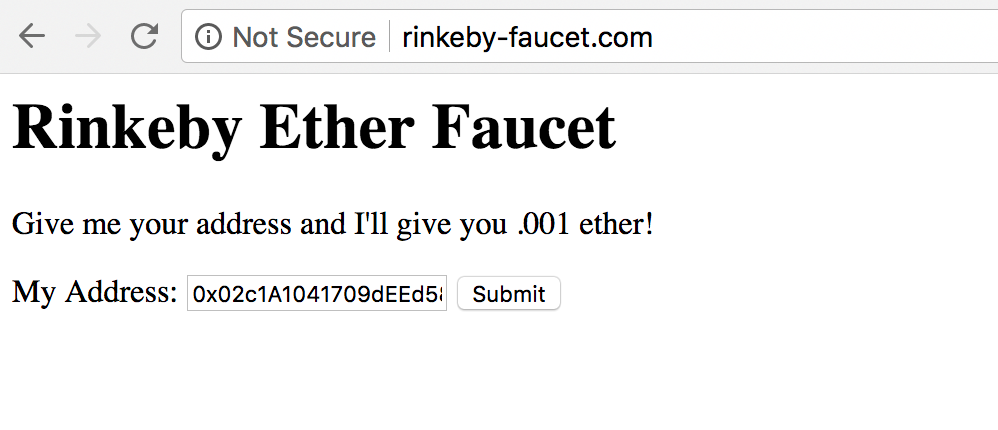
To get free Rinkeby ether, open up a new browser window, navigate to , enter the ethereum addrees (copy it from Metamask)on “My Address” text box, and then click Submit button. We need to have some amount of ether balance in the account to deploy the contract.
Create a deploy.js file under SmartContracts directory and paste the below code inside the file.
The above code creates a web3 instance with HDWAlletProvider using mnemonic and Infura API access token to connect outside network, and deploy exhibition contract on it using ABI and bytecode.
Run the below command from SmartContract directory to deploy exhibition contract.
node deploy.js
It takes some time for deployment. Once deployed, the address (where contract is deployed) is displayed on the terminal as below.

Note down this address which will be used to create contract instance from Angular 5 application.
In part 2 we will see how to interact with deployed exhibition contract from Angular 5 application.
You can find all the source code in the below repository.
How Matrix AI Network is carving out new business models and saving the planet all at the same time
I’ve been in crypto for quite a while now and seen lots of projects take off and many fade away. For any of you that have read my other articles, there is no hiding my interest in Matrix. That’s mostly because the more I research Matrix the more hidden gems I find. The diamond I’m going to focus on is Matrix’s hardware and mining ambitions.
One of the reasons I love Matrix is that breaks a lot of the blockchain norms. Using AI to replace a lot of the conventional and standard blockchain models has been their hallmark. Their hardware and mining ambitions are no different and no less significant.
Traditional mining models use cryptographic hash functions to do what is commonly referred to as “roll of the dice” calculations. The calculations themselves are fairly simple, but use a lot of energy. Proof of Work (think bitcoin) models are commonly referenced as being environmentally wasteful for these simple calculations.
Matrix went a different route from a standard hash model and built an MCMC (Markov Chain) engine. MCMC is a more modern day statistical model with many possible applications. While MCMC is computationally heavy, it is much more powerful than standard hash functions. Given that MCMC isn’t very friendly to standard CPU and GPU systems Matrix is building their own chips and algorithms for hyper fast calculations.
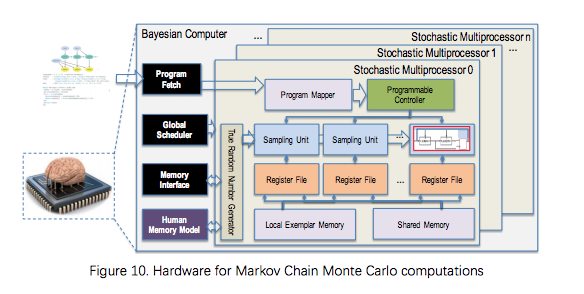
In reading over the white paper and some articles it gets extremely technical, but the general concept is that Matrix is building stochastic multiprocessors to support their MCMC model. In essence this will allow Matrix to calculate both mining and purposeful statistics on a grand scale.
At some point, Matrix is planning to do a second ICO to support the hardware portion of their business. It’s immensely costly and labor intensive to build a hardware business, but this is also yet another reason why Matrix is different from its competitors and another way they can pull away from the competition. The best part from this investment is that rich business models should be realized from this. Steve mentions this in his video with Boxmining (seen below).
Typical mining equipment is “dumb” and performs a single task. MCMC is different as it will have the ability to calculate complex probability, statistical, and AI computations. This is where the new business models come into place and also where purposeful mining is exposed. By combining friendly (low energy) and purposeful (multi-use) mining Matrix will be able to better support their own platform and open up the environment for shared computational power.
Golem, another big crypto name, is building a wide scale and distributed super computer platform. Academics, businesses, and common folk will all be able to use their platform for shared computing power. Matrix’s model is to allow others to calculate probabilities (think finance, predictive analytics), statistics (think finance, healthcare, academics), and AI (think broadly).
While it’s early stages, Matrix already has a working prototype for their Bayesian interface. They also have their algorithms on github.
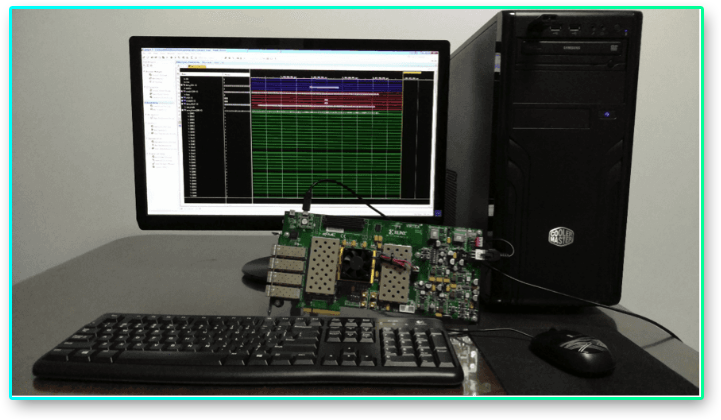
While all the energy is on completing the project first it’s easy to see that once this is created many novel and viable business opportunities could surface. Some of the ideas are rentable computational power, licensing the chip for new calculation engines, collaborative relationships with industry heavyweights like AMD and nVidia. Gamers have long complained that miners are buying up all of the GPUs and making them difficult to find — wouldn’t it be an interesting addition to GPU card makers to have Matrix’s chips embedded within their workhorse mining cards?
While a lot of Matrix’s attention is on the AI and blockchain side, one must look at the team that Matrix is building to understand how important their hardware business is to them and how many connections they already have. As if Steve already hadn’t already achieved rock star status, he is also listed on Nvidia’s website as a professor associate to them. (). In addition, take a look at Tim Shi their Chief Chip Scientist. He was the Principal System Architect at AMD and senior chip designer at Samsung. I must admit — when I read about Matrix’s team, I find myself feeling very inadequate.

I could delve into all of the white papers the team has written like real-time ray tracing, energy-efficient automatic train driving, innovative hand gesture recognition for smart cities, but there is so much depth that this would have to be a three part article.
As a parting shot and an ‘oh by the way’ moment, Matrix has a prototype of their own digital asset safe deposit box. Though I have little information on this and what I do have is highly technical it appears to be a Ledger style device with “hot and cold end separation, private key disconnection, proactive test confirmation before trading to prevent wrong address insertion, active sniffing and protection of trade loopholes and the support of mainstream blockchain digital assets” — whew, I hope you got something from that…
Suffice to say that, for good reason, most of the attention towards Matrix is on their AI, adaptive blockchain, and partnerships but we shouldn’t forget that the weight of their team is focused and well equipped on the hardware front.
There is a most excellent interview that Boxmining did with Steve Deng where they talk about the details of the hardware, algorithms, and MCMC. It can get a bit technical, but if you’re so inclined it’s WELL worth the watch:

I continue to be amazed at Matrix’s breath and just how many sandboxes they play in. Normally I would argue that focus is better, but Matrix has a very clear vision on where they want to go and certainly the team to pull it off. I intend to sit back and enjoy the ride because what a wild one it should be.
Really? Again? No payment, just a continued passion for, in my opinion, the #1 crypto to own.
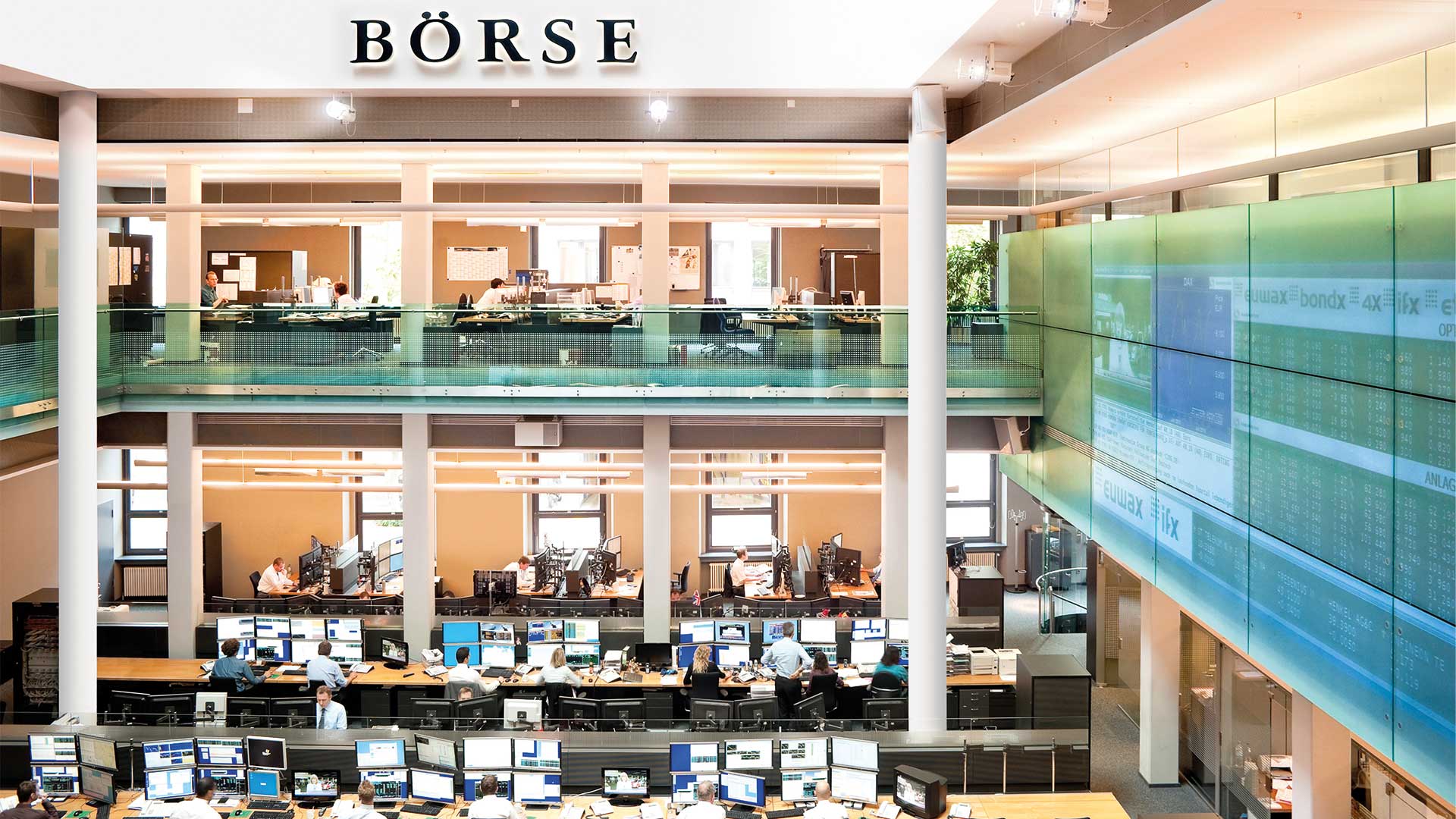
Börse Stuttgart, second leading stock exchange in Germany, has declared that plans are set in motion for a crypto-exchange application to be launched that functions under the no-trading fee idea. The name of the app will be Bison and will be handling large cryptos like [ETH], bitcoin [BTC], [LTC] and [XRP].
The name and details were released by a subsidiary company of Börse Stuttgart and creator of Bison – Swoba Labs on Friday April 13. As various other cryptocurrency exchange-platforms did in the past, firstly it will feature the above mentioned coins and afterwards more are to be added. It is set to be available first in Germany and then with updates the English language will be :
“Bison makes trading in digital currencies easy. It is the first crypto app in the world to have a traditional stock exchange behind it.” – Managing Director of Swoba Labs Ulli Spankowski.
The firm made the decision to develop an app that is very user-friendly while giving the opportunity to individuals to trade and invest the digital currency assets from their phones.
“With Bison, also registering and providing proof of identity is less complicated,” said Mr Spankowski. “This is exactly what Bison is optimized to provide.”
The application will offer a “Cryptoradar” service that will use artificial intelligence to provide the users with the most important news in social media. The main intention with this functionality is keep the users informed about the latest developments in the crypto space, and know which currencies are being discussed the most.
The much welcomed feature by the community is that the app will not charge any trading fees, which will make the application reach competitive levels on instant in the market. On the same path, does not take fees from users which is why many cryptocurrency exchanges are lowering fees and reducing their withdrawals so they can keep up on the show.
The post appeared first on .