May 18, 2026

Capitalizations Index – B ∞/21M

Christine Lagarde: The Slowdown Of The Chinese Economy

Christine lagarde: the slowdown of the chinese economy

Christine Lagarde: The Slowdown Of The Chinese Economy

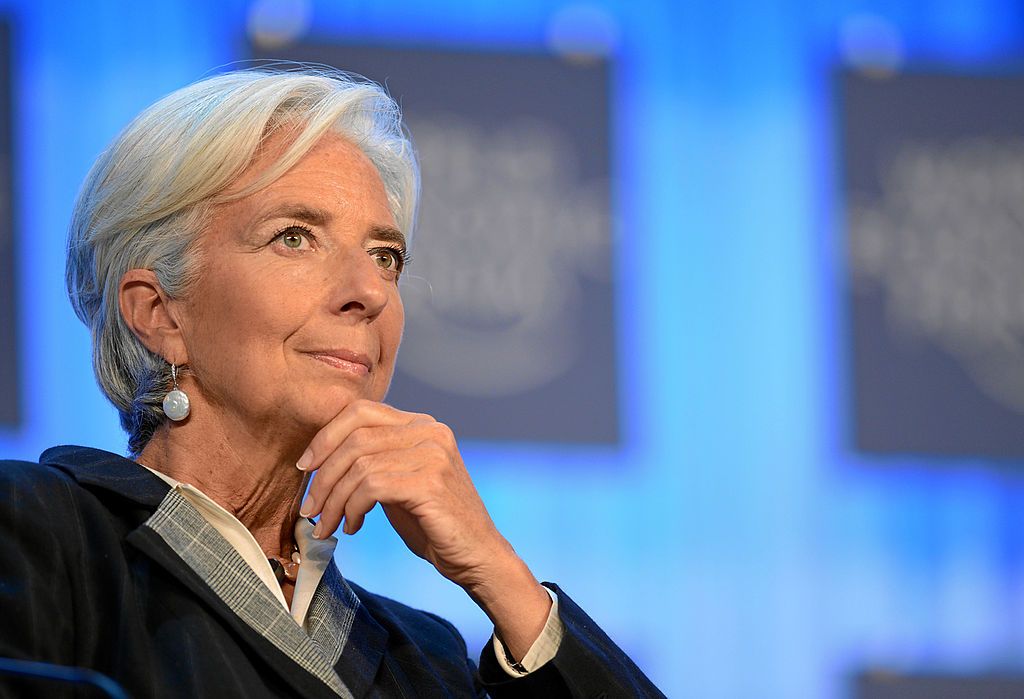
Cross-border capital flows have fallen 65% since the financial crisis, while new production and finance technologies are transforming the landscape for growth and investment. Christine Lagarde discusses the slowdown of the Chinese economy.

Slowdown of the chinese economy
By World Economic Forum from Cologny, Switzerland [CC BY-SA 2.0], via Wikimedia Commons

Christine Lagarde: The Slowdown Of The Chinese Economy

Get The Full Warren Buffett Series in PDF

Get the entire 10-part series on Warren Buffett in PDF. Save it to your desktop, read it on your tablet, or email to your colleagues

Q4 hedge fund letters, conference, scoops etc

Transcript

First of all thank you very much for summarizing the views that were taking at this at this moment. I would like to qualify a teeny tiny bit what you said. We did revise modestly the forecast for 2019. It’s only a point two percent revision. So it’s modest. What we are essentially saying is number one it is coming from the advanced economies. So we don’t have a synchronized movement as we had observed before. There is a synchronicity in the making. And second we are. We have revised downwards modestly because we are seeing those risks that we had identified pretty far along the horizon which prompted me to say sun is still shining. Fix the roof please. Have resilient economies. But we are seeing those clouds coming much closer. And if I may I’d like to just identify two of those one which I think is particularly relevant. And yet it is not affecting the two major players in that risk. And I mean by that U.S. and China and clearly what we see as the major risk at the moment is the development of tensions notably in trade but not only in trade unfortunately and I think between these two the two largest economies on the planet. And we have not revised down our forecast for these two because theU.S. still has the benefit of the stimulus package that it had launched about a year ago. The corporate tax reform that it took a year ago and on the other hand China has taken some modest success and stimulus measures that have helped it sustain a growth that as you said European finance ministers would not be surprised about but would dream off. And I was one of them so that’s true. So those those are the this is the major risks that we are seeing that could precipitate even more market recognition of what has finally been recognised at the end of 2018. Number one. Number two it could if it was aggravated and accelerated Euro precipitate a slower slowdown of the Chinese economy. But by that I mean that the Chinese economy is slowing down is fine. It’s legitimate it’s right and I think it’s very much designed to be under control by the Chinese authorities that the slowdown the excessively fast would constitute a real issue both domestically and probably on a more systemic basis.

Those are the two points that I want to thank you Minister cookies. So for us of course as a as an economy that is very exposed to the global cycles through our integration in the global value chain and the supply chain. Obviously the question of Trade’s functioning smoothly is a predominant issue and if you look at our numbers the vast majority of the growth slowdown has been driven by a one off issues which are weather related and related to to some elements of the new rules around the automotive industry. But of course the overriding concern to us is the is on the one side the exposure to slowdown in growth to the global economy but also the less smooth functioning of world trade be it through the threat of increased tariffs be it through all of the potential disruptions that we’re facing related to Brexit and its effects on the supply chain. So those are the things that we are very worried about and are looking at most carefully. On the other side of course the question is how do we deal with these issues and for us the key element there is sending signals of increased unity. For us of course predominantly in the EU and we’ve achieved some progress in that sense with some implementations of the global financial reforms. With respect to your questions on strengthening the robustness of the banking system in December Europe agreed on quite far reaching implementations and deepening of the European Monetary Union. But of course we need to go much much further than that because the European market as opposed to the Chinese and U.S. financial markets is still very fragmented and a lot still needs to be done both on the risk sharing within the banking union the capital markets union and the fiscal cooperation.

Since you’ve taken me down this path and I hate to interrupt the flow but why doesn’t Europe yet have a targeted fiscal instrument for supporting individual countries in the eurozone that may be suffering fiscal.

The post Christine Lagarde: The Slowdown Of The Chinese Economy appeared first on ValueWalk.

Published at Fri, 25 Jan 2019 23:39:31 +0000

Previous Article

Bitcoin continuing to fall as I knew it would!!!!

Next Article

JP Morgan: Crypto Value Unproven, Bitcoin [BTC] (BTC) Could Fall as Low as $1,260 in Near Future

You might be interested in …

Investors Hoping to Make a Killing off of Bitcoin May Not Get Rich After All

The value of bitcoin continues to dominate the headlines as prices climb ever higher. This has attracted even more investors to venture into bitcoin mining, looking to make a killing off the digital currency.


If you’re thinking about getting rich by mining bitcoin, though, think again. Much like panning for gold in the Yukon River was a waste of time for more than 100,000 prospectors looking to find their fortunes during the Klondike Gold Rush of the 1890s, so too is mining for the popular cryptocurrency.

In simplest terms, in order to mine bitcoin, computers running special mining software mine ‘blocks’ that reward them with bitcoin. bitcoin Wiki explains:

Each block contains, among other things, a record of some or all recent transactions, and a reference to the block that came immediately before it. It also contains an answer to a difficult-to-solve mathematical puzzle – the answer to which is unique to each block. New blocks cannot be submitted to the network without the correct answer – the process of “mining” is essentially the process of competing to be the next to find the answer that “solves” the current block. The mathematical problem in each block is extremely difficult to solve, but once a valid solution is found, it is very easy for the rest of the network to confirm that the solution is correct. There are multiple valid solutions for any given block – only one of the solutions needs to be found for the block to be solved.

Sounds easy, right? Wrong. The difficulty to mine each block and the power required to do so have increased to such an extent that only those who have invested enough in mining rigs and computing power have any real chance to mine enough bitcoins to be considered ‘rich’. The rest are lucky to break even, and most end up spending more in equipment and electricity costs than they ever actually earn.

Bitcoin mining

Should Investors Be Worried About the Turn of Events?

With more and more people joining the mining community, two questions still linger – one, should you be worried about the abrupt turn of events? Two, will bitcoin mining be remembered in history as just an investment that got only a few people rich?

The tremendous increase in the price of bitcoin in the last year or so has seen many speculators sucked in, with many of them being ordinary investors without much know-how about bitcoin mining. It is also likely that more have been drawn in because of news from mainstream financial exchanges announcing that they plan to make bitcoin a tradable asset by offering Bitcoin futures and derivatives.

Satoshi Nakamoto’s original idea behind the digital currency was that it would become purely a store of value, just like gold. But over time it has come to be viewed by many as a replacement of currencies like the pound, euro, and dollar – one that is fully decentralized therefore incapable of being altered or controlled by any central bank. This has led to many people in the banking industry to consider bitcoin as a big fraud, with big names such as Lloyd Blankfein of Goldman Sachs and Jamie Dimon of JP Morgan describing it as a bubble that would eventually pop.

The Bank of England’s deputy Governor Sir Jon Cunliffe also added his view, saying that bitcoin is just a sideshow and that it is not big enough to pose a threat to the larger global economy. He has also cautioned investors, asking them to first “do their homework” before they put in money into it.

bitcoin is enjoying a free ride, as of now, but with regulators getting closer to regulating this freshly minted industry, it is not certain what the future holds. Investors feel that they have done their homework well, while regulators, on the other hand, feel that they have more work yet to do.

Do you bitcoin a worthy investment now that mainstream financial exchanges are considering it as a tradable asset or a risky one considering regulators are likely to move in soon? Let us know in the comments below.


Images courtesy of AdobeStock

The post Investors Hoping to Make a Killing off of Bitcoin May Not Get Rich After All appeared first on Bitcoinist.com.

BTC PITCHFORK CHANNEL

BTC PITCHFORK CHANNEL [unable to retrieve full-text content] Will the bitcoin keep itself wihin the PITCHFORK channel? We have a clear breakout from the falling wedge, confirmed by the weekly RSI – cross above 40 […]