June 11, 2026

Capitalizations Index – B ∞/21M

China’s Resurgent Stock Market is Seeing Profits Flow Into Bitcoin

China’s resurgent stock market is seeing profits flow into bitcoin

China’s Resurgent Stock Market is Seeing Profits Flow Into Bitcoin

China is returning to bitcoin investment despite its ongoing trading ban, data suggests this week as the bitcoin price holds higher.


Yuan No.2 Entry Fiat Currency

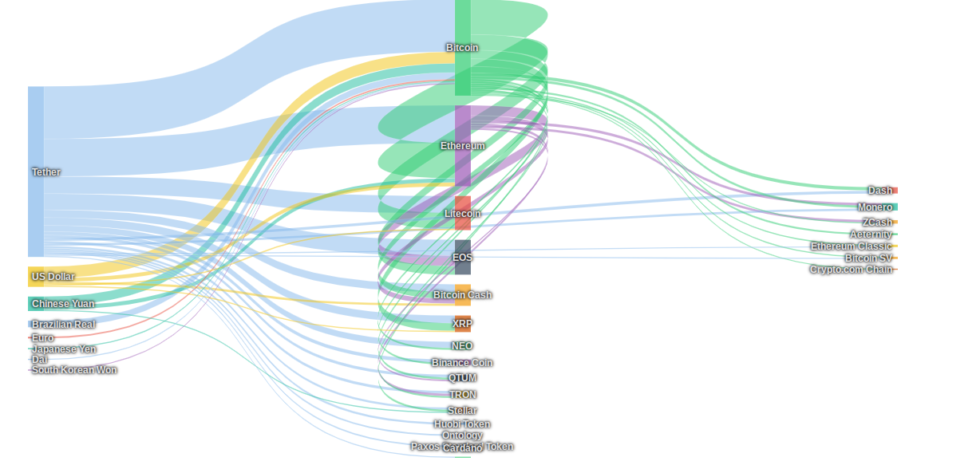
Statistics gathered by monitoring resource Coinlib showing capital inflow into bitcoin and other cryptocurrencies puts the Chinese yuan (CNY) in the top entry currencies.

For the 24 hours to press time, CNY inflows into bitcoin topped the equivalent of $165 million, with Ether, the largest altcoin, seeing just under $75 million during the same period.

That performance puts China second out of the fiat entry assets, predictably behind the US dollar, while by far the largest inflows come from cryptocurrency stablecoin Tether.
China’s resurgent stock market is seeing profits flow into bitcoin

Crawling Out Of The Pit?

The figures come at a time when China’s bitcoin-focused economy – specifically mining giants – appear to be emerging from six months’ retraction.

As Bitcoinist reported, entities such as Bitmain had announced major downsizing and cost-cutting initiatives on the back of the bitcoin price 00 falling from $6500 to $3100 last November.

More recently, however, the industry has begun putting out good news. Canaan Creative, Bitmain’s major competitor, closed a funding round earlier this month which sources claim is worth “hundreds of millions” of dollars.

Now, the added strength of bitcoin (BTC), which continues to trade around $4000, could signal renewed faith from what was once its biggest investment market.

The cues lie not just in mining: FatBTC, the largest cryptocurrency-only exchange serving Chinese clients, increased its volumes by more than 50 percent over the past day alone.

Nonetheless, Chinese lawmakers have given no hint that they intend to revisit a decision from 2017 to outlaw all legal trading options for local residents. Favoring blockchain technology, only the practice of cryptocurrency holding remains de facto legal.

This month, research from The Next Web revealed China as the country holding the largest number of blockchain patents with awards totalling nearly 800.

What do you think about China’s bitcoin investment stats? Let us know in the comments below!


Images courtesy of Shutterstock

Published at Mon, 18 Mar 2019 09:00:46 +0000

Previous Article

Citi Scraps Its Plan for a JPM Coin-Like Bank-Backed Cryptocurrency

Next Article

Market Update and Ripple XRP Price Analysis: March 18, 2019

You might be interested in …

Big up - eleva [youtube music sessions]

Big Up – Eleva [Youtube Music Sessions]

Big Up – Eleva [Youtube Music Sessions] Versão ao vivo o de “Eleva” no YouTube Music Sessions. FICHA TECNICA: Produção: ForMusic/LaMotta Filmes. Co-produção: BOA Eventos Direção: Guilherme Paganini LaMotta Direção de fotografia: Filipe Ferreira e […]

Does Regulation Slow Down or Accelerate Adoption?

Recently, many countries and cities have published new laws and legislations to regulate bitcoin. Does this help contribute to mainstream adoption, or is it merely a hindrance to it?


Regulation Slowing Adoption

New York was the first state in the USA to tighten regulation on bitcoin and other virtual currencies, via its BitLicense. This is issued by the New York State Department of Financial Services, and it regulates businesses which work with virtual currency.

The implementation of this law caused some bitcoin companies to cease operations in the state, while some others decided to go through the regulatory process to operate legally. However, to date, only 3 BitLicenses have been granted. Circle, Ripple and Coinbase are the only companies with the right to operate, and they must collect information on New York residents and report it back to the NYSDFS.

Other companies, like BitFinex and Kraken, decided to cease operations in the area and ban New York residents from using their services. They deemed the BitLicense to be too complicated to work with, and simply moving out of the area was the simplest option.

In other countries like China, regulation has been a bit harsher. Major exchanges were forced to introduce fees, freeze withdrawals and disable margin trading to comply with new regulation from the People’s Bank of China. Zhou Xuedong, director of the PBoC’s Business Administration unit, stated:

“There is a significant risk, one is the risk of customer funds security, the second is the risk of money laundering, the third is the risk of leveraged transactions.”

Ways Around Regulation

However, the bitcoin community has developed solutions to avoid regulation. Decentralized, peer-to-peer marketplaces exist, where users can spend and obtain bitcoins without adhering to any official regulation since the platform isn’t run by a third party.

BitSquare is a decentralized bitcoin exchange, where users can buy and sell bitcoins without proving their identity. OpenBazaar employs a similar concept and allows users to set up stores to sell their products.

There are also other platforms that aim to promote decentralisation. For example, Blockonomics.co provides a free, detailed bitcoin invoice services for freelancers and businesses, as an alternative to Coinbase or BitPay. This means that again, users can enjoy the same services without having to go through long verification processes.

Regulation Fueling Adoption

Contrary to popular belief, regulation doesn’t necessarily have to slow down adoption. In some cases, regulation could help bring cryptocurrency technology to the masses; an excellent example of this is Humaniq.

Humaniq is a new platform which aims to bring mobile banking services to those who reside in emerging economies. The platform is powered by blockchain technology, but they aim to be compliant with KYC/AML laws in the countries they will operate in.

However, users no longer have to go through a complicated verification process. Instead, the users’ identity can be verified by simply having them take a photo of themselves or by reading a short piece of text.

Africa mobile

This could mean a significant step forward for blockchain technology. Users would be able to access all of its advantages without too much trouble, which is very important for those who live in emerging economies.

Nonetheless, any person can use Humaniq; their ICO (Initial Coin Offering) begins today, April 6th, which is a great chance to contribute to the project if you haven’t yet already done so.

[Disclaimer: This is a sponsored article. Publication does not constitute an endorsement and should not be considered as investment advice. Bitcoinist is not responsible for any outcome that may result from investing in this ICO.] 

Do you think that cryptocurrency businesses should be regulated? If so, why? Let us know your thoughts below!


Images courtesy of Blockonomics.co, BitSquare, Humaniq, NewsBTC, CoinFox and The Houston Free Thinkers.

The post Does Regulation Slow Down or Accelerate Adoption? appeared first on Bitcoinist.com.