Controversial stablecoin is in the spotlight again after changes to the details of the way in which it backs up in supply.
As reported on , various online users noted and posted disconcerting changes to the , which have seemingly altered the way that the company is providing surety for the it issues.
Tether is a stablecoin backed up by the United States dollar at a 1:1 ratio, meaning the company has $1 for every USDT that is in circulation. This has long been a point of contention by the wider community due to the fact that Tether has never carried out a third-party audit of its financial accounts.
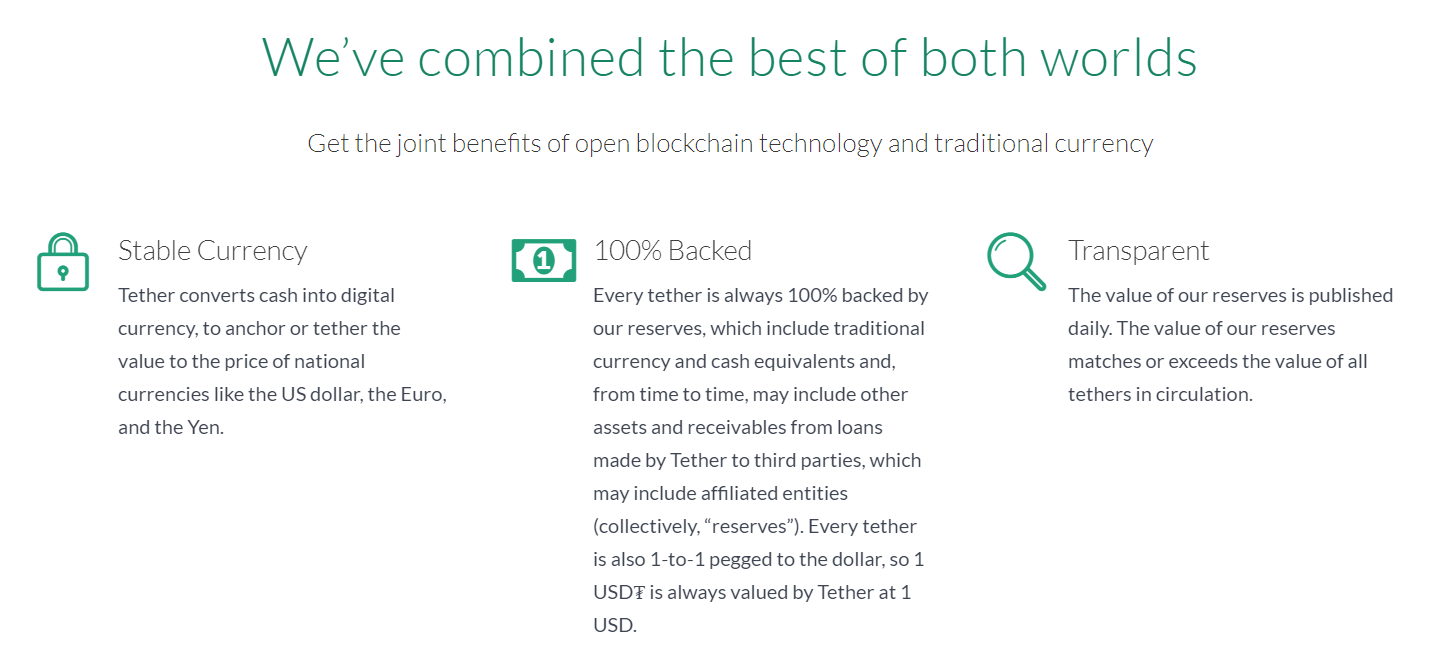
While the exact date of the change is not known, Tether’s website has seemingly adjusted the details of how it ensures a reserve for circulating , with the “100% Backed” statement no longer claiming that every USDT is backed by fiat currency:
“Every tether is always 100% backed by our reserves, which include traditional currency and cash equivalents and, from time to time, may include other assets and receivables from loans made by Tether to third parties, which may include affiliated entities.”
It is the latest twist in Tether’s chequered history, which Cointelegraph has .
Debatable assurances of reserves
The company’s latest attestation of its financial accounts is a from law firm Freeh, Sporkin & Sullivan LLP, which provided confirmation of Tether’s currency reserves in 2018.
A number of clauses near the end of the document make the assurances unsubstantial.
Firstly, Freeh, Sporkin & Sullivan is not an accounting firm, and did not make the confirmations using generally accepted accounting principles. The document also makes it clear that the confirmation should not be construed as the result of an official audit.
The findings are also only seen as being valid as of June 2018, meaning the company still has not provided third-party assurance of reserves for circulating currency for over nine months.
Tether also had to carry out a search for another banking service provider following its split with Puerto Rico-based . The company with Bahamas-based Deltec Bank in November.
Following this, a report from Bloomberg in claimed that the company did indeed have the necessary cash reserves in its new bank accounts.
All the while during this period, USDT its 1:1 peg with the US dollar, as its value dipped below the $1 mark. This set off waves of fresh controversy, as the struggled to retain its stablecoin status.
It is worth noting that Tether is not the only stablecoin that has struggled to maintain its 1:1 peg to the U.S. dollar.
The Dai () stablecoin, which is also backed by the US dollar, has dipped below the $1 mark on various exchanges, prompting a hike in fees in order to maintain its peg.
Industry experts raise concerns of fractional reserve
With the community raising the alarm bells around Tether’s change in reserve policy, industry experts have also joined in and given their take on the situation.
, a renowned investor and analyst, provided some , unpacking what he described as a slippery slope to Tether operating a:
“Slippery language by Tether. “100% backed” <=> “may also include receivables from loans issued”. Imo this is a clear transition from full to fractional reserve banking.”
“Note how Tether’s comment that their reserves “may also include other assets” opens the door to backing by virtually anything, with fuzzy valuation assumptions. Would be helpful to at least see more details from the contractual fineprint.”
Replying to questions from Cointelegraph, Demeester said in an email the main concern was how Tether would be investing some its reserves and the liquidity of those assets in order to satisfy the potential redemption of a large amount of at any given time:
“I can only speculate, but based on USDT currently almost at par with USD, I would venture a guess that at this moment Tether does have adequate cash reserves to survive a “run on the bank.” My concern is mainly about the precedent that this change in the terms is setting: it opens the door to potentially start investing Tether’s reserve in assets that are illiquid or hard to value.”
XDex analyst and crypto-podcast host Fernando Ulrich also weighed in on the controversial changes to Tether’s website. In a lengthy , Ulrich unpacked his views on fractional reserve banking and how Tether’s operations should be cause for concern.
Writing directly to Cointelegraph, Ulrich’s focus was not on whether Tether has the necessary reserves for circulating USDT, but the quality and nature of these reserves:
“I do believe Tether has 100% of reserves for issued . But again, that’s not the problem, the problem is the quality of these reserves. Are they made of 50% Treasury-Bills, 30% bank certificate of deposits, and 20% receivables? Or is it 99% Treasury-Bills? We don’t know, and therein lies the problem. It’s the quality of reserves, not the quantity.”
Another point of concern raised over the past two years is Tether’s connection to exchange Bitfinex. The companies share the some of the same leadership, including CEO ,
There have been allegations that over the past few years effectively on credit. Ulrich believes this could have serious ramifications for the market, if people are using USDT to buy other .
“I do find it concerning, especially because the possibility of issuing on credit results in liquidity that can affect prices in the short-term. Furthermore, it may put Tether in an illiquidity situation, possibly causing a run on its reserves. Given that their main exchanges (by average daily volume) rely on USDT for its /USD pair, it can surely affect these markets. The whole thing may cause turbulence for the crypto markets in the short-term.”
Bitfinex went as far as against various social media commentators in December 2017 that were speculating about the relationship between these two companies.
Tether refutes claims
Tether’s general counsel Stuart Hoegner responded to Cointelegraph’s request for comment on a number of issued raised by various members of the wider community.
First, Hoegner stated that Tether’s reserve includes cash, cash equivalents, and other assets – while maintaining that these reserves are equal to or greater than the amount of USDT in circulation.
Hoegner declined to elaborate on the type of assets that the company would be using as reserves, but said the decision to change its reserve policy was a result of the changing stablecoin landscape:
“We generally do not comment on the specific composition of our reserves, but this change in optionality reflects the growth of Tether and the growth of the stablecoin industry — and attendant, non-demand account options — more generally.”
When asked to comment on claims that Tether does not have reserves equal to the amount of USDT in circulation, Hoegner asserted that the company did have necessary reserves and was openly transparent about its holding on its website:
“Tethers remain completely stable and 100% backed, so Tether’s reserves always equal or exceed the number of issued Tethers. Moreover, our reserves are posted in real time on Tether.to.”
He was also asked if and when Tether would carry out a third-party audit of its accounts. Hoegner said Tether’s website provided a transparent account of its reserves – which it deems adequate.
“Tether operates as transparently as possible. We publish the value of our reserves daily, and provide 24/7 access to our bank balance and value of reserves.”
Critics’ claims that Tether is also operating a fractional reserve system was also refuted by the company. Hoegner stated that Tether does not have a banking business lending reserve amounts to retail .
“Tether’s reserves remain, and have always been, 100% backed by its reserves. Tether maintains the ability to honour all redemption requests.”
In his replies to Cointelegraph, Xdex’s Ulrich said that these claims by Tether cannot truly be trusted until an official third party audit is carried out:
“There’s no way to confirm it without an audited financial statement from a reputable firm. We can only speculate. What I can say is that the updated terms of service opens the possibility for that to happen. From now onwards, Tether can issue on credit and the “outstanding receivable” may serve as reserves for issued . Furthermore, it isn’t clear the extent to which such reserves can be used. Would it be possible to have 10% of reserves as receivables? 50%? 90%? What about the maturity of receivables? Only up to 30 days or even longer? The terms of service don’t make it clear. So my guess everything is possible, and that should be a cause of concern for holders of USDT.”
Ulrich also brings up an interesting point regarding the major holders of USDT and what situations could test the liquidity of Tether and its reserves.
A potential acid test would require a large amount of USDT holders to ask for redemption of their , which would force Tether to prove its liquidity.
According to Tether’s Rich List on , holds over $732 million in USDT and Huobi holds $264 million – accounting for half of all USDT in circulation. Ulrich says these relationships pose some interesting questions:
“Would they want to force Tether into illiquidity by redeeming ? Have they bought USDTs on credit as well? How much do they owe (if at all) to Tether? It’s an intricate relationship lacking transparency.”
As Demeester points out, any holder of USDT would do well to pose some serious questions to the company about its accounts and how it intends to invest in certain assets classed as reserves:
“If I had interest in buying or holding USDT, I would want to know in more detail how the exactly the reserves are invested.”
Tether trudges onward
Despite the fresh controversy surrounding Tether, the company is forging ahead with efforts to increase the availability of Tether to more players in the space.
At the beginning of March, Tether to partner up with protocol (), which would see USDT being issued on the later this year.
USDT will be issued as an TRC-20 and will be compatible with -based decentralized applications. This will allow USDT to be used for transactions on the .
Published at Sun, 24 Mar 2019 20:00:36 +0000