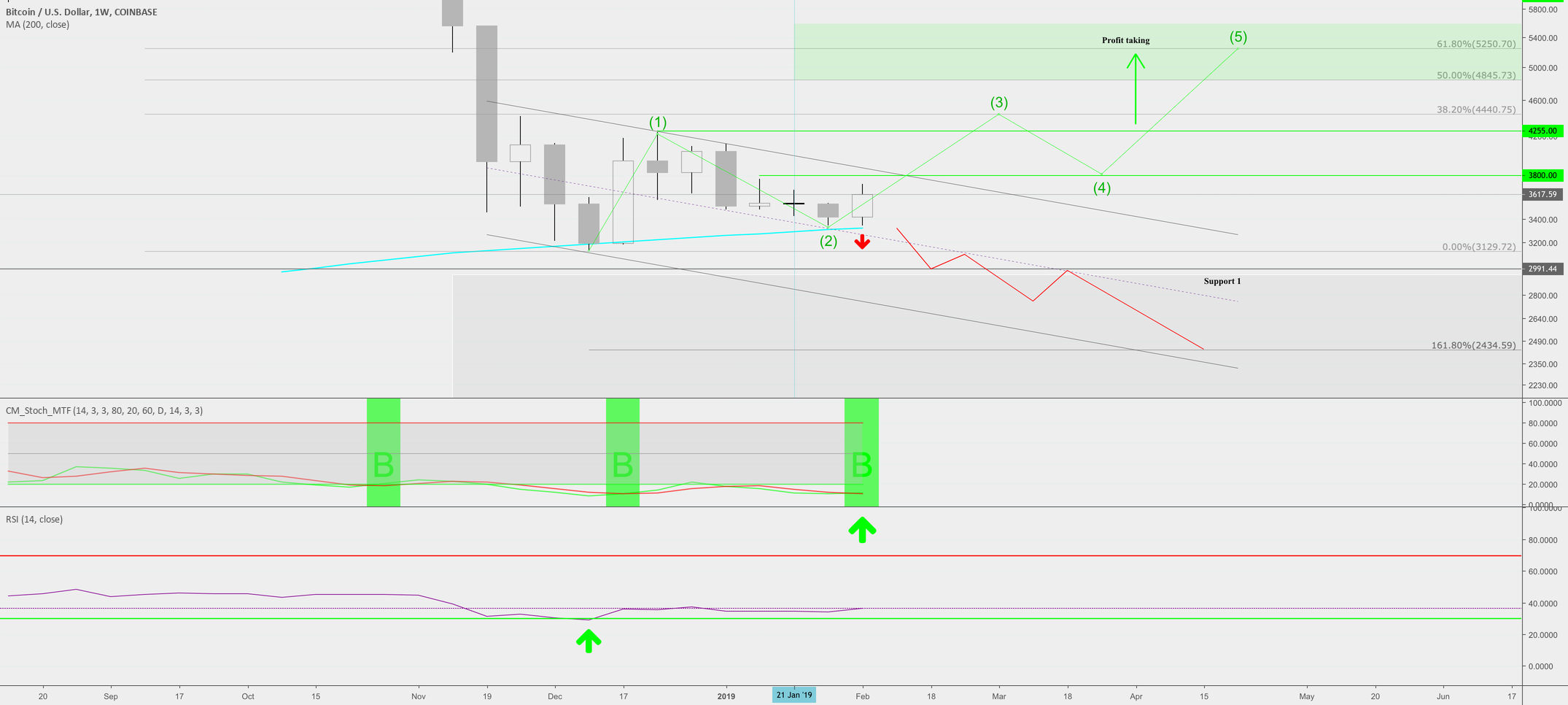
BTC Weekly: Litecoin has passed the baton BTC Bulls!
Chart should be uber clear to understand. I really feel the market is nearing a point where bulls need to step up and continue the positive trend next week or we risk making this another dead cat bounce. If prices get squeezed again in sideways trading coupled with low it will not be good for us bulls. The infamous 200 Week MA is not far away and bears would love to break through this level like they did with $6,000 back in December.
If you are:
Bullish bias: Need to break through $3,800, $4,255 and then 38.2% Fib extension to get to the profit taking area in the coming weeks. OR Bearish bias: Simple – break through the 200 Week MA (blue ) and you WIN! We’ll grind our way down to $2,400-$2,600 price area.
Stochastic: Printed a buy signal on current weekly candle. %K rolled over the signal line and confirms higher low on 2nd wave is gaining positive momentum overall. We need to continue printing these higher lows on Wave 4. RSI: Dec 10th was historically most oversold weekly candle in history. Has slowly (very slowly) been trending up. But remains in bear territory.
Summary: Bulls have everything they need to turn this market around printing a lower high on the Wave 2 impulse wave. However, Bulls really need to step it up over the next couple of weeks and continue printing higher candles and breaking through the key resistance levels I have stated. If you bought with me around that $3,500 there is nothing for us to do but be patient. Ideally we want to see next week’s candle continue the positive momentum. I’m still bias until breaks through the $4,255 level.
Continue having a great weekend and my next follow up reports will be on Monday.
The Importance of Secondary Dai Markets The Dai credit system has been one of the most remarkable developments in the #DeFi ecosystem. As we’ve previously discussed, anyone in the world can now get their hands […]
Bitcoinist has compiled a list of ten VPN providers that will gladly offer you their services for your bitcoin.
Why VPN?
One of the primary reasons for purchasing a service is to keep your online activity private. It is ironic, then, that some still choose to buy their VPN service via a payment method tantamount to a suitcase filled with marked bills and a transponder — which, if you’ve ever seen No Country for Old Men, you’ll know is a very bad idea.
The most commonly used online payment methods, PayPal and credit cards, are among the easiest to trace, funneling out to tax entities, third-party processors, and enormous — as well as enormously connected — financial institutions. As if this weren’t bad enough, PayPal and credit cards also charge steep that drain revenues from VPN providers, making them dependent on income that can, at the whim of the banks and legislation, vanish without a trace — unlike the information they will keep on you.
Looking for privacy along the entire transaction many consumers now opt for anonymous payment methods like bitcoin to purchase VPN services. With bitcoin, as long as you employ the full range of the system’s features — like and aliases — your transactions will not identify you.
Also, since bitcoin is a decentralized payment method, no corporation, government, or financial institution can shut it down. Lastly, bitcoin is fast, cheap, and safe: Its transactions wait on no clearing times, its transaction fees are often far lower than those of a standard credit card, and it provides excellent fraud protection.
Because of this, several prominent VPN providers now accept bitcoin payments (while some no longer accept credit card payments at all). Since the differences between these providers can be a bit nuanced, however, a can help you in figuring out which VPN is the best fit for you.
With more than 1250 servers in over 42 countries, TorGuard ranks highly among the elite VPN providers. It even works in countries where VPN protocols are government-filtered, such as Iran, China, Syria, and the UAE. However, there is no trial software and some consider the website a little confusing to navigate.
Private Internet Access
This VPN service is known for its minimalist efficiency. Ad-blocking, one-click activation, and fast performance are among its highlights, though a few users find its spare design off-putting.
IPVanish VPN
Solid speeds, a straightforward interface, and automatic IP address cycling are a few perks of IPVanish. It is spendier than some other VPNs, however, and though its interface is user-friendly, visually it leaves something to be desired.
Express VPN
Netflix, BitTorrent, and P2P are all accessible with the highly versatile Express VPN. Though international downloads are fast, in general this VPN tends to be on the slower side. Also, like IPVanish, it is expensive.
VPNArea
Registered in Bulgaria, hosted in Switzerland, and operating in 54 countries (including Saudi Arabia, South Africa, and Russia), VPNArea provides unlimited bandwidth and a kill switch system. VPNArea has been accused, however, of poor customer service and slow speeds in the more out-of-the-way countries.
Air VPN
No logs, port forwarding, and a stable connection make Air VPN a favorite among those wishing to protect their anonymity. Among its cons: It does not offer an abundance of server locations, and using the service can sometimes necessitate an advanced knowledge of VPN configuration.
IronSocket
This service is direct and easy to understand, and its users love the ability to download customized open VPN settings. Even so, some reviewers have cited its lack of special features (like a kill switch and DNS leak protection) as deal breakers.
Anonine
This VPN boasts IP shuffling, no restrictions, and a no-logging policy. Even so, its customer service has left a few users feeling less than satisfied.
SaferVPN
With a dedicated Chrome extension for added security, SaferVPN delivers a reliable performance and welcoming interface. On the downside, it does keep logs and requires additional payment to get more connections.
ShadeYou
ShadeYou is simple to use, allows five simultaneous connections, and its Dutch registration source guarantees maximum privacy by law. Some users have criticized small defects in its webpage, though, as well as occasionally slow speeds.
These are 10 good VPN providers that accept bitcoin, there are probably more as there are dozens of VPN companies out there, but these will all do the job for you. If you want to dive into the details of each we do recommend visiting a third party comparison site for real in-depth analysis.
Have you paid for VPN services in bitcoin? Share your experience below!