Dear colleagues and followers,
The Osiris team remains constantly improving predictive and trading algorithms to deliver the best results achievable. We are using the of the recent days as a wonderful opportunity to stress-test our systems and to make them less susceptible to statistical outliers.
Yesterday, we saw a short term upside move above $3,600 and $3,800 in price against the . The BTC/USD pair traded above the $4,000 barrier as well, but it failed to hold gains. The price was rejected near the $4,100 barrier and the 100 hourly . It seems like buyers struggled to gain strength above $4,000, resulting in a reaction. (Source: )
The most notably pro-bitcoin SEC commissioner, Hester Peirce, appeared on the ‘What Did’ podcast at the weekend. Whilst unwilling to describe a future as inevitable, she did confirm it was definitely possible. Peirce first won the hearts of the crypto-community with her ‘statement of dissent’, following yet another denied Winklevoss application. In the statement made in July, she publicly disagreed with the Commission’s view, that was not “ripe enough, respectable enough, or regulated enough to be worthy of our markets.” (Source: )
A Node.js module called event-stream is used in millions of web applications, including BitPay’s open-source wallet — Copay — and this module was reportedly compromised thanks to what can objectively referred to as social engineering, laziness, and incompetence. A user with very little coding activity on GitHub requested publishing rights to the event-stream library from its previous maintainer, Dominic Tarr, who said that he had not maintained the repository in years and gave control to the new user, called right9ctrl. The library event-stream is used in many Node.js applications. According to a complainant on GitHub, the new maintainer right9ctrl either pulled a sneaky move to inject malware or unknowingly had the same effect as if he had, that effect being that it would leak private keys from applications that relied on both the event-stream and copay-dash modules. (Source: )
According to an internal document published on Nov. 23, developers are quietly discussing an upgrade that has the potential to boost the capabilities of the tech more aggressively in the short-term. The document published on Github details four meetings that took place at the end of October at the Devcon4 conference. The minutes refer to the upgrade “ethereum 1x,” that could be possibly updated in June 2019. (Source: )
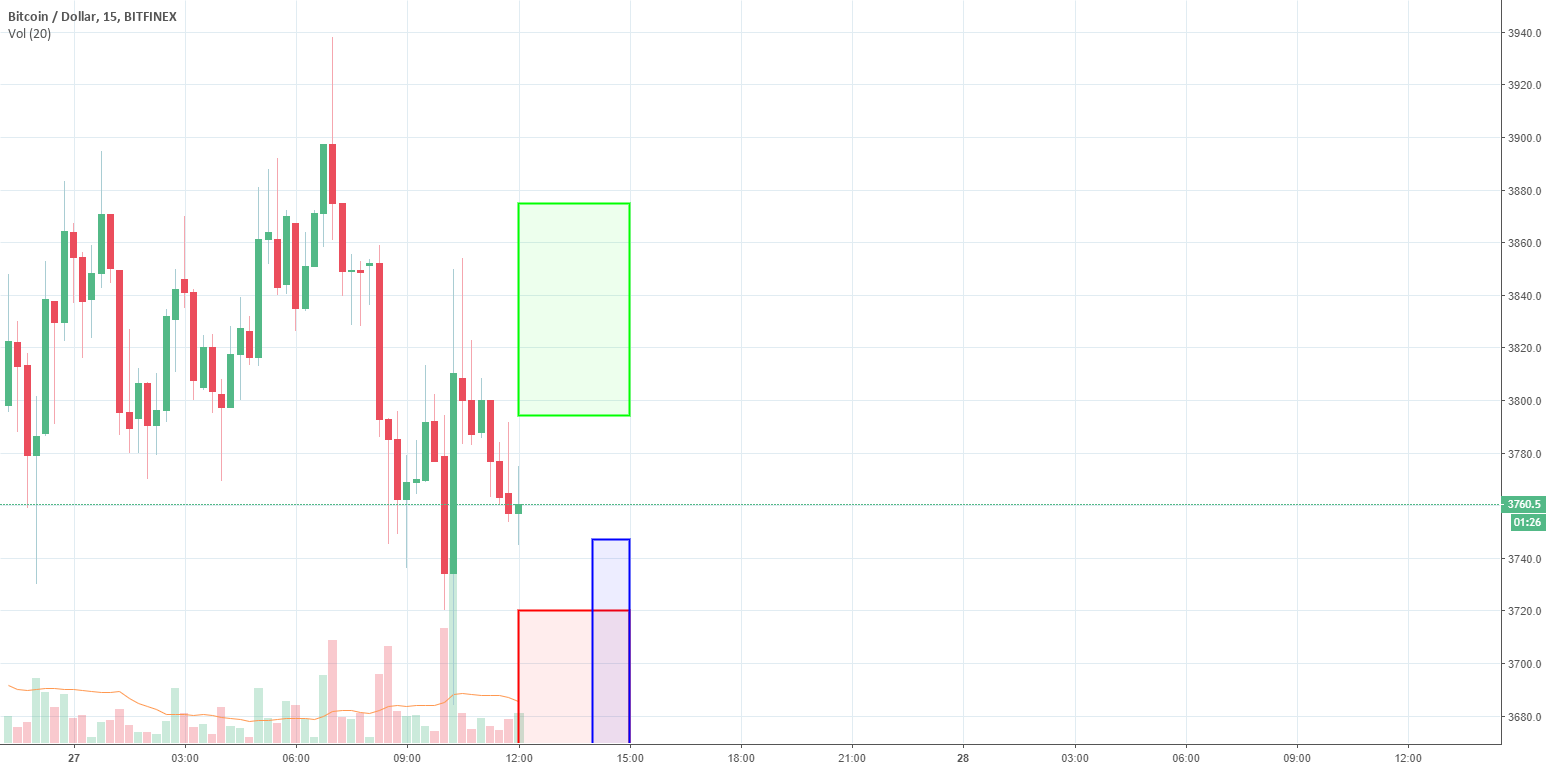
The following is a scheduled notification from the Osiris team. Our models have been working hard and smart on forecasting the market, and here are the most up-to-date predictions for the next 3 hours:
As usual, red, green and blue rectangles demonstrate predicted values of low, high and close, respectively, with corresponding confidence intervals, and the black arrow illustrates our trades.
Pair: BTC/USD
High: 3834.70
Low: 3673.95
Close: 3696.28
During the recent days, the “hash wars” surrounding the Cash hard fork have intensified. As predicted by the Osiris Team, the pool .com representing over 40% of the hash rate post-fork has slowed its mining. Miners supporting the chain have capitalised on this opportunity and, for a brief period of time, have gained the lead in terms of blocks mined and the network hash rate, chain being 32 blocks ahead and controlling 71% of the hash rate for a brief period (Source: ). However, this advantage was short-lived, as the chain has quickly caught up almost immediately. As for now, the chain is leading once again, with an outstanding 55 block-advantage and over 67% of hash rate (Sources: , ). Just as the Osiris Team has asserted previously, the chain remains much more concentrated in terms of hashing power distribution, with its native pool mining over 60% of the recent blocks in the chain. The chain shows a much more balanced picture, with no pool having more than 30% of the mined blocks. In terms of mining profitability, the chain is extremely volatile, currently being 28% more profitable to mine on than (before price hike, it used to be twice as profitable to mine on the chain). , in turn, manages to secure a robust advantage in terms of mining profitability compared to , fluctuating from 5% to 15% depending on the current price. This remains a major factor in explaining the diverse mix of mining pools currently working on the chain (Source: ). The Osiris Team, despite acknowledging the unfortunate downward trend of the recent days, reminds that has overall performed comparatively well to the market in general, and, due to fundamental factors outlined above, remains on the coin.
Thank you for staying in touch. We are looking forward to your feedback and any suggestions here at TradingView.
Published at Tue, 27 Nov 2018 12:13:35 +0000