February 19, 2026

Capitalizations Index – B ∞/21M

BTC 3-hour forecast. Machine learning.

Btc 3-hour forecast. Machine learning.

BTC 3-hour forecast. Machine learning.

Btc 3-hour forecast. Machine learning.

Dear colleagues and followers,

We would like to sincerely thank you for staying in touch and interacting with our posts. The Osiris team will keep working hard to constantly improve our predictive and trading algorithms to deliver the best results achievable.

After capturing a new annual low, bitcoin was consolidating before reaching to lower areas and marking the $3200 zone as the new yearly low. This was followed by a new record of the open short positions on Bitfinex. As anticipated, not long afterward, a short squeeze had occurred sending bitcoin for 10% gains, reaching a high of $3530. The short-term’s wedge pattern is still active. During the recent hours, bitcoin is consolidating underneath the upper trend-line of the wedge . The RSI is forming a bearish triangle pattern . As of now, the RSI level is at 50, touching the descending trend-line from below. Breakout of the triangle is likely to produce a move towards the breakout’s direction. Critical support and resistance levels are $3500, $3600 and $3850 from the bull side and $3300, $3200, $3000, $2900 and $2700 from the bear side (Source: https://cryptopotato.com/bitcoin-price-analysis-dec-8-after-10-short-squeeze-the-situation-is-still-bearish/).

As reported recently, Bitwise Asset Management has broadened its fund family with the two new strategies which join the Bitwise 10 Private Index Fund. The bitcoin and Ethereum funds are being promoted as a low cost alternative to current existing options which charge exit fees and other expenses. Hunter Horsley, chief executive officer of Bitwise Asset Management, believes the 68 percent drawdown in bitcoin prices this year has given investors a unique opportunity to enter the market at very low prices. The bitcoin and Ethereum funds aim to capture the total returns available to bitcoin and ethereum investors, respectively, including hard forks and air drops. Bitwise holds the capital in cold storage with an institutional third-party custodian. The asset management firm offers an institutional offering, with an all-in expense ratio of 1.0% and a minimum investment of $1 million, and a retail offering, with an all-in expense ratio of 1.5% and a minimum investment of $25,000 (Source: https://www.newsbtc.com/2018/12/08/institutional-investors-still-interested-bitwise-releases-bitcoin-and-ethereum-funds/).

The Swiss wing of Russia’s Gazprombank will start offering crypto assets services by mid-2019, according to a press release published by its bank-tech partner Avaloq. The financial technology firm announced that it would build a fully integrated solution for the management of client portfolios across all asset classes, including cryptocurrencies. Gazprombank will integrate the said solution into its services to cater for clients that are looking to incorporate crypto assets like bitcoin into their investment services. The whole deal will become another sign of how crypto adoption in Switzerland is moving in the right direction. Avaloq will not work alone on creating the crypto assets solution. The press release confirmed that the Swiss fintech giant would integrate Silo, a crypto-wallet management and storage product developed by Metaco, in within its Avaloq Banking Suite. Once up, the duo would enable Gazprombank to purchase, transfer and sell crypto assets on behalf of customers. They would also provide a blended view of the portfolio, without any necessity for a crypto-wallet or private keys (Source: https://www.ccn.com/gazprombank-forges-new-partnership-to-offer-crypto-assets-services/).

Chinese miners are reportedly becoming the biggest short sellers both locally and internationally, following an increased number of hedging operations in the current bear market. The severe cryptocurrency market decline in the last month has reportedly caused new generation miners to start hedging their coins to avoid market risks. At the same time, frequent hedging operations make miners the biggest short sellers of bitcoin . Most common schemes involve buying already used graphic processing unit (GPU) miners to boost the machines’ performance. Once the “shutdown price” is reached, the miners power down the equipment, remove GPU chips and sell them to game players. As reported earlier in late November, cryptocurrency mining operators in China are reportedly selling mining equipment by weight, as opposed to price per unit, as the market slump had resulted in a large drop in mining profitability. Crypto miners were reportedly especially eager to sell the older models, including Antminer S7, Antminer T9, and Avalon A741, as these have reached their “shutdown price” (Source: https://cointelegraph.com/news/report-more-chinese-miners-selling-short-following-crypto-market-slump).
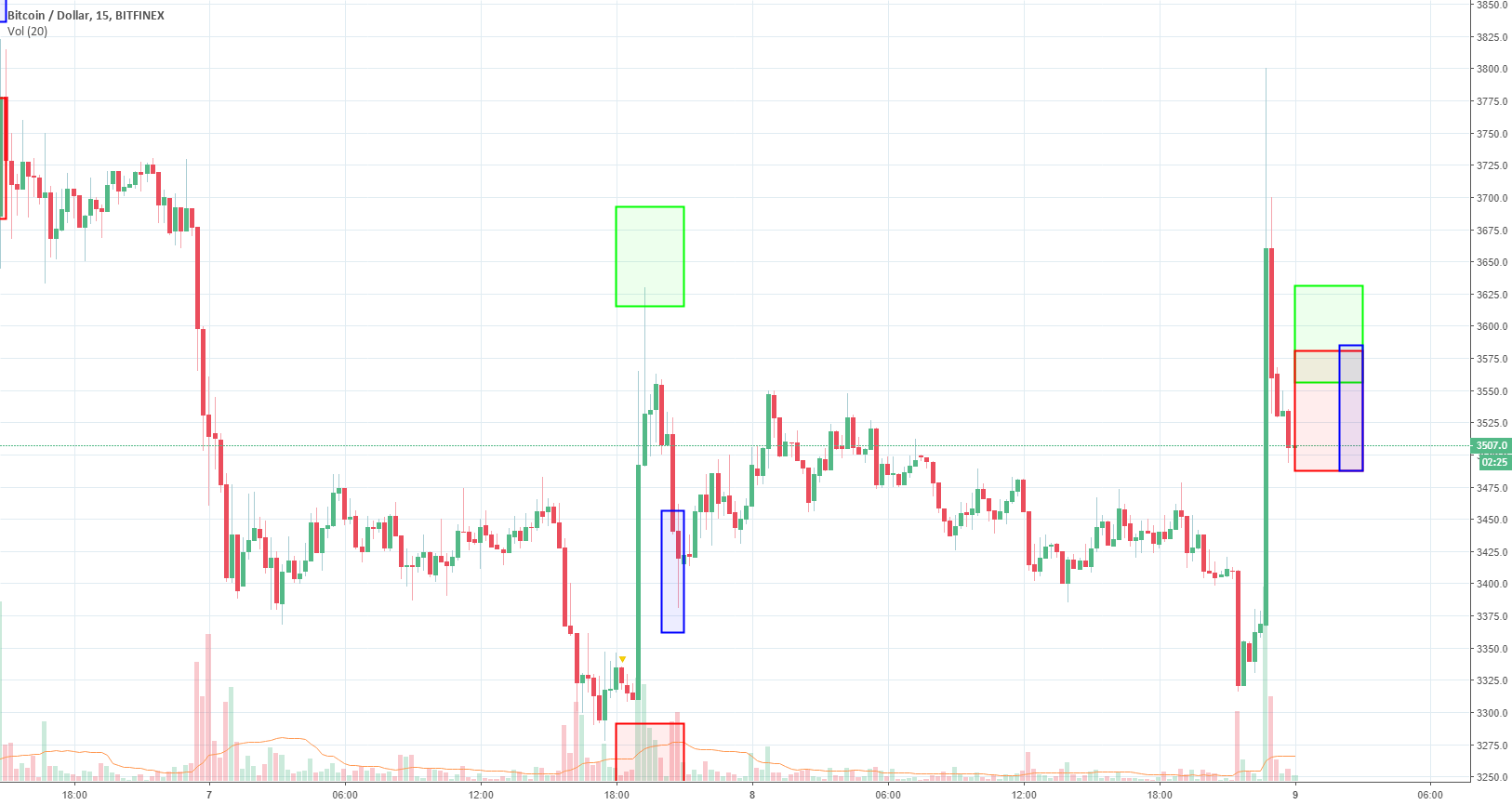
The following is a scheduled notification from the Osiris team. Our models have been working hard and smart on forecasting the market, and here are the most up-to-date predictions for the next 3 hours:

As usual, red, green and blue rectangles demonstrate predicted values of low, high and close, respectively, with corresponding confidence intervals, and the black arrow illustrates our trades.

Pair: BTC/USD
High: 3593.74
Low: 3536.48
Close: 3536.48

It has been three weeks since the notable bitcoin Cash hard fork, which has resulted in two rival chains, bitcoin ABC and bitcoin SV . The recurrent “hash wars” are going back in forth, with the market still responding to the changes in networks’ relative hash rates. bitcoin ABC is continuously struggling to maintaining slim advantage and is currently 6 blocks ahead. BAB price has somewhat recovered from previous lows and now has reached $102. As for now, the SV chain has minor advantage in terms of hash power (57%), however the ABC chain is still controlling 73% of the network’s nodes (Sources: https://cash.coin.dance, https://blockchair.com/bitcoin-cash/blocks). The mining profitability of bitcoin SV is continuously volatile: as for now, it is 14% more profitable to mine on the original bitcoin chain. bitcoin ABC mining profitability is somewhat stable now being 11.60% higher than that of the bitcoin chain (a 26% advantage compared to the rival SV chain). bitcoin ABC miner concentration remains unchanged, slightly above historical levels. As for today, ViaBTC is the apparent leader, having mined 31.25% of recent blocks, followed by BTC .com with slightly below 28%. bitcoin ABC is continuing to attract occasional mining from Waterhole, Prohashing, DPool, Copernicus, P2Pool, okminer and Multipool, the first five pools now consistently mining at least one block every day (Sources: https://cash.coin.dance/, https://blockchair.com/bitcoin-cash/blocks), contributing to the overall more healthy and diverse environment of the ABC chain, stemming from more attractive mining profitability and more technologically reasonable adjustable blocksize cap solution implemented by the bitcoin ABC team. Regarding the SV chain, the mining activities continue to be dominated by SVPool, Coingeek and BMG Pool, with Mempool lagging behind today with only 6.25%. The Osiris team is therefore reasonably certain that there is substantial growing potential for BAB , guided primarily by fundamental analysis .

Thank you for staying in touch. We are looking forward to your feedback and any suggestions here at TradingView.

Published at Sun, 09 Dec 2018 00:12:37 +0000

Previous Article

Microsoft Blockchain-as-a-Service(BaaS) Project Bletchley training in Denver | Training in Azure Blockchain(keywords-blockchain-fabric-Developer-Ethereum enterprise smart contract Bitcoin Hyperledger Cryptlets Cryptodelegate)

Next Article

Bitcoin Cash [BCH] slips by 38% over the week; while Bitcoin SV [BSV] grows by 10%

You might be interested in …

Crypto Scammers Hijack Vertcoin’s Twitter Account

Altcoin Today Crypto Scammers Hijack Vertcoin’s Twitter Account Crypto Scammers Hijack Vertcoin’s Twitter Account Vertcoin’s Twitter account has been compromised in an attempt to facilitate a cryptocurrency giveaway scam. On May 1, near 20:13 UTC, […]

The Moonbeam Scaling Network: A “Semi-Decentralized” Scaling Solution

Moonbeam scaling solution

bitcoin exchange and hosted wallet provider Luno (formerly BitX) is developing a bitcoin scaling solution called Moonbeam. Unlike the lightning network, Moonbeam does not require SegWit’s transaction malleability fix and would be able to operate on the bitcoin network as it is today.

Moonbeam  aims to provide a way for multi-user bitcoin platforms — such as exchanges, hosted wallets, and payment processors — to easily open standardized one-way payment channels with each other, and thereby offload the bitcoin network from a growing number of transactions.

How Does it Work?

Moonbeam aims to take advantage of the fact that many bitcoin transactions occur among multi-user platforms. Using Moonbeam, these platforms can open standardized one-way payment channel contracts with one another to facilitate payments. By taking these transactions off-chain, Moonbeam can reduce transaction fees for those who use it and benefit bitcoin users generally by reducing congestion in the mempool.

These channels are simple smart contracts in which one party locks up a certain amount of bitcoins for a specified period of time (with the end point referred to as the “timeout”) for the purpose of sending payments to the other party. Before the timeout, the party that has locked up funds can send an unlimited number of off-chain transactions using those locked up bitcoins (until the channel runs out of bitcoins). Each channel involves only two on-chain transactions: one to open the channel and one to close it.

Because these intermediate transactions are off-chain, they are nearly instant. Without the need for a blockchain confirmation, the transactions only take as long as it takes to route an http request (think: loading a simple web page). These transactions would also be cheap. Only two transactions per channel require miner fees, and the rest are essentially free to the platform, though the platform could charge fees to its users.

The one-way payment channels used by Moonbeam are not a new invention. bitcoin inventor Satoshi Nakamoto embedded preliminary code for payment channels in the very first release of bitcoin, and more recent protocol upgrades like CheckLockTimeVerify have further enabled this usecase. bitcoin platforms could negotiate and implement these smart contracts on the blockchain today.

What Moonbeam aims to do is facilitate the creation of these channels between major payment platforms by using the Domain Name System (DNS) to route communications related to creating and using these channels. This way, high volume platforms can easily discover one another and enter into a payment channel smart contact using the standardized Moonbeam terms. Using the Moonbeam protocol, this process can happen automatically when it is more efficient to open a channel than sending payments on-chain.

Trust

The Moonbeam project overview indicates that it is “semi-decentralized.” It is labeled as such because while the Moonbeam network does not require platforms to trust one another, it does require users to trust their platforms. A hosted wallet with a Moonbeam address is a custodial account, where the platform is managing the funds, and credits and debits user accounts accordingly as users send and receive transactions. Exchanges such as Coinbase operate in this manner; users do not directly control their private keys. Moonbeam can be a useful tool for these services, but it will likely not be a suitable scaling solution for users who prefer to manage their own private keys.

Other Downsides

The Moonbeam specification document also mentions several other potential downsides. Among them is the cost of capital. In order to open these channels, sending platforms must commit capital in the form of bitcoin for a period of time. If the receiver does not use the channel, the sending platform must wait until timeout to regain control of the funds, entailing potentially large financing costs.

Another risk involves the use of DNS. DNS hijacking is an attack that involves rerouting domain name requests to an attacker’s server. These attacks could be used to receive payments over new channels that were meant for the authentic server.

While Moonbeam does not offer the level of decentralization of the lightning network, the fact that it does not require any fork to the network may may make it an attractive solution to bitcoin’s scaling troubles in the short term. It could be implemented by hosted wallet providers as soon as the project is production ready.

The current state of Moonbeam can be found on the project’s Github.

Luno was not available for comment for this article.

The post The Moonbeam Scaling Network: A “Semi-Decentralized” Scaling Solution appeared first on Bitcoin Magazine.