September 24, 2026

Capitalizations Index – B ∞/21M

Brave Rewards launches in latest version of Brave for Android |

Brave rewards launches in latest version of brave for android |

Brave Rewards launches in latest version of Brave for Android |

Brave rewards launches in latest version of brave for android |

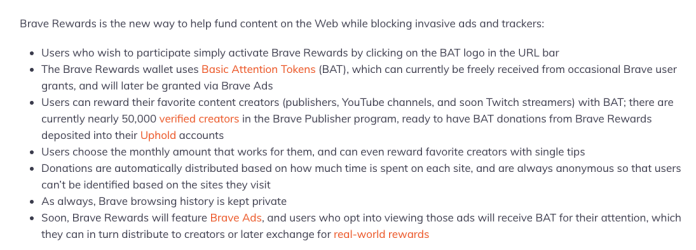
Brave Browser, an open-source web browser based on the Chromium web browser, and its utility token, BAT has been making headlines with updates pertaining to the project’s development and the token’s price surge. Now, the project is back in the limelight with the launch of Brave Rewards in the latest version of Brave for Android.

Additionally, to commemorate this event, the team announced that it would be granting 100,000 BAT to Brave Android users, in an official blog post. According to the post, each BAT token will be worth around $5, and users can receive it by clicking on the “accept button in Brave Rewards”.

Source: Brave

Bat-chriscat said on Reddit,

“Just to be clear, this particular release on Android includes the Tipping feature, but not the Ads (earning) feature just yet. However, it now exposes the BAT token symbol and idea of BAT (in the URL bar) to millions upon millions of Android Brave users.”

Moreover, the Founder of Brave, Brendan Eich, recently spoke about how Brave generates revenue and the future of the project, in an interview with Fast Company. He stated that they would be doing ads that would be privately matched by the browser, based on the user’s interest.

“and puts them in the place that the publisher has arranged for us to have an ad. The ads are static […] they won’t look like these crazy flyover ads. But it will allow publishers to get the big revenue share”

He stated that,

“We give 70% to the owner of the ad space. And then we get the same 15% that we give to the user. That’s why we use the triangle logo–you have users, advertisers, and publishers. This is something that hasn’t been fully tried. It’s complex. So it’s a multi-year mission.”

The post Brave Rewards launches in latest version of Brave for Android appeared first on AMBCrypto.

Published at Fri, 19 Apr 2019 22:41:03 +0000

Previous Article

Financial Giants still Investing in Blockchain despite Bear Markets

Next Article

Chinese Company Lost $23 Million Allegedly Mining Cryptocurrency in Secret

You might be interested in …

Cardano Blockchain's First Use Case: Proof of University Diplomas in Greece

cardano use case

Greek graduates may soon be able to prove their qualifications by way of a blockchain.

GRNET, the national research and education network of Greece, is working on a pilot project with blockchain research and development company IOHK to verify student diplomas on Cardano, a blockchain that launched in September.

The project is notable because it is the first official use case of Cardano, a proof-of-stake-based cryptocurrency and soon-to-be smart contract platform currently under development by IOHK.

The GRNET app will be built on Enterprise Cardano, a private or permissioned ledger version of Cardano. Unlike a public blockchain, where anyone can join in and participate, a private blockchain allows only a restricted set of users to validate block transactions.

So far, three Greek universities are participating in the project. While IOHK is providing the decentralized database, GRNET is providing the web front end and support and will bring together other universities participating beyond the pilot.

Funding for the project comes in part from Horizon 2020, a European program for research and innovation. Development of the prototype is already under way, Aggelos Kiayias, IOHK’s chief scientist, told bitcoin Magazine.    

Why Diplomas?

Given IOHK’s deep ties with academia, it is no surprise to find the company working on a project that involves universities. But why diplomas?

Putting diplomas on a blockchain takes the paperwork out of the process and makes it easy and simple to check if someone holds a degree.

Typically, when a student graduates, they receive a paper copy of a diploma signed by the dean and co-signed the university’s registrar. All of the students’ transcripts and records are stored in the university’s centralized database.

To confirm that a graduate has the degree they claim to have, an employer has to check the official diploma or call the university. The labor-intensive process makes it too easy for unqualified applicants to slip under the radar.

Putting documents and records on the blockchain eliminates opportunity for fraud in that it allows graduates and universities to “issue a proof that a qualification exists that is undeniable,” said Kiayias. “This is a point of reference that can be agreed [on] by everyone.”

Cryptographic Proof

But to protect student privacy, instead of putting an entire diploma on the blockchain, GRNET plans to put only a cryptographic hash of a diploma on the blockchain.

Digital documents are easy to alter in ways that are undetectable to the human eye. But as long as the digital version shown to an employer hashes to the same output as what is stored on the blockchain, that proves the document is the original, unaltered version.

“We cannot put any plaintext on the blockchain, as diplomas and transcripts are personal information. We only put hashes; we may put entire diplomas and transcripts, but they will always be encrypted,” Panos Louridas, GRNET consultant and associate professor at Athens University of Economics and Business, explained to bitcoin Magazine in an email.

This is not the first effort to store diplomas on the blockchain. In October, MIT announced its own pilot project to verify digital diplomas using the blockchain.   

But Louridas claims the GRNET pilot is different from prior projects in that it stores the entire chain of verification steps on the blockchain. Each step would be recorded as its own immutable transaction on a separate block in the blockchain.  

“You don’t really need a blockchain to store diplomas: a simple system with some digital signatures by the host institution would do,” he said. “We want to be able to record that somebody has asked for proof of a degree, that the proof has been granted, that the proof has been forwarded to a verifier, and that the verifier can verify that the degree is valid, and nobody can dispute any of the above steps.”

The three Greek universities taking part in the pilot include Aristotle University of Thessaloniki, Democritus University of Thrace and Athens University of Economics and Business.


The post Cardano Blockchain's First Use Case: Proof of University Diplomas in Greece appeared first on Bitcoin Magazine.

Intro to Blockchain and Smart Contracts

Intro to Blockchain and Smart Contracts In this course you will learn about the Blockchain and how to build Ethereum decentralized applications. The power of Blockchain apps is no central authority and verified transactions among untrusted parties. […]