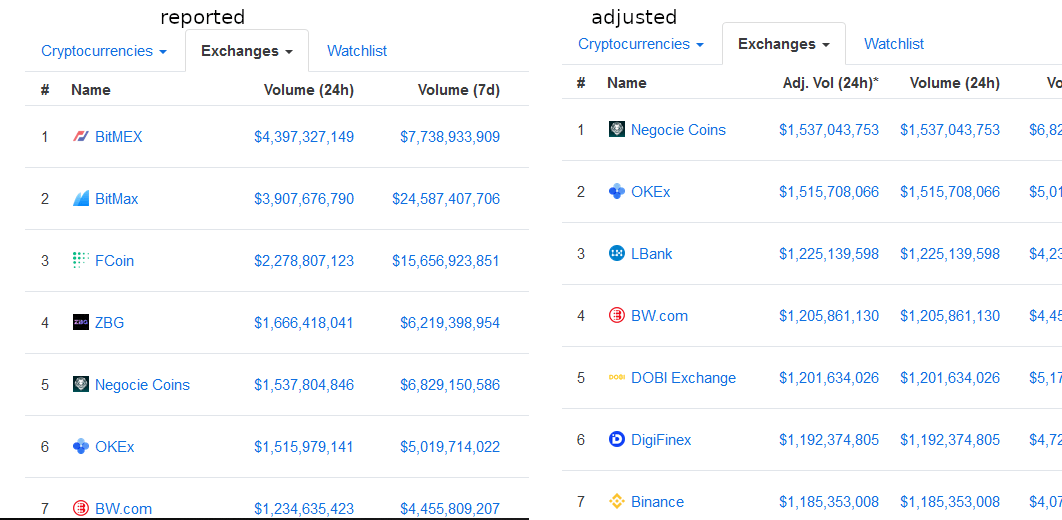
By : ‘Reported volume’ is the default metric that people look for when determining the ranks of crypto exchanges. ‘Reported’ and ‘adjusted’ volumes wildly differ on sites like CoinMarketCap.com. For example, if you look at the image below, you’ll notice a wild difference in “reported” and “adjusted” volumes at press time.
Ranking Exchanges Beyond Their “Volume”
Notice the difference between “reported” and “adjusted” volume on CoinMarketCap.com
ViewBase, a “market insights and community” platform centered around , recently published which details other ways we might rank exchanges. Rankings could be based on real facts, like how much crypto they hold or the value of all their combined.
The platform watches for large movements of various coins, including , and provides traders the opportunity to discuss observations. It’s a bit like TradingView but crypto-centric.
Ranking exchanges purely by volume – reported or otherwise – may soon be a fallacy in and of itself, as the trend of “initial exchange offerings” gives rise to more “transaction .” Transaction is where users earn for making trades; this may increase the volume but does it mean the exchange is more significant?
Three New Ways to Objectively Rank Exchanges
So ViewBase looks at three new ways to rank exchanges.
The first way is by ether balances.
Kraken holds the most . Source: ViewBase
Kraken, with nearly 3 million ether, by far has the deepest pockets. Kraken’s volume in ether is interestingly currently ranked No. 98, with less than 1% of ’s alleged daily volume of more than $7.4 billion.
Kraken may have the most , but they don’t do the most . Source: CoinMarketCap.com
comes in second place by this method. ’s ETH/USDT market is 32nd in volume, with almost 1% of ’s daily volume, according to .
Binance Crushes With Help from BNB
The next metric ViewBase uses is the value of all ERC-20 combined, which drops way down the list being that Kraken primarily focuses on fiat/major-cap markets.
leads in other ways. Source: ViewBase
, however, gets a huge boost thanks to all its . is right behind it. ViewBase writes:
“A vast majority of Initial Coin Offering (ICO) are issued on the , ranging from established projects like Omisego to the latest IEO like Fetch.AI and Celer. Hence it is reasonable to expect the valuation of ERC20 deposited on an exchange to be reasonably proportional to its reported volumes.”
The last metric is the value of all and all combined.
has a massive lead when you combine its and all of its . A big part of this is the fact that its own , a routine top 20 , is largely stored on the exchange for obvious reasons. Source: ViewBase
This chart surprisingly brings Kraken back into the top 5, but remains king – by a long shot.
If we’ve learned anything from all the fake volume scandals over the past year, it’s that volume is not necessarily the best way to judge an exchange. While it’s an important metric, especially for traders who require a lot of liquidity, there is a lot more to exchanges than the number of times change hands.
The actual crypto holdings of exchanges are perhaps the most exciting takeaway here. On the one hand, it’s a scary situation that a few places control that much crypto – “” comes to mind. On the other, it’s a real testament to the level of trust people place in these companies.
Published at Sat, 04 May 2019 23:00:46 +0000
