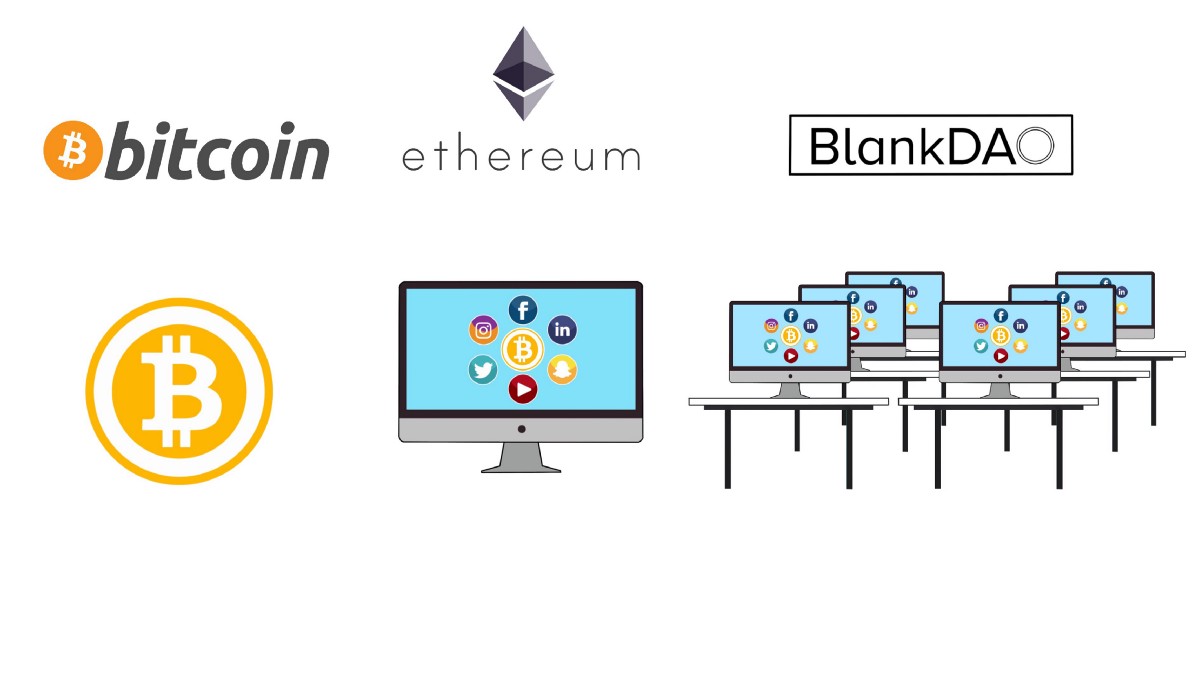
When was introduced in 2014, new terms were added to the decentralized world. It was the first time we were facing words like , , smart contracts and DApps. These new terms and words are practical results of a paradigm shift from which is merely a payment system with coins to that is a world computer and considers as a single DApp among its millions of other possible DApps.
DAOs and in particular BlankDAO claims to bring about yet another paradigm shift from and a world computer to organizations that can include world computers as a single part of their vast possibilities.
Now, ’s ability to describe and elaborate on with its own terms and words as a DApp made it eligible to be called a paradigm shift. BlankDAO, similarly, needs to be able to define its previous generations with its organizational terms.
In this brief story, let’s take a look at the benefits of and as organizations and see where they get their security from. Bear in mind that security of organizations and where their benefits are streamed to are two of their most essential factors to analyze.
bitcoin as an Organization
, as you might already know, works based on proof of work or POW which means its security in face of Sybil and double-spending attacks is achieved through miners who provide their processing power in hopes of receiving newly generated coins and transaction fees.
But do they really receive much?
In order to enjoy the handsome benefits of , miners are required to purchase processors and feed them with electricity to play their part. These processors aka devices aka ASIC devices are produced by not so many companies. Bitmain is known to produce the majority of these devices.
A closer analysis of miners’ and pool business models leaves no doubt that at least for the first year of starting the business most — if not all — revenues are spent purchasing devices and paying electricity bills.
Long story short, is secured by its miners and their processors. Its benefits, however, are indirectly streamed towards device producers and electricity companies.
Ethereum as an organization
EthSuisse raised $18 million in during its crowdsale. Sixty million ether were exchanged for approximately 31,000 . As is known to enthusiasts, most of the in ICO events are usually sold to a limited number of early buyers which more often that not, will play major roles in the future of projects. If we suppose that the same sequence of events has happened for ’s ICO — which is very probable considering the facts and prominent active players in ’s ecosystem — we can logically get to the conclusion that a limited number of early investors and buyers have bought most of the .
Even after 5 years now, more than 60% of all the ETH available in ’s $17B market cap are the that were sold in the early ICO. That means that most of the benefits of as an organization have been streamed towards a handful of early investors.
As you can see, most — if not all — the benefits in ’s network belong to a limited number of early buyers.
BlankDAO as an organization
BlankDAO’s security is based on proof of uniqueness aka POU which is robust using BrightID and its capabilities.
BrightID has different algorithms to analyze people’s connections with each other and the groups they create with their friends. The more crowded BrightID’s network gets, the better it gets in preventing Sybil attacks.
With all that in mind, we can clearly conclude that the security in BlankDAO is based on people and their network of connections.
The benefits in BlankDAO, on the other hand, are distributed among all people equally as is mentioned in the whitepaper. This is done regardless of the processing power they provide or even the number of stakes they own in the system.
To sum up, BlankDAO claims to gain security from people and stream its benefits among all people equally.
Make sure to visit Blankdao.org and read the whitepaper.
Join our community at
Check out BrightID and awesome new possibilities at brightid.org
Published at Mon, 22 Apr 2019 12:58:49 +0000