Bitmain and other crypto companies suffered massive losses during the bear market. However, Bitmain’s effect on ’s price, performance, and its decentralization was discovered to be more than what was previously anticipated.
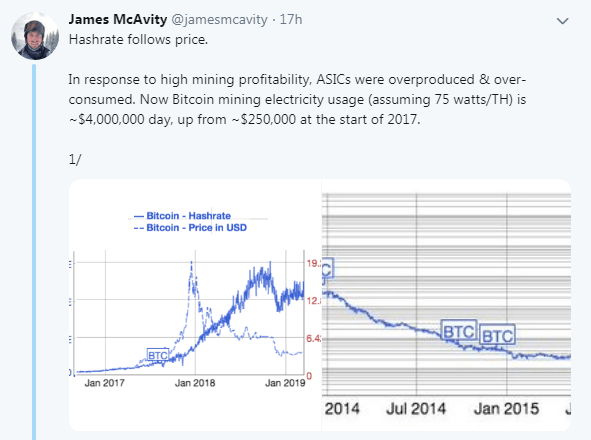
James McAvity, a enthusiast and miner, posted a series of tweets explaining how Bitmain’s overproduction of ASIC miners ultimately affected the coin’s miners.
Source: Twitter | James McAvity
When the frenzy reached its peak in 2017, so did the price. This resulted in the relentless production of Bitmain’s famed, top of the line, ASIC miners, that came to be used by most of the miners.
McAvity also pointed out the increase in ’s electricity usage from 2017 to 2019. The electricity usage at the start of 2017 was around ~$250,000, which later surged exponentially to $4,000,000 a day [McAvity assumed 75 watts/TH]. The graphs attached below show the same correlation,
Source: Twitter | James McAvity
Source: Twitter | James McAvity
Bitmain controlled massive amounts of the hash rate for , at one point in the past. However, decisions taken by the company resulted in its dominance over weakening. According to some reports, Bitmain even sold most of their crypto holdings to survive the crypto winter that enveloped the coin market.
In a subsequent thread, McAvity tweeted,
“BITMAIN is the gift that keeps on giving.
Not only did they (in)voluntarily give up their position as the leading manufacturer, fostering greater decentralization.. but they also flooded the market with ASICs, sentencing their to waning profitability.”
As a result of the above, McAvity suggested that Bitcoins so purchased, would be from a “distressed miner” who would have to sell those BTCs to keep the farm alive. Most enthusiasts attributed the drop in ’s price from $6,000 to $3,000, to a reallocation of hash power by Bitmain during the hash wars.
McAvity tweeted,
“Look at the drop from $6400 to $3300, at the time that was 10c KW/H breakeven to ~5c. Hashrate got crushed as high OPEX production got REKT. I predict we would drop to 20mm TH/s if the halving happens today, cutting network-wide miner electrical OPEX by 60%.”
The post appeared first on .
Published at Fri, 22 Mar 2019 01:15:49 +0000