October 14, 2026

Capitalizations Index – B ∞/21M

BitLicense Refugees: Kraken, ShapeShift CEOs Talk Escape from New York

Bitlicense refugees: kraken, shapeshift ceos talk escape from new york

BitLicense Refugees: Kraken, ShapeShift CEOs Talk Escape from New York

Bitlicense refugees: kraken, shapeshift ceos talk escape from new york

If you wanted to hear red-meat rhetoric about New York State’s regulatory approach, a fireside chat Tuesday between two of the cryptocurrency industry’s most outspoken leaders delivered.

For example, the audience at Consensus 2018 in New York City cheered when ShapeShift CEO Erik Voorhees invoked a local icon to make the case that the state’s BitLicense was a case of regulatory overreach.

“Here we are two miles from the Statue of Liberty and you cannot sell CryptoKitties in the state without that license. That’s the absurdity of what’s happened here,” he said.

And Jesse Powell, the CEO of Kraken, got some laughs at the expense of former New York Attorney General Eric Schneiderman.

When Scheniderman’s office sent a request for information to Kraken (along with several other exchanges) earlier this year – three years after his company stopped doing business in New York – it felt like “a slap in the face,” Powell said.

But then “it turns out this asshole actually slapped people in the face,” he quipped, referring to the allegations of physical abuse that forced Schneiderman to resign shortly afterward.

Yet between these zingers and applause lines about the BitLicense – which both executives blame for driving their companies out of state – there were subtler points made. The conversation highlighted the challenges facing both the industry and regulators worldwide as governments come to terms with the ramifications of cryptocurrency.

Powell, for example, pointed out the tension between anti-money-laundering regulations and customer privacy protections. In the case of the BitLicense, he said, Kraken would have had to “disclose all the information about our entire global client base to the state of New York.”

That was not only distasteful, Powell said, but “potentially illegal” under the privacy laws of other countries.

“To service New York today, what we’d have to do is create a special purpose entity just to service New York and completely firewall off” all the exchange’s other users to protect their privacy, he said.

Alternative models

Widening the lens, Powell contended that the U.S. “has really failed” by leaving it up to local regulators to figure out how to deal with cryptocurrencies.

“In others parts of the world, it’s an issue that’s being taken seriously by heads of state – presidents, prime ministers. It’s not something that’s relegated to individual regulators at a state level,” he said. “It should be treated as a national economic and national security issue, maybe even an international issue.”

Powell cited Japan’s Virtual Currency Act as an example of “reasonable” regulation. Although the law is “not perfect,” he said, “we’re already seeing an explosion of business in Japan” as a result of the clarity it brought.

Voorhees, however, held up a different U.S. state as an example of how to do things right: Wyoming, which recently passed a package of five blockchain-related laws.

The two most important ones, in his view, were a law that excludes tokens from being automatically categorized as securities, and another that excludes digital asset companies from being automatically classified as money transmitters.

“That’s the model people should be looking at, they’ve done it the best,” Voorhees said.

And despite using the phrase “statist oppression” early in the conversation to describe his feelings about New York when the BitLicense was created, Voorhees later clarified that he thinks regulators generally have good intentions.

But their aims can be met today by means other than imposing bureaucratic, bank-style regulations on businesses that want to be nothing like traditional financial institutions, he argued.

“The crypto industry and regulators can find common ground in realizing that this incredible new technology can achieve many of the noble goals of the regulators such as protecting consumers,” Voorhees said.

Regulatory hopscotch

Ultimately, though, the two executives depicted cryptocurrency as a highly mobile activity that can easily relocate when any jurisdiction starts to appear heavy-handed.

Powell said Kraken’s main office is located in San Francisco only as a convenience because that’s where he lived when he started the company. Crypto businesses can basically pick up and move anywhere in the world they want to be, he said.

And users need not always move to another place, use a VPN to mask their IP address or even break the law to get around restrictions; Powell shared a tip for New York residents who feel deprived because of the way the BitLicense has limited their cryptocurrency trading options.

“If you’re here stuck in New York and you can’t trade how you want to trade, set up a Wyoming LLC and you can trade through that and have your business trade for you,” he said.

Further limiting regulators’ power, Powell said, the rise of decentralized exchanges will give users even more alternatives.

“If they can’t do what they want on Kraken they’re doing to do it on a decentralized exchange,” he said.

And Voorhees said “regulatory hopscotch” by exchanges and other businesses that move from one country to another is only a symptom of a broader phenomenon that won’t easily be resolved.

He concluded:

“bitcoin basically broke down the borders of how value moves across humanity. There is no way that an invention like that doesn’t run straight into the jaws of regulations. And that conflict is going to be one of the great themes of my lifetime.”

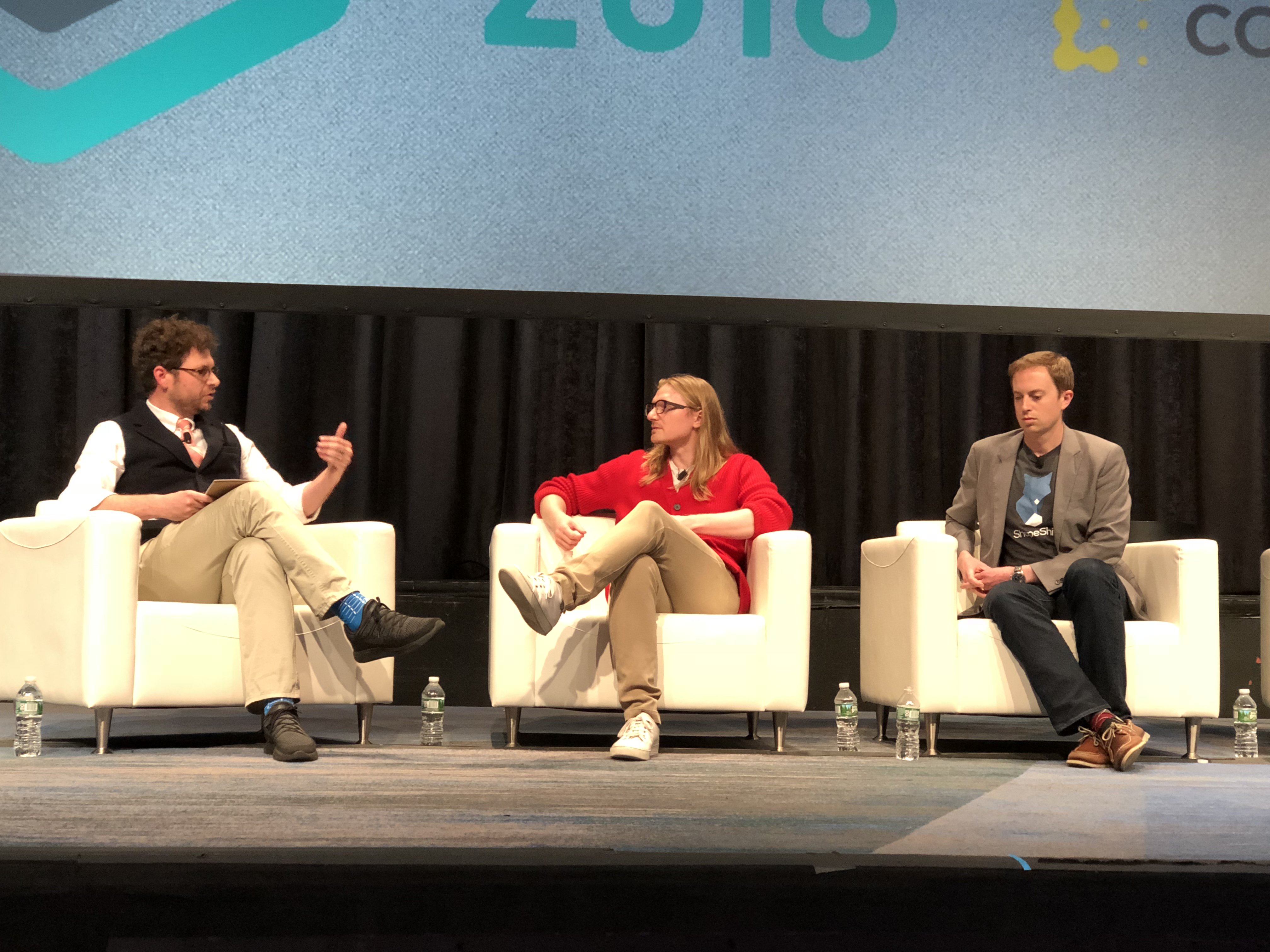
Photo via Wolfie Zhao for CoinDesk. Left to right: CoinDesk research director Nolan Bauerle, Jesse Powell and Erik Voorhees. 

The leader in blockchain news, CoinDesk is a media outlet that strives for the highest journalistic standards and abides by a strict set of editorial policies. CoinDesk is an independent operating subsidiary of Digital Currency Group, which invests in cryptocurrencies and blockchain startups.

Published at Wed, 16 May 2018 07:00:15 +0000

Regulation

Previous Article

Upcoming Cryptocurrency Events 8th – 14th of January – Looking for Good Investments and Pumps

Next Article

A Slim Design Kangaroo Leather Wallet – Black Colour. Mens Gift. Birthday Gift. Groomsman Gift. Graduation Gift. Bitcoin Accepted

You might be interested in …

Play2Live – The World’s First Decentralized Streaming Platform for Gamers and eSports Fans

Take a look at websites like Twitch or Youtube, and you will see it: Gamers are everywhere. Occupying a 105 billion dollar market share, and more than 2.2 billion people who play video games worldwide, video games have become so popular, that they have surpassed film to become the world’s number one way to be entertained. Viewership for eSports is surpassing that of many traditional sports.

[Note: This is a press release.]


The way people seek entertainment has changed forever, while, as we all know, the blockchain is changing the way people spend money. The economy is becoming decentralized, and payments are becoming more secure and transparent. The new, blockchain-based and decentralized, video game and eSports streaming platform, Play2Live, is the first game streaming platform which brings eSports together with the cutting-edge of blockchain technology.

In P2L both players AND audience members earn tokens by doing lots of cool things like watching ads because of peer 2 peer cdn, advancing streams, and watching ads if he wants. And there are other intellectual methods. AND THIS IS A REVOLUTION! Thanks to the blockchain.The Play2Live platform with the Level Up Chan and Level Up Coin is taking over the world! Gaming will never be the same!!

Utilizing some of the remarkable innovations of blockchain tech, the team at Play2Live has developed an ecosystem where each participant, including the viewer, will become a full-fledged member of the system. Participants will be able to interact on a peer-to-peer basis with one another and to earn money using many platform features. Audience members and streamers alike have the ability to earn and spend money doing what they love.

The following is a brief overview of the project:

eSports – The Future of Entertainment

Gamers love playing games, but they might like watching them even more. The eSports industry has already seen the rise of a number of gaming celebrities and millionaires, and viewership is already much higher for video game tournaments than for many traditional sports.

Unfortunately, eSports streaming sites, like the ones listed above, have one major fault: They lack an effective platform for interaction between streamers and viewers. Fans are dying to be able to get in touch with their favorite streamers, and take part in the game on a deeper level, but at the moment this is impossible.

Play2Live

That is, until now. A group of experts, with years of experience in eSports, game publishing, and developing high level online gaming services, has come together to find a solution. They have conceptualized the Play2Live (P2L) platform –  the first decentralized streaming platform for gamers and eSports fans.

By integrating the blockchain into video game streaming, P2L is making interaction between gamers and fans easy, and making gaming even more fun and entertaining for everybody. On the business side, P2L is monetizing game streaming and creating an entire infrastructure for fans to spend money in order to interact with their favorite streamers. Due to the use of the blockchain, P2L managed to increase the number of revenue sources on the platform from 5 sources at traditional centralized solutions to 15. Try to think of another blockchain project that allows users to spend tokens inside any project in so many ways!

This will radically and forever change the industry. At the same time, P2L is likely to have a great impact on eSports and gaming, giving new opportunities for the so-called Let’s play streamers that just stream games, and for organizers of eSports tournaments.  Play2Live gives you, and other users all of the world interaction at a whole new level. It is truly a level up in gaming. 

Platform Structure

The key advantage of the Play2Live system is that we are a complete ecosystem and not a service solving only one or a few highly specialized tasks. P2L is an independent generator of gaming and eSports content and a potential partner for other eSports platforms. This means we can continually integrate new products and partners into the service who will be able to interact with the platform’s audience through the “Level Up Chain”  blockchain.

A New Level of Interaction

At its base, P2L is an e-marketplace, operating using a blockchain-based token – the Level Up Coin (LUC), and a streaming platform, enabling access to share video streams.

The marketplace enables the ultimate in interaction between streamers and their audience. Streamers can use the platform to build and maintain a fanbase, and make money doing it and making streams – right from the start without any applications forms or complicated procedures. Viewers can spend LUC to interact with streamers, and earn it by voting for the streams that they like. The more positive votes, the more LUC earned. Sharing streams becomes a way to earn.

This is a revolution for fans. It will be possible to make specific requests or choose from streamers’ custom-made options. For example, if fans want to see a streamer switch from “difficult” to “hard” mode on a game, they could give the streamer LUC in exchange for doing so. They could tell a streamer to “level up” with LUC if they so please. Fans can also get together and form a crowdfund to pay for the content that they want to see. They can earn money by watching ads if they want.

There are lots of the other ways for streamers to earn LUC, such as by selling advertisements or taking donations. Viewers Eventually, the platform will support the placement of bets by viewers of eSport tournaments.

Blockchain Integration

All the innovative features of P2L are made possible by the blockchain, a decentralized technology that renders transactions secure, transparent, and convenient.

P2L uses the custom-built Level Up Chain blockchain. Since it was built using Graphene technology, these transactions will go at light-speed -50,000 TPS – hundreds of times faster than bitcoin and Ethereum transactions.

P2L is able to keep fees low and services functioning at a high level because of its blockchain integration. The Level Up Coin is set to one day become the top currency in the gaming industry.

The Upcoming Crowdsale

The Pre-sale for the LUC token will start on November 20th, and go until November 26th. The token sale will begin December 4th and end December 10th.

Your chance to get in early on the project starts soon! For more information visit  www.play2live.io, or follow us on various bitcoin-oriented media sources.

Contact – Please feel free to get in touch with us on any of our social media accounts!

https://twitter.com/play_2_live

https://www.linkedin.com/company/18255836/

https://t.me/play2live

https://www.facebook.com/Play2Live-504880049864038/

https://medium.com/@play2live.project

The post Play2Live – The World’s First Decentralized Streaming Platform for Gamers and eSports Fans appeared first on Bitcoinist.com.