On May 22, 2010, a Florida programmer named Laszlo Hanyecz made what is widely recognized as the first real‑world purchase using bitcoin: two Papa John’s pizzas bought for 10,000 BTC. At the time, the transaction was worth about $41, based on the going rate for bitcoin in online forums, and was seen primarily as a proof of concept rather than a financial decision with long‑term implications .
This seemingly ordinary food order has since become one of the most famous events in cryptocurrency history, annually commemorated as “bitcoin Pizza Day” within the crypto community . As bitcoin’s price climbed over the years, the 10,000 BTC spent on those pizzas came to represent hundreds of millions of dollars on paper, turning the transaction into a cautionary legend and a milestone in the evolution of digital money . This article examines the context, mechanics, and legacy of that first bitcoin purchase, and why it still matters to discussions about cryptocurrency today.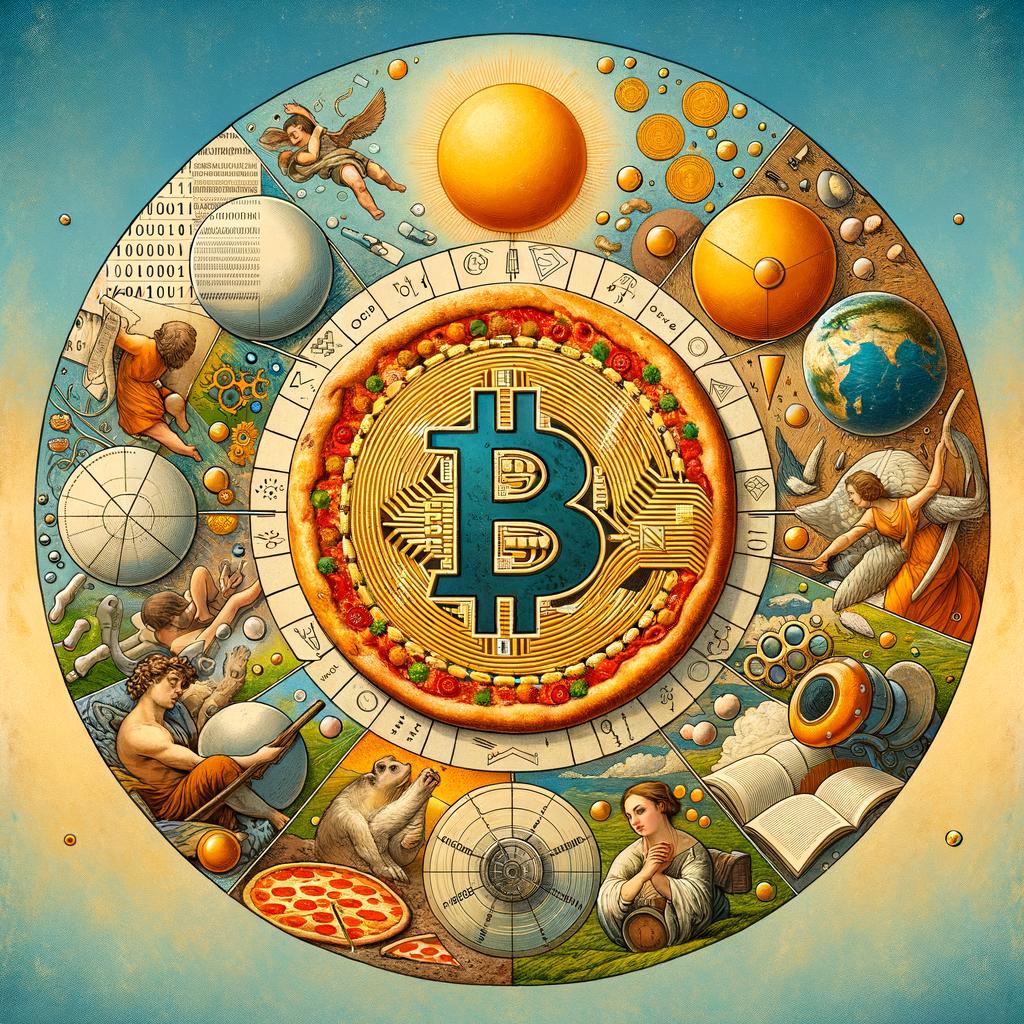
Origins of the bitcoin Pizza Transaction and Its Historical Context
In May 2010, barely a year after the bitcoin network launched, a Florida programmer named Laszlo Hanyecz posted an offer on an online forum: 10,000 BTC in exchange for two delivered pizzas. At that time, bitcoin was still an experimental protocol-an open-source peer-to-peer digital cash system secured by cryptography and maintained by a distributed network of nodes, each keeping a copy of the public ledger or blockchain . There was no widely accepted market price, no major exchanges, and almost no merchants willing to accept BTC. By using bitcoin to buy a mundane, real-world item, participants were attempting to prove that this nascent digital asset could function as money, not just as an abstract technical curiosity.
This transaction emerged from a specific early-community culture that revolved around experimentation, open collaboration and a distrust of traditional financial intermediaries. bitcoin had been introduced as an alternative to bank-controlled systems, allowing value to move directly between users without central oversight or permission . Enthusiasts frequented online forums and IRC channels were they:
- Traded BTC informally for goods, services or hobbyist hardware
- Discussed protocol upgrades and mining software
- Promoted the idea of bitcoin as a censorship-resistant, borderless currency
In that environment, arranging a pizza delivery funded entirely by BTC served as both a social experiment and a exhibition of the network’s potential to support everyday commerce, foreshadowing the much larger payment ecosystem and price infrastructure that would later develop on platforms tracking live BTC prices and market data .
historically, the pizza purchase is notable because it marks one of the first widely documented instances of bitcoin being exchanged for a tangible consumer good, anchoring the abstract idea of digital cash to a concrete economic event. At the time,10,000 BTC represented only a modest sum in U.S.dollar terms; today, that same amount is used as a reference point to illustrate bitcoin’s dramatic price thankfulness and shifting perception from hobby project to global asset class .Within the community, the episode is commemorated annually as “bitcoin Pizza Day,” highlighting how a simple food delivery became a cultural milestone that encapsulates early adoption challenges, the evolution of bitcoin’s monetary narrative, and the transition from a niche experiment in peer-to-peer value transfer to a cornerstone of the broader crypto economy.
Economic Value of 10,000 BTC Then and Now A Comparative Perspective
When 10,000 BTC bought two pizzas in 2010, the transaction was worth roughly $40-$50, reflecting a time when bitcoin had almost no established market price and functioned more as an experimental digital token than a recognized asset. In economic terms, those coins represented a bold bet on a nascent technology rather than a store of wealth.Today, with bitcoin trading around $88,000 per BTC on major platforms such as Kraken and other exchanges, 10,000 BTC would be valued at approximately $880 million in USD, underscoring the dramatic repricing of risk, scarcity, and market confidence over little more than a decade.
| Metric | 2010 (Pizza Day) | 2026 (Approx.) |
|---|---|---|
| Price per BTC | ~$0.004 | ~$88,000 |
| Value of 10,000 BTC | ≈ $40-$50 | ≈ $880,000,000 |
| Use Case | Experimental payment | Global asset & store of value |
This shift in economic value is not just numerical; it reflects a transformation in how bitcoin is perceived and utilized. Once a curiosity traded on forums, bitcoin is now a highly liquid asset with real-time price discovery and deep markets, as seen on platforms tracking live charts and market caps. In practical terms, 10,000 BTC moved from paying for a single everyday purchase to representing a portfolio-defining position. this evolution can be framed through changes in:
- Market maturity – From thin, peer-to-peer trades to institutional-grade exchanges with robust liquidity.
- Perceived scarcity - Growing awareness of bitcoin’s 21 million supply cap driving long-term value narratives.
- Macroeconomic role – Repositioning from niche internet money to a digital asset often compared to gold and used for diversification.
Technical Mechanics of Early bitcoin Transactions and Wallets
When those 10,000 BTC moved in exchange for two pizzas, the transfer was orchestrated by a small, globally scattered network of nodes each keeping a full copy of bitcoin’s ledger, the blockchain . Transactions were simple scripts: coins were locked to a public key and could only be unlocked with a corresponding private key signature, using a basic form of bitcoin’s scripting language (standard pay‑to‑public‑key‑hash was just emerging as a convention). There were no fee markets or mempool dashboards-fees were negligible, blocks were rarely full, and miners mostly relied on the fixed block subsidy rather than transaction fees to secure the network in those early days . Once broadcast, a transaction was picked up by connected nodes, validated against consensus rules, and eventually packed into a block, permanently anchoring that pizza payment in bitcoin’s history.
Wallets at the time were far from today’s polished mobile apps. The original bitcoin client bundled a full node and a basic wallet into one desktop submission, requiring users to download and verify the entire chain before spending coins . Keys were commonly stored in an unencrypted file (wallet.dat) on a personal computer, making good operational security more a matter of luck than design. there were no hardware wallets, seed phrases, or hierarchical deterministic key trees; instead, users manually backed up their wallets and often reused addresses, which would later be discouraged for privacy and security reasons. Typical user actions revolved around a few core operations:
- Generating new addresses directly inside the reference client
- Backing up the raw wallet file to external media
- Broadcasting transactions over a low‑traffic peer‑to‑peer network
- Verifying confirmations by watching block height and transaction status
| Aspect | Early Era (Pizza Time) | Modern Era |
|---|---|---|
| Wallet Type | Desktop full-node client | Mobile,web,hardware,multisig |
| Key Storage | Plain wallet.dat file |
Encrypted, seed phrases, secure elements |
| Network Load | Low traffic, near-empty blocks | High traffic, dynamic fee markets |
| User Actions | Manual backups, address reuse | Automatic backups, HD wallets, better privacy |
Market Liquidity and Price Discovery in bitcoin’s Pre Exchange Era
Before dedicated trading venues emerged, bitcoin traded in a kind of monetary wilderness. Liquidity was thin, fragmented across forum posts, IRC chats, and private agreements between early adopters who mostly mined rather than “bought” coins.In this environment, price discovery was less about order books and more about negotiation, experimentation, and curiosity. With no central authority or institution setting a reference rate, participants had to infer value from a mixture of mining costs, perceived future potential, and the willingness of another enthusiast to part with real-world goods for a string of digital signatures on a distributed ledger maintained by a peer-to-peer network.
The famous pizza transaction became a focal point for this primitive market because it translated abstract code into a tangible product. A single trade between two forum users effectively served as a quasi-benchmark, hinting at what 10,000 BTC could command in the real world.With no established exchanges like the modern platforms that now provide live price feeds and deep order books, the community looked to such anecdotes as informal reference prices. Early participants compared notes on completed deals, gradually converging on ranges that felt reasonable, while still recognizing that any quoted “price” could shift dramatically with each new trade.
Market activity in this period relied on trust and coordination rather than automated matching engines. Informal marketplaces were characterized by:
- Direct peer negotiation rather of anonymous, exchange-based order matching.
- Barter-style trades (goods,services,or fiat) arranged via message boards.
- Extremely low velocity of trades, which made any transaction disproportionately influential.
| Aspect | Pre-Exchange bitcoin | Today’s Markets |
|---|---|---|
| Price source | Forum deals, anecdotes | Global exchanges, indices |
| Liquidity | Scattered, very thin | High, 24/7 markets |
| Discovery mechanism | Manual negotiation | Order books, algorithms |
Psychology of Early Adopters Risk Perception and Utility Over Speculation
Early adopters of bitcoin evaluated the world through a different lens: one where experimental technology and real-world utility outweighed short-term price concerns. Psychologically, they were driven less by the fear of loss and more by curiosity, ideological alignment with decentralization, and the satisfaction of participating in a monetary experiment at its inception. In classic behavioral terms,they discounted conventional notions of being “too early” (acting before wider social validation or clear economic benchmarks),choosing instead to optimize for learning and contribution rather than immediate financial gain. Their reference point for value was not fiat price, but whether the system could actually be used to move value from one person to another.
For these participants, the act of buying pizza with BTC functioned as a proof-of-concept that validated the currency’s usefulness in everyday life. Utility reduced perceived risk: if bitcoin could pay for food, it was more than an abstract token on a forum. This mindset contrasts with later, more speculative waves of adoption, where the focus shifted from ”Can this work in practice?” to “How high can the price go?”. Early users were effectively making a trade-off between certainty and meaning: accepting high technical and economic uncertainty in exchange for being early contributors to an emerging financial paradigm, consistent with dictionary notions of “early” as acting “at or near the beginning” and “before the usual or expected time” , .
Instead of obsessing over future charts,they prioritized concrete benefits such as censorship resistance,open participation,and the thrill of using a non-state currency in daily life. Their decision-making often featured:
- Action over speculation: proving a use case mattered more than holding for an unknown payoff.
- Community validation: trust came from peer builders and miners, not institutional endorsements.
- Long-term optionality: even if the experiment failed, the knowledge and precedent gained were seen as valuable outcomes.
| Early Adopter Focus | Speculative Focus |
|---|---|
| Can I spend it today? | What will it be worth tommorow? |
| Network resilience | Price volatility |
| Real-world experiments | Market narratives |
Lessons for Long Term Crypto Investors From the bitcoin Pizza Story
In 2010, Laszlo Hanyecz traded 10,000 BTC for two pizzas in what is widely regarded as the first real‑world purchase using bitcoin, worth roughly $41 at the time . Another Bitcoiner received the coins and then ordered the pizzas with a credit card,meaning the merchant never actually handled BTC .This episode, now celebrated each year as bitcoin Pizza Day on May 22 , offers a clear reminder that early prices frequently enough fail to capture an asset’s long‑term potential, and that short‑term convenience can overshadow asymmetric upside. For long‑term investors, the story is less about “regret” and more about understanding how quickly narratives and valuations can change in emerging technologies.
Long‑term crypto investors can extract several practical principles from this event:
- Differentiate spending from core holdings: Treat a portion of your crypto as “transactional” and another as “never sell early” capital to avoid liquidating high‑conviction assets for trivial expenses.
- Respect uncertainty in early valuations: Assets that look insignificant in price today can represent a large future share of your net worth; size positions and spending habits accordingly.
- Accept prospect cost as part of innovation: Without real‑world use cases-like that pizza order-network value may never develop; early adopters inevitably “overpay” in hindsight to help build the ecosystem.
- Document your thesis: Write down why you hold a coin (store of value, payment rail, speculation); it helps you decide when it makes sense to spend, hold, or rebalance rather of acting emotionally.
| Aspect | Pizza Story | Investor Lesson |
|---|---|---|
| Time Horizon | Focused on a meal that day | Plan for multi‑year outcomes |
| Perceived Value | 10,000 BTC ≈ $41 | Early prices can be misleading |
| Use of BTC | Spent entirely on consumption | Segment spending vs. long‑term stash |
| Network Growth | Helped prove real‑world utility | Adoption often requires “costly” pioneers |
Implications for Cryptocurrency Valuation Models and Scarcity Narratives
The pizza transaction shattered the notion that digital coins were mere curiosities, forcing early observers to grapple with how to assign value to something that was both programmable and strictly limited in supply. Traditional discounted cash flow models had little to anchor to,so early frameworks leaned on emergent metrics such as network activity,hash rate,and on-chain velocity. this event highlighted that value in cryptocurrencies is not only a function of speculative demand, but also of their ability to facilitate real-world exchange, pushing analysts to adapt models that blend monetary premium, utility, and network effects into a single valuation narrative.
Scarcity narratives were simultaneously strengthened and complicated. On the one hand, a fixed cap of 21 million BTC and a visible ledger of every coin spent created a uniquely clear form of digital scarcity. On the other, watching 10,000 BTC buy two pizzas underscored how subjective and time-sensitive value really is.As new assets such as Ethereum gained prominence-with their own issuance rules and use cases, from smart contracts to DeFi applications-the market began differentiating between hard-cap scarcity (like bitcoin) and programmatic, flexible issuance (like many smart-contract platforms that still command multi-billion dollar market caps despite different supply dynamics).This contrast forced investors to refine models beyond simple “fixed supply = high value” assumptions.
In response, modern frameworks increasingly treat scarcity as one variable among many. Analysts now consider:
- token economics: Emission schedules, burn mechanisms, and staking rewards.
- Use-case density: How many distinct, recurring economic activities a network supports.
- Market structure: liquidity, derivatives, and correlations across the broader crypto landscape.
| Factor | Role in Valuation | Scarcity Impact |
|---|---|---|
| Fixed Supply | Supports long-term store-of-value thesis | High,but depends on demand durability |
| Utility & Fees | Generates organic demand for block space | Can offset higher supply via strong usage |
| Network Effects | Reinforces liquidity and price discovery | Amplifies perceived scarcity over time |
From the perspective of today’s extensive list of active cryptocurrencies, the pizza purchase stands as a reference point: a vivid reminder that valuation models must accommodate evolving narratives, behavioral feedback loops, and the reality that scarcity only matters when someone is willing to trade it for something as tangible-and as ordinary-as a meal.
Guidelines for Spending Versus Holding Digital Assets in Emerging Markets
In economies where inflation and capital controls are common, digital assets can function as both a payment rail and a store of value. Before choosing to spend or hold, it is useful to distinguish between transactional balances and strategic reserves. Transactional balances are small, liquid amounts you are prepared to use for everyday payments, remittances or cross-border commerce-similar to cash in a mobile wallet-while strategic reserves are long-term holdings intended to preserve value against currency debasement or banking instability, echoing how institutional players are beginning to view tokenized and digital assets in traditional finance . Maintaining this separation can help individuals and businesses avoid repeating the “pizza problem” of spending a scarce asset too early without recognizing its potential future worth.
Clear criteria can support disciplined decisions in volatile environments.Users might choose to spend when:
- Local currency is losing value faster than the asset’s volatility risk.
- Merchants offer meaningful discounts or better access to goods and services for on-chain payments.
- They face urgent needs, such as cross-border payments or supplies, where banks are slow or unreliable.
Conversely, users may decide to hold when:
- Regulatory frameworks recognize and protect digital asset ownership .
- There is limited merchant adoption,forcing conversion back into unstable local currencies.
- They can secure assets in robust self-custody or institutional-grade cold storage, like offline signing and confidential computing solutions designed to protect digital assets at rest .
| Use Case | Preferred Action | Key Consideration |
|---|---|---|
| Daily Purchases | Spend Small Amounts | Limit exposure to volatility |
| Long-term Savings | Hold Securely | Use cold or institutional-grade storage |
| Cross-Border Trade | Spend Strategically | optimize fees and settlement speed |
In emerging markets,where data connectivity,regulation and financial inclusion vary widely,these guidelines should be updated as infrastructure matures. As digital asset rails evolve toward integrated ”threads” that connect issuance, custody, and settlement across an asset’s life cycle-similar in spirit to how digital threads unify data flows in complex industries -users will gain clearer visibility into risks and opportunities. Until then, a prudent split between spending for essential access and holding for long-term resilience helps market participants respect both the transactional power and potential future value of scarce digital assets.
How the bitcoin Pizza Event Shapes Public Perception and Regulatory Debate
The pizza purchase has become a vivid narrative device that shapes how the public understands bitcoin: a quirky story that illustrates both its humble beginnings and its extraordinary price growth over time. Today, those 10,000 BTC are frequently compared against current market values on major exchanges and data platforms such as Coinbase, Google Finance, and CoinMarketCap, highlighting the dramatic appreciation of the asset over the years . This contrast reinforces a few enduring public narratives: bitcoin as a speculative gold rush, bitcoin as a missed opportunity, and bitcoin as a serious financial instrument that has evolved far beyond a novelty payment for fast food.
Regulators and policymakers frequently invoke this early transaction to underscore that bitcoin is not merely an abstract technology but a functioning medium of exchange with real-world implications. The event fuels ongoing debate about whether bitcoin should be treated primarily as digital cash, property, or a speculative investment, since one everyday purchase now represents a vast store of value. In policy discussions, the pizza story is used to highlight perceived risks-such as volatility and consumer protection-while also showing that decentralized assets can support legitimate commerce outside traditional banking rails. This duality complicates regulatory approaches, pushing authorities to craft rules that recognize both innovation and systemic risk.
In public forums,the pizza anecdote is often distilled into simple talking points that influence opinion and,indirectly,regulatory pressure. Common themes include:
- Volatility reminder: A lighthearted example that underscores price swings and long-term uncertainty.
- Adoption milestone: Proof that bitcoin can function as payment, not just as a speculative token.
- Policy testing ground: A case study for tax treatment, accounting, and consumer rights in crypto transactions.
| Aspect | Public Perception | Regulatory Focus |
|---|---|---|
| Early Pizza Purchase | Curious, memorable origin story | Evidence of real economic use |
| Price Evolution | Symbol of “what if” wealth | Concerns over bubbles and risk |
| Daily Transactions | Step toward mainstream money | Need for taxation and oversight |
Q&A
Q: What is meant by “bitcoin’s first purchase”?
A: “bitcoin’s first purchase” commonly refers to the first widely recognized commercial transaction where bitcoin (BTC) was used to buy a real-world good: two pizzas purchased for 10,000 BTC in May 2010.
Q: Who made the first bitcoin purchase and when did it happen?
A: The purchase was made by Laszlo Hanyecz, a programmer and early bitcoin miner. He posted his offer on an online forum on May 18, 2010, and the transaction is generally recognized as having occurred on May 22, 2010, a date later celebrated as “bitcoin Pizza Day.”
Q: What exactly was bought with 10,000 BTC?
A: Hanyecz offered 10,000 BTC to anyone who would order and have two large pizzas delivered to his home. Another forum user accepted and arranged the delivery from a local pizza restaurant. In return, Hanyecz sent 10,000 BTC, completing the trade of bitcoin for a physical good.
Q: How much were 10,000 BTC worth at the time of the pizza purchase?
A: At the time of the transaction in 2010, bitcoin was still largely experimental and not widely traded on exchanges. The dollar value of 10,000 BTC was very low-on the order of a few tens of US dollars for the two pizzas-making the purchase seem reasonable for participants then.
Q: How much would 10,000 BTC be worth today?
A: The value of bitcoin has increased dramatically since 2010. The current price of one bitcoin can be checked on major market tracking sites such as Google Finance, CoinW, or Blockchain.com, where BTC is quoted in real time against the US dollar . Multiplying the latest BTC/USD price by 10,000 reveals that the pizzas would now represent a sum worth many millions of dollars.
Q: Why is this event considered historically critically important for bitcoin?
A: Before this transaction, bitcoin was mostly used within a small community for testing and experimentation. The pizza purchase demonstrated that BTC could be exchanged for a real, tangible product, helping to establish it as a medium of exchange rather than just an abstract digital token. It is often cited as a key moment in bitcoin’s transition from a niche project to an emerging form of money.
Q: What does this tell us about bitcoin’s role as a currency?
A: Economists often highlight three classic functions of money: store of value, medium of exchange, and unit of account.In 2010,bitcoin was not yet widely seen as a store of value,nor used as a common unit of account. The pizza transaction showed that, despite its volatility and early-stage status, bitcoin could function as a medium of exchange in voluntary transactions between individuals.
Q: How does the pizza transaction relate to bitcoin’s later price surge?
A: The pizza purchase took place when bitcoin’s market was extremely illiquid and prices were highly uncertain. As adoption increased and exchanges developed, demand rose and the price of BTC escalated over time, as reflected in modern price charts and historical performance data on platforms like Google finance and Blockchain.com . Looking back, the transaction appears exceptionally costly in hindsight, but at the time, it reflected the perceived value and risk of an unproven technology.
Q: What is “bitcoin Pizza Day” and how is it commemorated?
A: Every year on May 22, the crypto community marks “bitcoin Pizza Day” to commemorate the two-pizza transaction.Enthusiasts often share memes, historical charts, and discussions about opportunity cost, early adoption, and how far the bitcoin ecosystem has evolved since 2010.
Q: what is bitcoin, in basic terms?
A: bitcoin is a decentralized digital currency that operates without central authorities like banks or governments. Transactions are recorded on a public, permissionless ledger called the blockchain, and the system is secured by cryptography and economic incentives for participants who validate transactions (miners) .
Q: Why were early bitcoin users willing to part with large amounts of BTC for small purchases?
A: In the early years, bitcoin had uncertain prospects, minimal liquidity, and limited recognition. Many early users viewed BTC as experimental and were willing to spend large nominal amounts to encourage real-world use, test the system, and promote adoption. The true future value of bitcoin was unknown and highly speculative at that time.
Q: What economic concept is often illustrated by the pizza story?
A: The pizza purchase is frequently used to explain “opportunity cost”-the idea that the value of a choice includes what must be given up. In this case, the opportunity cost of two pizzas became extremely high once bitcoin’s price rose.It also highlights how early-stage assets can be radically mispriced relative to their eventual market value.
Q: How did this early transaction influence subsequent bitcoin adoption and development?
A: The pizza purchase provided a concrete example journalists, developers, and investors could point to when describing bitcoin’s potential as digital money. It helped spur interest in real-world use cases, encouraged more people to accept BTC for goods and services, and indirectly contributed to the growth of exchanges and infrastructure that now support global bitcoin trading and payments .
Q: What lessons do people draw from the “10,000 BTC pizzas” today?
A: common lessons include:
- Early-stage technologies can be dramatically undervalued.
- Real-world usage is critical for transforming a concept into a functioning economic system.
- Volatility and uncertainty make pricing emerging assets difficult.
- Hindsight can make rational past decisions appear irrational when underlying asset values change by many orders of magnitude.
These points make the pizza story a concise case study in technological innovation, markets, and human decision-making under uncertainty.
Wrapping Up
bitcoin’s first documented commercial purchase-two pizzas bought for 10,000 BTC-has become a reference point for how far the technology and its perceived value have come. At the time, bitcoin was an experimental form of digital cash, moving value directly between individuals over a peer‑to‑peer network without banks or central intermediaries, and secured by a distributed ledger known as the blockchain. Today, the same underlying system supports a global market where bitcoin is traded, held, and priced in real time on major platforms and tracking sites.
The pizza transaction illustrates both the technological breakthrough and the uncertainty of early valuation: what was once seen as a modest, even playful use of a new digital currency is now viewed as a landmark in economic and technological history. It underscores how innovation frequently enough begins with small, seemingly ordinary events that later define entire markets. As bitcoin continues to evolve-from an experimental payment system into a widely recognized digital asset-the story of those two pizzas remains a concrete reminder of its origins and of how value in emerging technologies can change over time.
