Bitcoin Unexpectedly Maintains its 13% Gain, Remains Above $7,800 as Market Strengthens
Advertisement
bitcoin, the most dominant cryptocurrency in the global market, recorded a 15.94 percent increase in value, from $6,900 to $8,000. The price of the cryptocurrency rose by $1,100 within a 30-minute window, as massive buy volumes emerged.
Strong Momentum
Some reports suggested that bitcoin had processed the most amount of trades within a one-hour period on April 12 than any other day in its 10-year history. While this data is difficult to confirm given that the trading volume of all cryptocurrency exchanges in the global market would have to be analyzed, bitcoin has rarely seen a sudden 16 percent increase in its price, primarily because of its large market valuation and high daily trading volume.
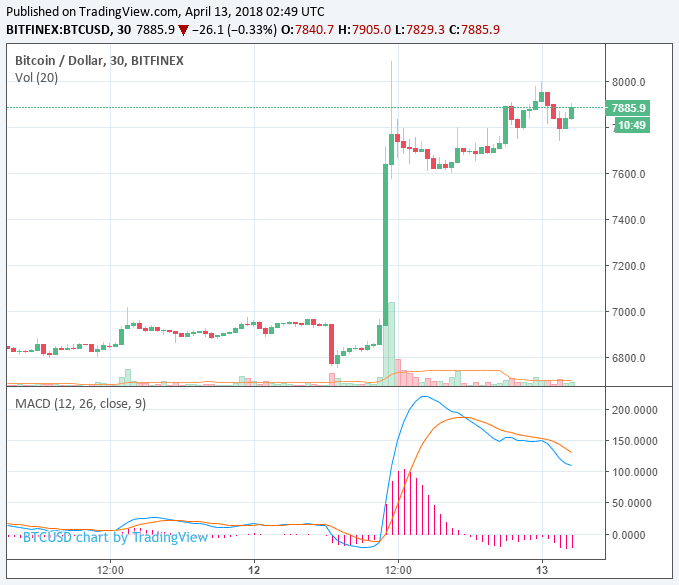
To influence the price of bitcoin, which has a daily trading volume of above $9 billion, billions of dollars would have to be traded. More importantly, billions of dollars worth of new capital have to flow into the cryptocurrency market in order for the price of bitcoin to spike up, and bring the entire market with it.
The April 12 surge in the price of bitcoin was not caused by investors cashing out from alternative cryptocurrencies (altcoins) to bitcoin or reallocating their funds from other major cryptocurrencies to bitcoin, because the valuation of the cryptocurrency market increased by more than $20 billion.
A wave of new investors or potentially a few institutional investors likely allocated billions of dollars into the market in a short period of time, causing a short-term pump and leading the price of the cryptocurrency to surge.
It is virtually impossible to pinpoint a single factor to justify the price trend of any cryptocurrency, because a variety of factors can contribute to the momentum of a cryptocurrency. In this case, the question of whether the price of bitcoin increased due to the entrance of institutional investors or retail traders is of less importance. The crucial takeaway is that bitcoin has achieved the $7,500 support level which it had eyed throughout April, and the recent price increase could allow bitcoin to rebound to the $8,000 region with strong momentum.
Bottomed Out
On April 12, CCN reported that Pantera Capital, one of the longest lasting cryptocurrency-focused hedge funds in the global market, has called for a bottom for bitcoin and predicted the market to rebound soon to reasonable levels.
“For those who are new to Pantera who might think a fund manager like Pantera would always be saying ‘Today’s a great day to get long. I rarely have such strong conviction on timing. A wall of institutional money will drive the markets much higher,” Pantera Capital CEO Dan Morehead and Augur founder Joey Krug, who also works as an executive at the hedge fund.
Investors and traders have grown tired of considering the entrance of institutional investors and retail traders as a major factor the long-term price growth of bitcoin and other cryptocurrencies. The truth is, the demand from institutional investors has been non-existent to this date. But, in April, the outlook on cryptocurrency market by retail traders have changed, following the entrance of George Soros, the Rockefeller family, and the Rothschild.
The Decent.Bet Blockchain Casino Is Delivering Technology Fast! Matthew Tompkins · January 30, 2018 · 12:00 pm Doesn’t it seem to take forever for a new ICO to deliver on their promises? Decent.bet, the community-owned […]
“There’s no such thing as a safe hard fork,” lead developer Thomas Voegtlin corrected an audience member at the conference in Paris last weekend. “I would recommend to have replay protection, of course,” he added.
Community support for SegWit2x, the bitcoin spearheaded by Barry Silbert’s, was virtually absent in Paris. Whenever the “2x” part of the was discussed in the French capital, speakers and visitors overwhelmingly considered it a risk to defend against — not a proposal to help succeed.
Electrum users, for example, will not blindly follow hash power in case of a chain-split, Voegtlin explained throughout his talk; instead, they’ll be able to choose which side of such a split they want to be on. And importantly, the lightweight wallet will implement security measures to prevent users from accidentally spending funds on both chains: “replay protection” that seems unlikely to be implemented on a protocol level if SegWit2x does fork off.
“We are ready,” Voegtlin said. “If [SegWit2x] doesn’t include replay protection, the fork detection we have in Electrum will be useful.”
the successful conference format, the French bitcoin community hosted the first edition of Breaking bitcoin two blocks from the Eiffel Tower last weekend. bitcoin developers, academics and other technical-minded Bitcoiners gathered for a diverse program, but with the common denominator being bitcoin’s security.
“For the past two years, the bitcoin community has been obsessing with scale and scalability,” Kevin Loaec, managing director at and co-organizer of the event, told bitcoin Magazine. “But I’m not so worried about scale, I’m worried about mining centralization, a lack of privacy and fungibility … these kinds of things. As an industry we need to recognize there are more challenges than just scalability; hopefully this conference reflects that.”
Whereas the first Scaling bitcoin conference two years ago was a very specific reaction to a looming block size limit increase hard fork — then put forth by — this wasn’t necessarily the motivation behind Breaking bitcoin. Yet, once again, a controversial hard fork is looming on the horizon. This time imbedded in the BTC1 implementation developed by co-founder Jeff Garzik, the New York Agreement’s SegWit2x is scheduled to increase bitcoin’s “base block size limit” to two megabytes by November — an incompatible protocol change that could split the bitcoin network in two.
And it did not take much to recognize how unpopular the proposal was in Paris. Perhaps most vividly, Italian bitcoin startup led a protest campaign by distributing NO2X stickers; the Twitter hashtag was proudly added as a piece of flair to the by now well-known Make bitcoin Great Again and UASF hats. And voices critical of the project — like Voegtlin and his call for replay protection — could consistently count on rounds of applause. From a technical perspective, the proposal is often considered — quite frankly — to be reckless.
“Unfortunately, SegWit2x […] was designed to effectively be as disruptive to the minority chain,” engineer and author James Hilliard said on stage during the miner panel.
SegWit2x: The Arguments
Arguments against the 2x hard fork are diverse.
Perhaps its biggest problem, SegWit2x currently lacks basic safety measures to prevent unsuspecting users from losing funds. This includes, most importantly, the aforementioned replay protection, but a new address format would be similarly helpful.
Additionally, the three-month lead time for this specific hard fork is considered extremely short — assuming the goal is to prevent a chain-split in the first place. “If you ask any of the developers, they will typically want to see 18 months or two years lead time, for something with as wide an impact on all the software and hardware out there as a hard fork,” co-founder and inventor Dr. Adam Back noted during a Q&A session.
And if the chain does split into different networks and currencies — one following the current bitcoin protocol and one adopting the hard fork — the question becomes which of the two gets to use the name “bitcoin.” So far, proponents of the SegWit2x hard fork have shown no willingness to pick a new name.
This branding issue, contributor and co-founder Eric Lombrozo pointed out, provides yet another point of controversy.
“My personal opinion is that whomever is proposing the change, the onus is on them to demonstrate widespread support,” Lombrozo said during his talk on protocol changes. “The people that want to keep status quo don’t need to show anything. It’s the people who want to change the stuff that actually need to demonstrate there is widespread support.”
And for now, not everyone is convinced that SegWit2x does indeed have this level of support — or anything close to it. While several large mining pools, as well as a significant number of companies, have signed on to the New York Agreement, this agreement was itself drafted without any feedback from bitcoin’s technical community nor — even more important — a reliable gauge of user sentiment.
And while some bitcoin companies claim to represent their customers, this is — once again — not taken for granted by everyone.
“One debate I want to draw attention to,” venture capitalist Alyse Killeen pointed out, “is the debate whether businesses speak for their users. I think this is probably a debate you would only see now in this space because it’s pretty well established that businesses outside of this space do not speak for users, but it’s a debate we still have in our community. Of course they don’t.”
NO2X
If Breaking bitcoin in Paris can be considered at all representative of SegWit2x’s community support — which, it should be noted, is not necessarily the case — the proposal will face an uphill battle to be widely accepted in November.
Indeed, some signatories of the agreement are not so sure about the hard fork anymore: and have publicly backed out of the agreement. And, during a mining panel in Paris, CIO Alex Petrov ever so slightly opened the door to potentially withdrawing support as well, if both the original and the 2x chain manage to survive.
In fact, it’s not just that contentious hard forks are considered a threat to be defended against by bitcoin’s technical community. It goes beyond that.
In the words of bitcoin developer Jimmy Song, at the conclusion of his opening talk of the event:
“What doesn’t kill bitcoin makes it stronger. And conferences like this prove that we’re getting better at this. We’re getting immunized to all these hard forks, and it’s creating a better bitcoin as a result, and that’s a very good thing. We’re securing against a lot of these attacks, and figuring out ways to mitigate these threats.”
La naissance des royaumes francs et la fin de l’Empire romain d’occident Facebook : https://fr-fr.facebook.com/lhistoireparlescartes/ Cette vidéo est une collaboration. Le texte a été écrit par Bernard Leboucq, un passionné d’histoire des Francs. J’ai ensuite […]