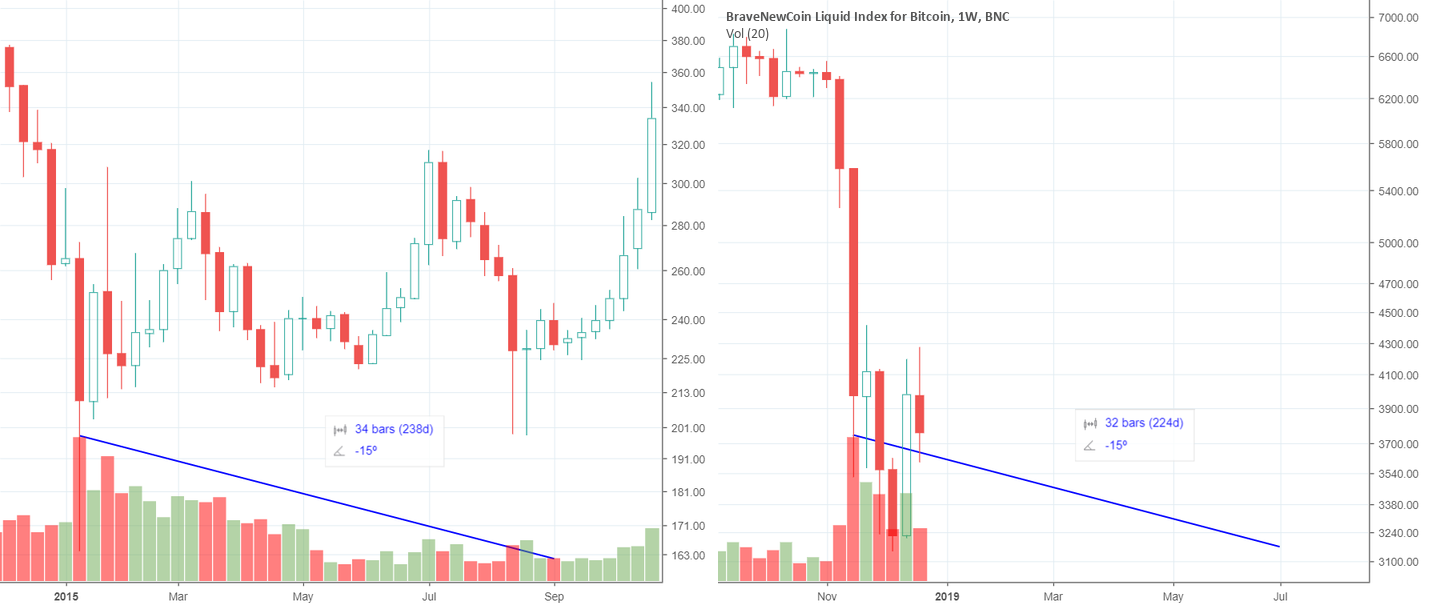
I’m fortunate to have a boss who majored & mastered in finance and thesis on use of lagging indicators such as , , etc. and day trader of 20 years. Yesterday, we had a discussion about TA in general. He said the most important factors are and patterns. I hadn’t really considered regular time as important before so I decided to compare the during the previous (2015) bear market bottom with the present (assumed) bear market bottom.
As we can see, logically the selling (red) decreases as the sellers dry up. Then the price begins to get some traction and start another glorious bull run. I have copied the % of the angle of the decrease in from 2015 just as a template, the point is: the decreases. Also, IF the bottom HAS been made, it was 1 month (last bear was 13 months so 1 month = 7.69%) shorter than the previous bear market so I have also reduced the length of the estimated bottom accordingly.
This is NOT meant to be a precise prediction or financial advice, of course of course of course. Just an interesting observation.
I think/hope this makes sense, if not, leave comments and discussions below.
bitcoin payments may be accepted at over 260,000 stores in Japan by this summer following partnerships between the country’s bitcoin exchanges and major retailers.
Japanese electronics chain has partnered with Tokyo-based bitFlyer, which runs the country’s largest bitcoin exchange that currently comprises of the bitcoin market.
This Friday, Bic Camera’s flagship shop in Tokyo’s Yurakucho district along with Bicqlo Bic Camera, a hybrid outlet with Uniqlo, will begin a trial run using bitFlyer’s bitcoin payment system, to the official release.
Customers will be able to pay up to 100,000 yen (~$900 USD) with bitcoin, which will also include reward points at the same rate as for cash payments. The trial will determine if Bic Camera will expand bitcoin payments to its other 39 nationwide locations.
Meanwhile, another Tokyo bitcoin exchange, Coincheck, has partnered with , the retail support arm of human resources conglomerate .
, which currently holds 99% of the bitcoin payment market share in Japan, will bring bitcoin payments to shops that use AirRegi, a point-of-sale app developed by Recruit Lifestyle, by this summer.
To pay with bitcoin, customers can simply scan the barcode displayed on the app. Coincheck will process the transaction, converting the bitcoin into yen for the merchant.
Additionally, the app also supports Alipay, China’s leading third-party payment solution. However, Chinese tourists visiting Japan will be able to finally spend their bitcoin, something they cannot do in their home country.
Today, the most popular electronic payment options in Japan include Suica andRakuten’s Edy, which are accepted at 380,000 and 470,000 locations, respectively. But with these recent moves, virtual currency could soon enter their ranks as AirRegi terminals are already used at 260,000 eateries and other retail locations nationwide.
Japan: Land of the Rising Bits
bitcoin transaction volume in Japan began to since 2016, and in January 2017 its volume exceeded 541.1 billion yen (about 20 times compared to the same period last year).
Just recently, on April 1, 2017, Japan’s Payment Services Act for virtual currencies , recognizing bitcoin as a legal payment option while forcing cryptocurrency exchanges to register with the government. Starting in July, purchases of virtual currency will be exempt from the consumption tax.
Overall, the new regulations and tax incentives are expected to boost consumer confidence and growth of the domestic virtual currency market, which already had accepting bitcoin.
Will these new partnership make bitcoin a mainstream payment method in the country? Share your thoughts below!
Susan Athey: The Economics of bitcoin & Virtual Currency Susan Athey explains how bitcoin works, and why virtual digital currency might change the way consumers and financial institutions do business. Athey is the Economics of […]