Bitcoin Trading Volume Tops $11 Billion For First Time In Nearly a Year
Daily trading volume for the world’s largest cryptocurrency bitcoin exceeded $11 billion Friday, the most observed in a 24-hour period since April 25 of last year.
At that time, the average price of bitcoin was $8,845, while today the crypto asset is listed for less than half the price, currently trading at $3,951 as per . However, the return in volume is potentially a sign investors aren’t losing interest in bitcoin despite the less than favorable market conditions.
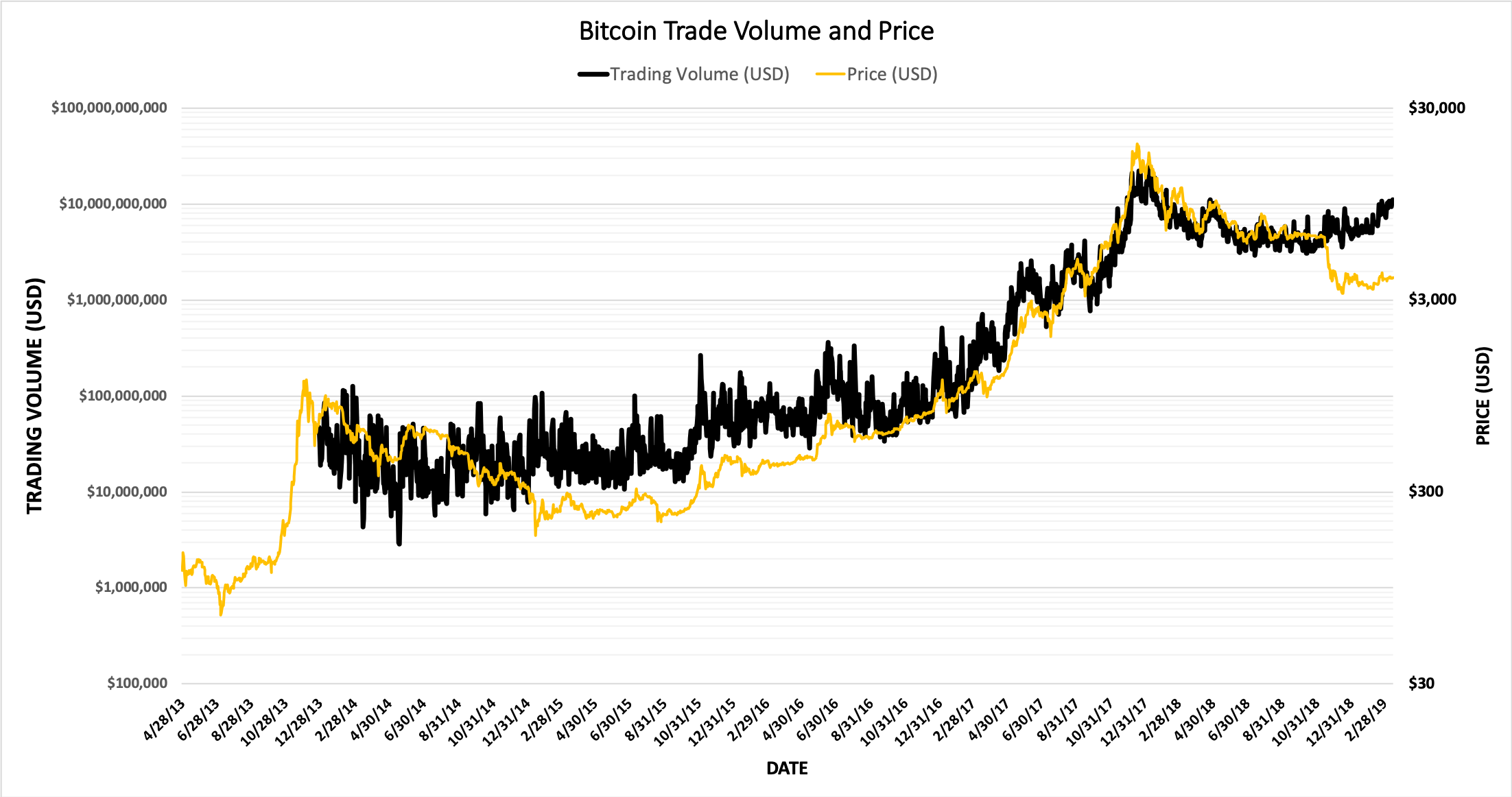
Interestingly, the amount of bitcoin trade volume had closely aligned with it’s price trend for years, but upon closer examination, the close connection ended during the in November when trade volumes failed to sink along with the quickly depreciating broader cryptocurrency market.
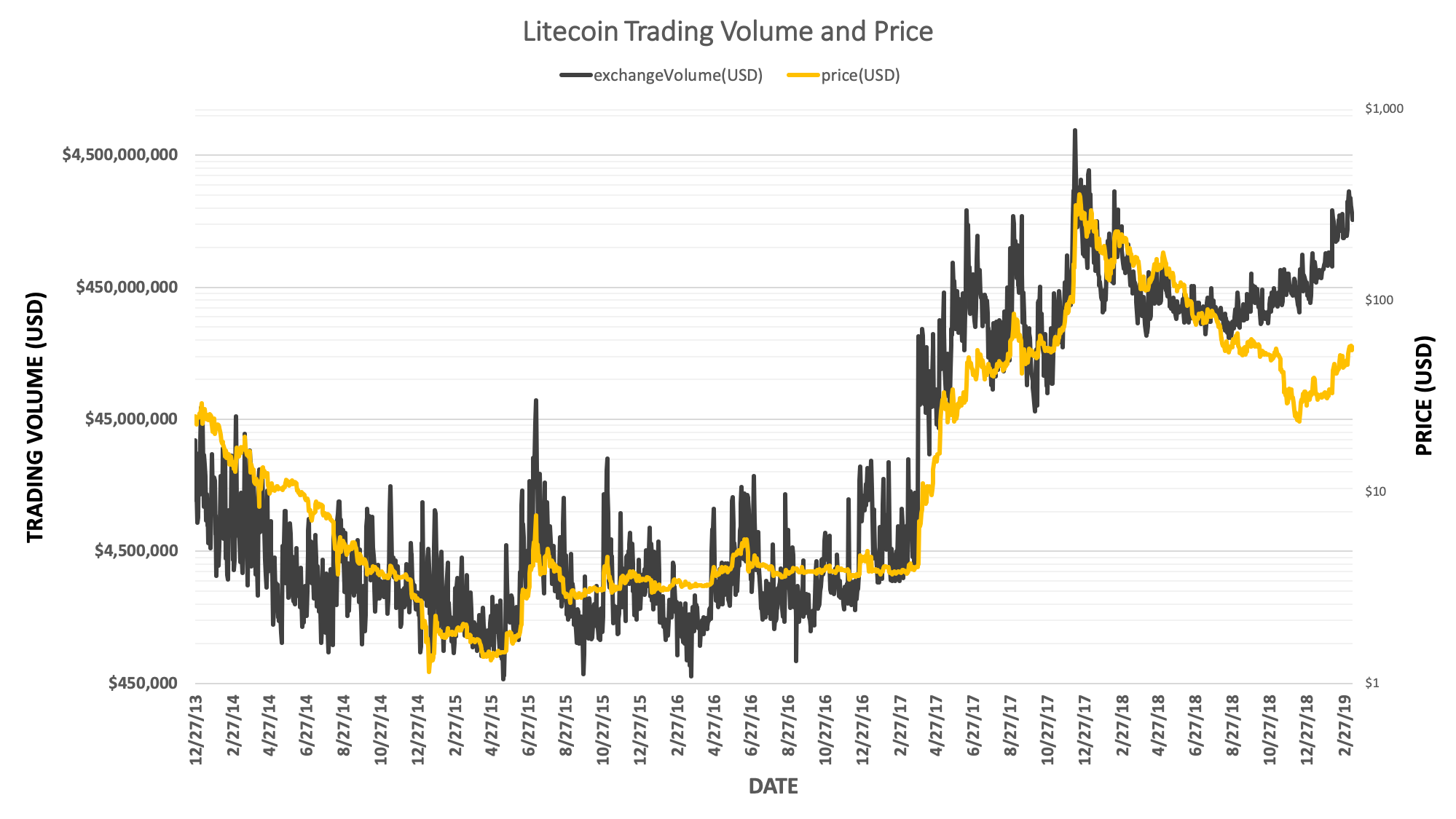
As can be seen below, the divergence between trading volume is evident for not only bitcoin, but other top-ranked cryptocurrencies like the fourth-largest in the world by market cap, litecoin (LTC).
Just before the plunge to $3,000, bitcoin was priced at $6,385 on Nov. 10 when it accumulated $3.70 billion in 24-hour exchange volume, according to data from .
Today, however, bitcoin’s price is nearly half of what it was in November, yet its trading volume is just above $11 billion, which is 200 percent more than the trading volume seen on Nov. 10 and a value last commonly observed in April 2018.
Coinmarketcap data further reveals the most exchange volume the world’s largest cryptocurrency ever saw in a single day was $23.84 billion when bitcoin’s price was $17,429.50 on Jan. 05, 2018.
Litecoin Exchange Volume
Litecoin’s exchange volume is following a similar trajectory as bitcoin’s exchange volume.
As can be seen above, exchange volume began to deviate from litecoin’s price trend around November once again, when the cryptocurrency was trading in the $50 dollar range and exchange volume figures spanned from roughly $300 million to just over $600 million, according to data from .
Litecoin’s is now trading at $58 and its 24-hour exchange volume registers $1.79 billion – again, more than double the values frequently observed before the cryptocurrency plunged below $30 in November.
The slight difference between litecoin and bitcoin’s trading volume and price relationship is that litecoin’s price has increased over 100 percent since its December low along with the rise in exchange volume, while bitcoin has seen a more seldom 20 percent increase from its low.
Disclosure: The author holds BTC, LTC, ETH, ZEC, AST, REQ, OMG, FUEL, ZIL, 1st and AMP at the time of writing.
Is This Crypto The IOTA of China? | CPChain CPC | Internet Of Things (IoT) | Cyber Physical A.I. CpChain (CPC) is a decentralized infrastructure for next generation IoT systems. It is currently an ERC-20 […]
Ripple’s XRP incubator invests in private payment channel solution from Bolt Labs Ripple’s XRP incubator invests in private payment channel solution from Bolt Labs ⋆ Crypto New Media Home 2019 April 17 News Ripple’s XRP […]
The hard fork part of the is scheduled to take place within about two weeks. This incompatible protocol rule change is set to increase bitcoin’s block weight limit, to allow for more transactions on the network — if everyone adopts the change. Otherwise, it will create a new blockchain and currency that be considered to be “bitcoin.” The list of signatories of this agreement includes several of the largest bitcoin startups and mining pools that, together, claim to represent a majority of users and hash power. Yet, it is far from clear that this part of proposal really has much support outside of these signatories. Most of bitcoin’s , a significant number of , some , as well as suggest otherwise.
And now, a growing list of international bitcoin communities is putting out public statements against the SegWit2x hard fork as well.
— the largest and longest-running bitcoin meetup in South Korea with over 1700 members — was the first user community to put out a on SegWit2x. More precisely, in their own words, the group voiced its “staunch opposition to this November’s proposed hardfork.”
In its statement, the Seoul bitcoin Meetup places emphasis on the manner in which the agreement was made. Typically, changes to the bitcoin protocol go through the Improvement Proposal (BIP) process where it is peer reviewed by developers across the ecosystem, whereas SegWit2x went through the New York Agreement, which was forged at an invite-only meeting among about a dozen company executives.
The Seoul Meetup states:
If a select group of CEOs and investors, no matter how benevolent their intentions, can unilaterally make decisions about the consensus rules without public comment and force these changes upon the network regardless of overall consensus, then bitcoin will have lost the properties that make it valuable in the first place.
Additionally, the Seoul bitcoin Meetup argues that the hard fork is needlessly risky without offering sufficient benefits to warrant the risk. It also takes issue with the of SegWit2x developers not to implement strong replay protection.
On the same day as the Seoul Meetup Group, the Munich meetup group also put out a public statement against the SegWit2x hard fork. This meetup group consists of over 2000 members — though only several dozen of them actually engaged in the vote whether or not the statement against the SegWit2x hard fork would be accepted. This itself was spread via on social media.
In its statement, the bitcoin Munich meetup explains it opposes the SegWit2x hard fork in part because of technical concerns:
Another doubling of the block size so quickly after SegWit seems hasty and might cause further mining centralization.
The statement further argues that a hard fork requires more and better preparation and should include more improvements from the, and it endorses bitcoin Core as “the true bitcoin client.”
The biggest user community also published the longest against the SegWit2x hard fork so far. A combined effort between a significant group of Argentinian and Brazilian users and companies, published on October 17,2017, voiced “their deepest concerns over the upcoming November hardfork as mandated by the so-called New York Agreement (NYA), also known as SegWit2x (S2X).”
Not unlike other critics of the hard fork, emphasis was placed on the process that led to the SegWit2x agreement:
The very nature of an ‘agreement’ between a few parties in a decentralized consensus protocol can be interpreted as an aggression against the network.
Similarly, the statement addresses the lack of transparency from SegWit2x proponents, criticizing the notion of a “political compromise instead of a technical upgrade” and the “consensus imposition instead of consensus building.”
Other points of concern include the lack of replay protection, the rushed nature of the hard fork, misleading statements by SegWit2x proponents and much more.
The Israeli bitcoin Association is a non-profit organization that promotes bitcoin and similar technologies in Israel, with an open membership. On October 24, 2017, this association put out its own on the SegWit2x hard fork.
Slightly different from several of the other statements, the Israeli bitcoin Association emphasizes the right of anyone to fork bitcoin and create a new cryptocurrency. That naturally includes SegWit2x proponents.
But importantly, the association adds:
A protocol change in the currency holding the name ‘bitcoin’, especially one requiring a hard fork, requires overwhelming consensus. The SegWit2x hard fork does not in any way enjoy such consensus, and while this remains the case we cannot refer to the resulting currency as ‘bitcoin.’
The SegWit2x currency will instead be referred to as “‘Bitcoin2x.’ ‘SegWit2x coins,’ BT2, B2X, S2X or any other distinctive term that the industry will adopt.”
The Hong Kong bitcoin Community / bitcoin Association of Hong Kong
The Hong Kong bitcoin Community in general, and the bitcoin Association of Hong Kong specifically, put out against SegWit2x on October 25, 2017.
While technically separate statements, both voice their concern about the lack of consensus for the hard fork. The Hong Kong bitcoin Community — a group of Hong Kong–based companies — states that “the lack of enthusiastic support for this fork among the community is striking.” The association — which mostly exists to promote bitcoin in Hong Kong — states that “the proponents of the hardfork should kindly ask the bitcoin community to support them and then only proceed with the hardfork if there is widespread community support.”
Additionally, the Hong Kong groups speak out against the lack of replay protection in the SegWit2x fork.
Due to the combination of both a lack of consensus across the community and a lack of strong replay protection, we consider SegWit2x a reckless endeavor that will cause disruption and harm to the ecosystem.
The Italian bitcoin community, more specifically a group of companies, meetups, lobbying groups and other organizations, put out a against SegWit2x on October 31, 2017.
The statement is largely inspired by an earlier by the Italian blockchain research lab , which rejected SegWit2x as “an attempt to perform a political takeover of bitcoin.”
The statement by the broader Italian bitcoin community is a bit more compact, but nonetheless touches on many of the familiar points of criticism regarding the SegWit2x hard fork. It reads:
The opposition is especially strong against any action of this kind that could cause huge inconveniences for service providers and serious confusion for users, potentially leading to financial losses: unilateral attempts to appropriate bitcoin name, logo or “ticker”, attempts to mislead light-clients and SPV wallets on alternative networks not explicitly chosen by them, attempts to launch new coins in a way which leave users vulnerable to “replay attacks” or address format confusion, attempts to attack the network with a temporary hashing-power majority in order to create disruptive reorgs or to slow down the normal activity.
Meanwhile, the French-speaking bitcoin communities are voicing their concerns with the SegWit2x hard fork through a. It is currently signed by over 1300 people and counting.
The (French) text that accompanies the petition is mostly inspired by and based on the statement published by the Seoul bitcoin Meetup. Like that statement, this petition emphasizes concerns about the manner in which the agreement was forged, while also noting the lack of replay protection and other problems.
Additionally, the petition includes a call to action to find alternatives for the companies that signed onto and continue to support the SegWit2x hard fork:
We would suggest avoiding the use of services of companies that support the NYA, and we hope to substitute them with alternative solutions.
Are they any more user communities that have put out statements against or in favor of the SegWit2x hard fork? Let me know at aaron@bitcoinmagazine.com.