April 17, 2026

Capitalizations Index – B ∞/21M

Bitcoin Trading Nets Square $37 Million in Q2 2018

Bitcoin trading nets square $37 million in q2 2018

Bitcoin Trading Nets Square $37 Million in Q2 2018

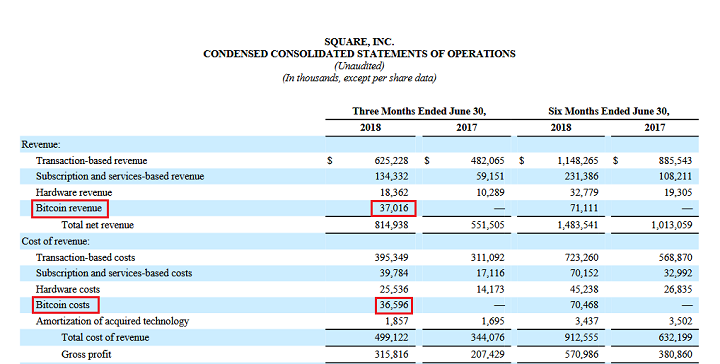
Square has announced earnings of $37 million for the second quarter of 2018 on its peer-to-peer mobile money app, Square Cash. However, even though some of its financial results exceeded expectations, the company still made a net loss of $6 million across the business. 


Steadily Increasing bitcoin Trading Revenue

Based on the second quarter performance report released by Square, bitcoin trading revenue is steadily increasing. However, despite this increase, the company barely made a profit on BTC trading in Q2 2018. Square incurred $36,596,000 as the operational cost on BTC trading — meaning the company made less than a profit of $1 million on bitcoin trading.
Bitcoin trading nets square $37 million in q2 2018

While the BTC trading feature on the Cash app is still in its early stages, critics have been quick to point out the lack of returns as a potential problem for the company.

In May 2018, the company announced that it traded $34.1 million worth of BTC in the first four months of the year. Square, however, made a profit of $200,000 — because it spent $33.9 million purchasing the BTC sold in that period.

A large percentage of Square’s operational cost for BTC trading stems from the amount of money spent in pursuing the swath of state and federal licenses required to legally trade cryptocurrency in the United States. Recently, the company became the seventh recipient of the notoriously difficult to obtain New York state BitLicense for trading cryptocurrencies in the state.

Square Share Price Boosted by Cryptocurrency Involvement

Despite the seemingly slow pace of growth from an earnings perspective, Square’s foray into the cryptocurrency space hasn’t been without its positives. Over the last twelve months, the company’s share price has increased by more than 200 percent.

Bitcoin trading nets square $37 million in q2 2018

The Square Cash app has also become one of the most popular mobile financial applications in the United States. Recently, it was revealed that the app had outstripped PayPal’s Venmo growth by as much as 300 percent.

Square CEO, Jack Dorsey, is a big believer in bitcoin. Earlier in the year, he declared that he believed bitcoin is the likeliest candidate for a single global currency within the next decade.

Do you think Square’s earnings from bitcoin trading will increase once all the necessary state and federal licenses have been obtained? Let us know in the comment section below. 


Image courtesy of Square and Tradingview.

Published at Fri, 03 Aug 2018 01:00:55 +0000

bitcoin

Previous Article

UBS: Bitcoin Must Hit $213,000 to Replace US Money Supply

Next Article

30 year old OYSTER {Catch Clean Cook} Best Po’ Boy EVER!!!

You might be interested in …

177 – Jason Teutsch & Christian Reitwiessner: TrueBit, Scalable Off-Chain Computations for Ethereum

Support the show, consider donating:BTC: 1B9JXncTuGtZx2yUTUjHXWDjugvkjtBQrw (http://bit.ly/2olzP8m)ETH: 0x8cdb49ca5103Ce06717C4daBBFD4857183f50935 (http://bit.ly/2nKneP1)

bitcoin and Ethereum miners collectively make up what is perhaps the most powerful computational resource in the world. However, mobile phones from the early 2000’s could arguably run more complex operations than these networks combined. While blockchains themselves may never reach the level of computational power of modern computers, they may be leveraged as the underlying verification layer for centralized computing.

We’re joined by Jason Teutsch and Christian Reitwiessner. They are the co-authors of a visionary whitepaper which describes Truebit. This protocol would allow complex computations to be executed on off-chain systems while being validated by Ethereum miners. The results of these computations would consequently be available to on-chain smart contracts. Truebit makes clever use of proof systems and game theory to build a protocol where a Task Giver can ask a third party, the Solver, to execute a complex computation in exchange for a reward. Not limited to Solidity, these could be executed in traditional languages such as Go, Python or C++. Verifiers could then challenge the results, incentivising the Solver to be honest or see his reward be stripped away. This incentive structure would guarantee fast and reliable results while eliminating the need for a trusted third party.

Topics discussed in this episode:

  • Jason and Christian respective backgrounds in the ecosystem.
  • The core problem being addressed by Truebit
  • Why a scalable decentralized computational resource is desirable
  • How Truebit makes use of proof systems and game theory to enable trusted computations off-chain
  • How the verification game works the incentive structures proposed in Truebit
  • The various use cases for Truebit
  • How Truebit could allow for blockchain interoperability without the need for “”blockchain of blockchains”” type networks

Links mentioned in this episode:

Sponsors:

  • Jaxx: Wallets that Unify the Blockchain Experience Across Devices – http://jaxx.io

This episode is also available on :

Watch or listen, Epicenter is available wherever you get your podcasts.

Epicenter is hosted by Brian Fabian Crain, S?ƒbastien Couture & Meher Roy.

Decentralized Nicosia Chapter Kickoff!

Decentralized Nicosia Chapter Kickoff! Decentralized Nicosia Kickoff   We invite you to attend the launch of our Decentralized Nicosia chapter on the 25th of October at 19:00, to discuss Blockchain Technology, Cryptocurrencies and meet in-person the distinguished digital currency expert, UNIC’s […]