September 24, 2026

Capitalizations Index – B ∞/21M

Bitcoin Surging 19% Only the Beginning, Halving Will Propel to Meteoric Gains

Bitcoin surging 19% only the beginning, halving will propel to meteoric gains

Bitcoin Surging 19% Only the Beginning, Halving Will Propel to Meteoric Gains

Bitcoin surging 19% only the beginning, halving will propel to meteoric gains

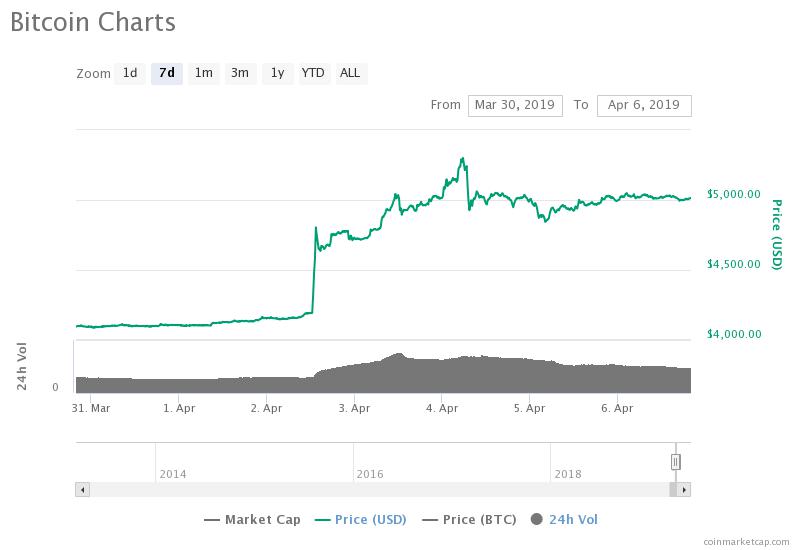
On April 1, the bitcoin price initiated a large 19 percent rally from $4,200 to $5,000, peaking at $5,300 the next day across several major crypto exchanges.

The bitcoin price surged by more than 19 percent in the past week but has slightly retraced since (source: coinmarketcap.com)

The rapid upside movement of bitcoin, which occurred in minutes, is said to have been triggered by two major factors. At $4,200, there were around $80 million worth of sell orders. As the sell orders were absorbed by buyers, it liquidated $500 million worth of short contracts.

The absorption of massive sell orders, a short squeeze of bitcoin contracts, and the lack of resistance above $4,200 are considered as the main catalysts of the recent bullish movement of the dominant cryptocurrency.

Only Just a Start For bitcoin

According to a cryptocurrency analyst, the 19 percent price increase of bitcoin was triggered by buy orders amounting to about 20,000 bitcoin, worth nearly $100 million.

Technically, if the absorption of sell orders at the $4,200 resistance level, which bitcoin failed to test for more than three months in the first quarter of 2019, the orders would amount to well over $200 million.

But, if the rest of the movement from $4,200 to the $5,000 level was triggered by 7,000 bitcoin, the analyst said that a promising rally is expected as block reward halving approaches.

“Three 7,000 BTC buy orders were the catalyst for this recent pump. That’s 0.1% of the supply bought up instantly. In 416 days the number of bitcoin created every 24 hours cuts in half. 328,500 LESS bitcoin will be created per year. This pump was just the start. Be ready,” the analyst said.

The 7,000 BTC figure came from a Reuters report, which cited Oliver von Landsberg-Sadie, CEO of cryptocurrency firm BCB Group.

Earlier this week, Landsberg-Sadie said:

There has been a single order that has been algorithmically-managed across these three venues, of around 20,000 BTC. If you look at the volumes on each of those three exchanges – there were in-concert, synchronized, units of volume of around 7,000 BTC in an hour.

Why is Halving So Important?

Analysts are carefully observing the price movement of bitcoin ahead of its scheduled block reward halving in 2020 because historically, bitcoin has tended to surge in price a year before its halving starts.

Large price orders prior to a block reward halving can be considered as a sign of confidence because the rate in which bitcoin is produced through mining drops following each halving.

Accumulation of bitcoin before a halving would imply that investors foresee the price of the asset rising as its circulating supply becomes more restricted over time.

In consideration of all factors, Peter Brandt, a widely recognized technical analyst, said that it would not surprise him if bitcoin enters a new parabolic phase during which it recovers beyond $20.000.

Whales are Buying Too

On Thursday, on CNBC’s Squawk Box, Fundstrat Global Advisors head of research Thomas Lee said that whales, or large bitcoin holders, began to accumulate the asset once again in recent weeks.

Lee cited various positive developments pertaining to the crypto industry and fundamental indicators such as improving infrastructure and rising volume.

“Bitcoin had a rough 2018 and for much of 2019, it’s been steadily climbing, and from what we can gather, it’s because there have been positive things taking place. You know a lot of the old whale wallets are buying bitcoin so it’s been slow accumulation,” he said.

Whales, most of whom sold relatively large portions of their holdings at $20,000, could be accumulating more BTC in anticipation of positive price movements ahead of the block reward halving.

Published at Sat, 06 Apr 2019 13:09:56 +0000

Previous Article

Cryptocurrency Adoption Grows Beyond ‘Bitcoin City’ in Slovenia and Croatia

Next Article

Cryptocurrency Adoption Grows Beyond ‘Bitcoin City’ in Slovenia and Croatia

You might be interested in …

Cardano Blockchain's First Use Case: Proof of University Diplomas in Greece

cardano use case

Greek graduates may soon be able to prove their qualifications by way of a blockchain.

GRNET, the national research and education network of Greece, is working on a pilot project with blockchain research and development company IOHK to verify student diplomas on Cardano, a blockchain that launched in September.

The project is notable because it is the first official use case of Cardano, a proof-of-stake-based cryptocurrency and soon-to-be smart contract platform currently under development by IOHK.

The GRNET app will be built on Enterprise Cardano, a private or permissioned ledger version of Cardano. Unlike a public blockchain, where anyone can join in and participate, a private blockchain allows only a restricted set of users to validate block transactions.

So far, three Greek universities are participating in the project. While IOHK is providing the decentralized database, GRNET is providing the web front end and support and will bring together other universities participating beyond the pilot.

Funding for the project comes in part from Horizon 2020, a European program for research and innovation. Development of the prototype is already under way, Aggelos Kiayias, IOHK’s chief scientist, told bitcoin Magazine.    

Why Diplomas?

Given IOHK’s deep ties with academia, it is no surprise to find the company working on a project that involves universities. But why diplomas?

Putting diplomas on a blockchain takes the paperwork out of the process and makes it easy and simple to check if someone holds a degree.

Typically, when a student graduates, they receive a paper copy of a diploma signed by the dean and co-signed the university’s registrar. All of the students’ transcripts and records are stored in the university’s centralized database.

To confirm that a graduate has the degree they claim to have, an employer has to check the official diploma or call the university. The labor-intensive process makes it too easy for unqualified applicants to slip under the radar.

Putting documents and records on the blockchain eliminates opportunity for fraud in that it allows graduates and universities to “issue a proof that a qualification exists that is undeniable,” said Kiayias. “This is a point of reference that can be agreed [on] by everyone.”

Cryptographic Proof

But to protect student privacy, instead of putting an entire diploma on the blockchain, GRNET plans to put only a cryptographic hash of a diploma on the blockchain.

Digital documents are easy to alter in ways that are undetectable to the human eye. But as long as the digital version shown to an employer hashes to the same output as what is stored on the blockchain, that proves the document is the original, unaltered version.

“We cannot put any plaintext on the blockchain, as diplomas and transcripts are personal information. We only put hashes; we may put entire diplomas and transcripts, but they will always be encrypted,” Panos Louridas, GRNET consultant and associate professor at Athens University of Economics and Business, explained to bitcoin Magazine in an email.

This is not the first effort to store diplomas on the blockchain. In October, MIT announced its own pilot project to verify digital diplomas using the blockchain.   

But Louridas claims the GRNET pilot is different from prior projects in that it stores the entire chain of verification steps on the blockchain. Each step would be recorded as its own immutable transaction on a separate block in the blockchain.  

“You don’t really need a blockchain to store diplomas: a simple system with some digital signatures by the host institution would do,” he said. “We want to be able to record that somebody has asked for proof of a degree, that the proof has been granted, that the proof has been forwarded to a verifier, and that the verifier can verify that the degree is valid, and nobody can dispute any of the above steps.”

The three Greek universities taking part in the pilot include Aristotle University of Thessaloniki, Democritus University of Thrace and Athens University of Economics and Business.


The post Cardano Blockchain's First Use Case: Proof of University Diplomas in Greece appeared first on Bitcoin Magazine.