January 26, 2026

Capitalizations Index – B ∞/21M

Bitcoin Price Moves Towards $9,000 With Strong Momentum, Bull Market

Bitcoin price moves towards $9,000 with strong momentum, bull market

Bitcoin Price Moves Towards $9,000 With Strong Momentum, Bull Market

Bitcoin price moves towards $9,000 with strong momentum, bull market
Advertisement

Join our community of 10 000 traders on Hacked.com for just $39 per month.

The bitcoin price has surpassed $8,800 after rising more than 6 percent over the past 24 hours. Volumes across major cryptocurrency exchanges remain strong and the daily trading volume of the market has increased past $26 billion for the first time over the past month.
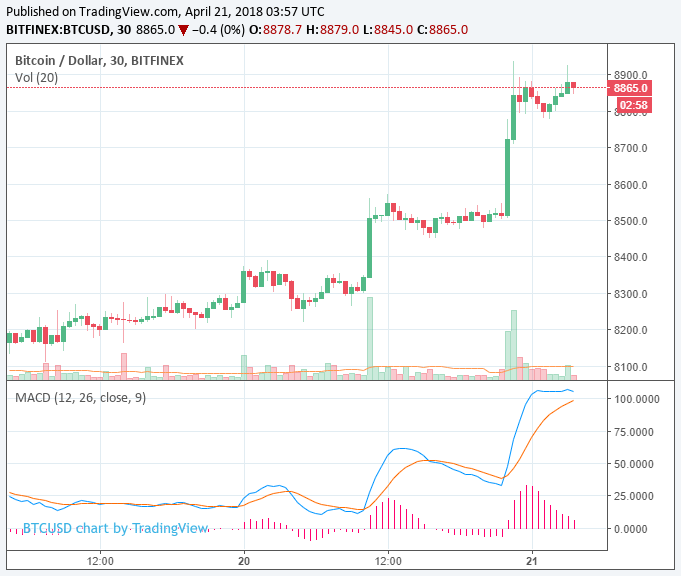
Bitcoin price moves towards $9,000 with strong momentum, bull market

$9,200

On March 21, the bitcoin price tested the $9,200 support level but failed to sustain momentum for mid-term growth and fell below the $6,500 mark within two weeks after struggling to bounce off $8,200.

At this juncture, it is likely that the bitcoin price tests the $9,200 level it had touched in late March, and a movement past that level would lead the bitcoin price to the $10,000 region by the end of April.

In November 2017, investors described the $10,000 mark as a psychological threshold and a key milestone. At the time, traders predicted the price of bitcoin to surge substantially subsequent to surpassing $10,000. Almost immediately after breaking into the $10,000 region, the bitcoin price surged to $14,000 and eventually to $20,000.

Since the initial correction of bitcoin in February, the market has not been able to demonstrate any sign of stability. The price of most alternative cryptocurrencies (altcoins) and tokens followed the short-term trend of bitcoin and the volume of regional exchanges in Japan and South Korea significantly decreased.

Fundamentally, bitcoin is in an ideal position to initiate a new rally in both the short and mid-term, given that the adoption of cryptocurrency in general has started to increase. Moveover, in late 2017, the majority of speculators who bought into the cryptocurrency market did so out of FOMO, or fear of missing out, without solid knowledge in the structure and fundamentals of cryptocurrencies.

Over the past five months, the awareness of cryptocurrency has increased drastically and a substantially large number of individuals have started to understand the basics of decentralized financial networks and cryptocurrencies.

As such, fintech company Smart Valor CEO Olga Feldmeier stated that in the next two years, the bitcoin price will reach a value of $100,000, and within 2018, the bitcoin price will surpass its previous high at $20,000.

“I believe that we will see a comeback to the height achieved at the end of 2017 this year. Over the next two years I still predict we could see it reach a value of $100,000,” Olga told The Independent.

Rise of Altcoins

Throughout this week, CCN reported that the altcoin season may have started with strong consistent performances of small cryptocurrencies and tokens. Today, several tokens like STORM have recorded a gain of above 30 percent against bitcoin and about 40 percent against the US dollar.

Investors have gained more confidence in the cryptocurrency market and are now willing to take more risks by investing in cryptocurrencies with higher volatility and lower liquidity.

Still, in an interview with FT, Ethereum creator Vitalik Buterin stated that the valuation of most altcoins or tokens cannot be justified and are overblown. “There’s projects that never had a soul, that are just like, ra-ra, price go up. Lambo, vrromm, buybuybuy now!” Buterin said.

Featured image from Shutterstock.

Follow us on Telegram.
Advertisement

Published at Sat, 21 Apr 2018 04:22:00 +0000

bitcoin Analysis

Previous Article

[Bitcoin] #52 Bitasean เหรียญใหม่ก้าวไกลสู้อาเซียน [สายขุดมาทางนี้]

Next Article

The Easy Guide to Building Your Own Online Casino in Just 5 Minutes

You might be interested in …

How to Secure Your Cryptocurrency Wallet: 16 Simple Tips for Beginners

Literally millions of people have joined the world of cryptocurrencies recently. For example, Coinbase, one of the biggest cryptocurrency exchanges, has added around 2 million new clients within two months. Blockchain.com, the major electronic wallet, found its client base increase by 1.8 million during the same time frame.


Most of these people are newbies, unacquainted with security issues and risks that surround complex but currently profitable cryptocurrency realm. This makes them easy targets for cybercriminals and thieves.

One popular crime which is conducted on cryptocurrency traders is the phone-porting attack. Crooks monitor social media in search of cryptocurrency discussions wherein people publish their emails and phone numbers for quick connection. After that, hackers use various social engineering techniques and posing as a victim, call the telephone provider and trick the customer support rep into transferring the telephone number to a phone they control. As soon as hackers take charge of the telephone number, they log in to the victim’s wallet or exchange account, reset the password and subsequently snatch all funds from the account.

A phone number is not the only security weak point. Hackers may get hold of your home PC too. Phishing attacks, Ponzi schemes, and ransomware are all widespread forms of cryptocurrency fraud and theft. Nothing teaches a person about security quicker than cybercriminals hacking his account and running off with $5,000 worth of Bitcoins. Once this happens, people tend to get really serious about their security.

So, what is the best method to safeguard your cryptocurrency assets from hacks? We must confess there is no ideal approach to the problem. In this digital age, hard drives, laptops, and phones are becoming the brand new bank vaults. Real-world experience and understanding of how to protect money from thieves are not sufficient for the virtual money.

How to Secure Your Crypto Wallet Like a Boss

How to Secure Your Crypto Wallet Like a Boss

The following tips can be used as a security guide for new cryptocurrency aficionados:

  1. Securing your software wallet is similar to protecting any data on your computer. You have to be a little more paranoid while browsing the Internet, clicking on links and email attachments.
  2. Mobile users may take advantage of Google authenticator with a single IP in its whitelist, which should be the VPN to access the online exchange.
  3. It is important to select an exchange that is not only flexible and easy to use but also reputable and secure. Try to follow the news. If industry leaders disengage from a project it should be a worrying signal. Repeated technical problems and strange policies are additional points of concern. bitcoin withdrawal difficulties will always be a red flag also.
  4. Do create backups. Kept in a secure place, a backup of your cryptocurrency wallet may save you from hardware failures and a lot of human slipups. It will also let you restore your wallet in case your PC or telephone gets stolen.
  5. Encrypting the wallet or your hole device enables you to create a password for those attempting to take out any money.
  6. Although passwords and encryption can protect from thieves, it is not able to put a stop to key-loggers or another malware. It is important to install and keep up-to-date leading antivirus and antimalware solutions. Many of them are free to use.
  7. Prior to creating an account on any exchange, set up a new email box that you will be using for that specific exchange account.
  8. Be sure to choose a very difficult and lengthy password, desirably a passphrase. Write it down on paper and store that piece of paper in a secret place.
  9. Turn on two-factor-authorization not only for login but for any transaction procedures.
  10. While on social media or forums, do not mention what cryptocurrency exchange or wallet you use.
  11. Contact your phone carrier and order all possible levels of security they can offer. Add passcodes, secret questions, pins, etc. Additionally, enable the “do not port” option for any new SIM card.
  12. Web exchanges and wallets all claim they treat security very seriously and implement all necessary protection technologies to prevent breaches and unauthorized transactions. Do not trust these words. Such companies are not banks; they often do not have the same level of security. And even banks get robbed often.
  13. Do not store all Bitcoins in one wallet or exchange. Diversify your risks. It is extremely difficult to steal money from several wallets at once, particularly when you set different email accounts and passphrases for each of them.
  14. Consider keeping big cryptocurrency sums in cold wallets off the Internet. The cold wallet is a technology of keeping Bitcoins offline on hard drives or even paper. Hackers will not be able to reach your funds. On the contrary, the hot wallet is linked to the Internet. It should be used for everyday transactions and is like a checking account, whereas cold wallet may represent your savings account.
  15. Consider examining decentralized exchanges. The difference between decentralized and centralized exchanges is that decentralized exchange does not store your funds. Nobody can gain access to your money except you.
  16. Tell your peers and especially close friends and relatives to embrace the same attitude and mindset. Ecosystems, where all participants treat security seriously, are less attractive to cybercriminals.

Try to always help beginners to buy and sell with security. This territory is new and we should assist people who are trying to find their way. Fortunately, you do not have to be a cryptography professional to make the first security steps which will save you from most of the problems.

Do you take any additional wallet security measures that are not on this list? Let us know in the comments below.


Images courtesy of Wikimedia Commons, AdobeStock

The post How to Secure Your Cryptocurrency Wallet: 16 Simple Tips for Beginners appeared first on Bitcoinist.com.

В Москве планируют увеличить число имущественных сделок на блокчейне

ForkLog В Москве планируют увеличить число имущественных сделок на блокчейне На первом этапе реализации проекта внедрения автоматизированных услуг в Москве ежемесячно будет проводиться около 5 тысяч сделок регистрации недвижимости с помощью технологии блокчейн. Об этом […]