
February 13, 2026

Capitalizations Index – B ∞/21M

Bitcoin Price Intraday Analysis: BTCUSD Recovers on Weak Upside Promise

Bitcoin price intraday analysis: btcusd recovers on weak upside promise

Bitcoin Price Intraday Analysis: BTCUSD Recovers on Weak Upside Promise


Bitcoin price
Advertisement

The bitcoin market on Wednesday attempted a decent bullish recovery, extending the recent marginal gains to an impressive 10% upside from the previous lows.

The Asian trading session witnessed an influx of buying orders in an attempt to pierce through $6,500-resistance. As we hiccuped through the European course, the bullish sentiment weakened and pulled the price almost $200 down. The US session, however, is attempting a bounce-back at the time of this writing, though with fragile bull support. We can notice a powerful selling sentiment around $6,500 – the price has reversed its uptrends before around there – owing to a robust bearish bias in medium-term.

BTCUSD Technical Analysis
Bitcoin price intraday analysis: btcusd recovers on weak upside promise

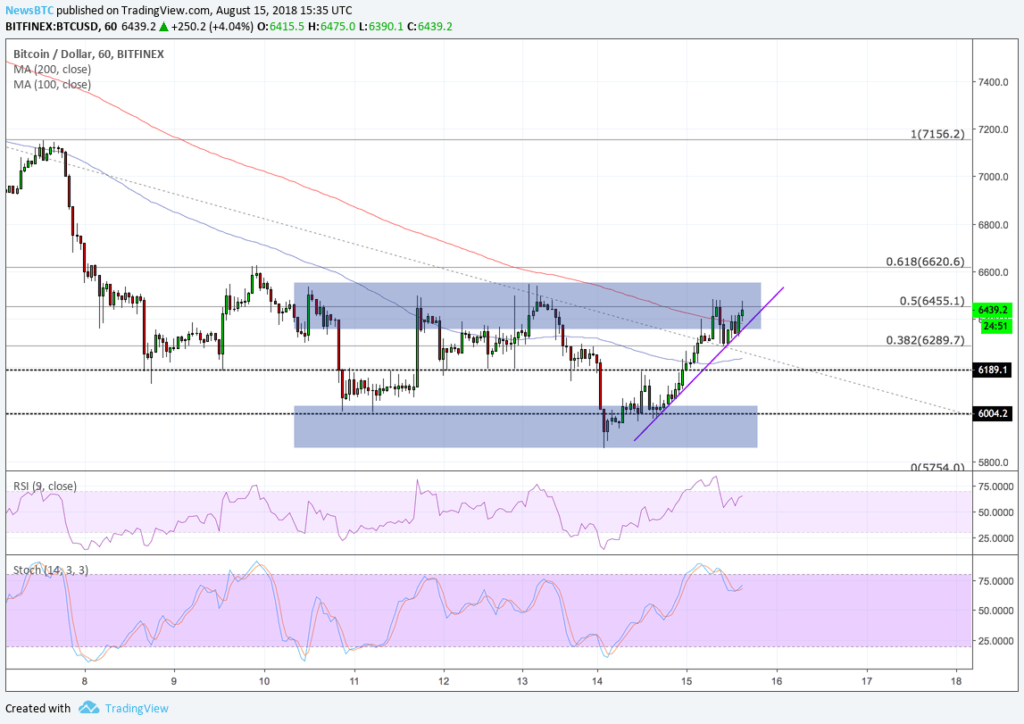
We can see the BTC/USD forming an accurate ascending trendline to indicate near-term support. The pair has already jumped above its 100 and 200H moving averages. The RSI and Stochastic indicators, at the same time, is hinting another move towards the overbought area. We also notice that BTC/USD is now inside a medium-term consolidation channel, indicated by two rectangular bars in the chart above. Both the support and resistance areas are proving to be much stronger than anticipated, pushing BTC/USD in a medium-term bias conflict.
Bitcoin price intraday analysis: btcusd recovers on weak upside promise

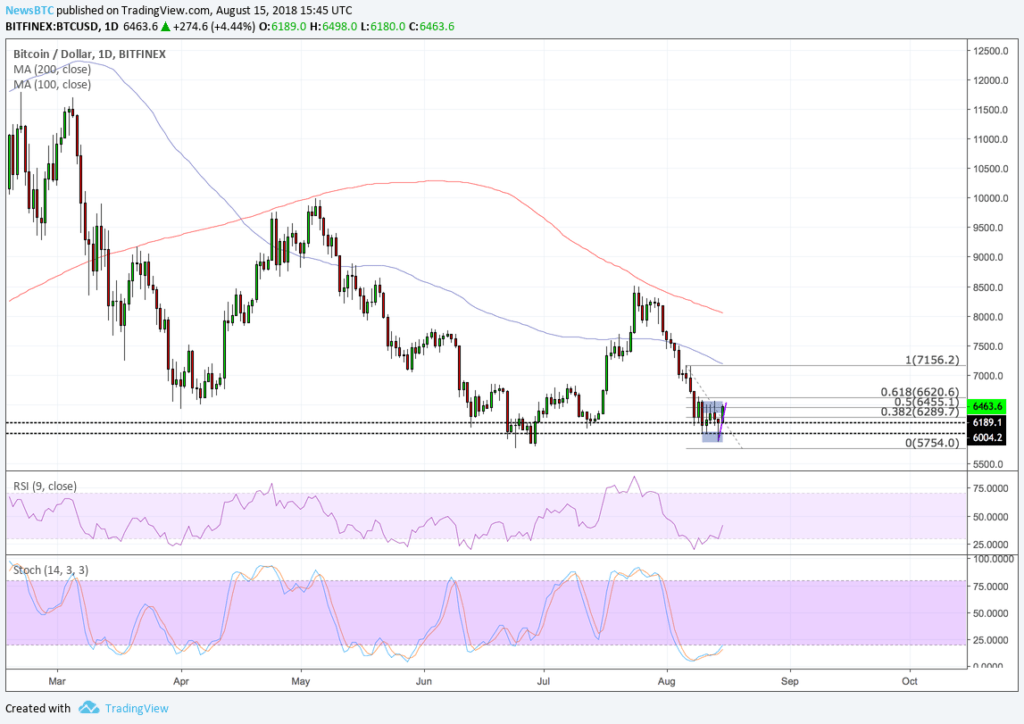
Nevertheless, on the daily chart, the current consolidation pattern is preceded by eight red candles. We are surely closer to testing 5754-fiat, the June’s low, again should the bearish momentum extend. There is also a potential Head and Shoulder pattern in the formation which, in the near-term, could push the bitcoin price towards 6850-fiat.

BTCUSD Intraday Analysis
Bitcoin price intraday analysis: btcusd recovers on weak upside promise

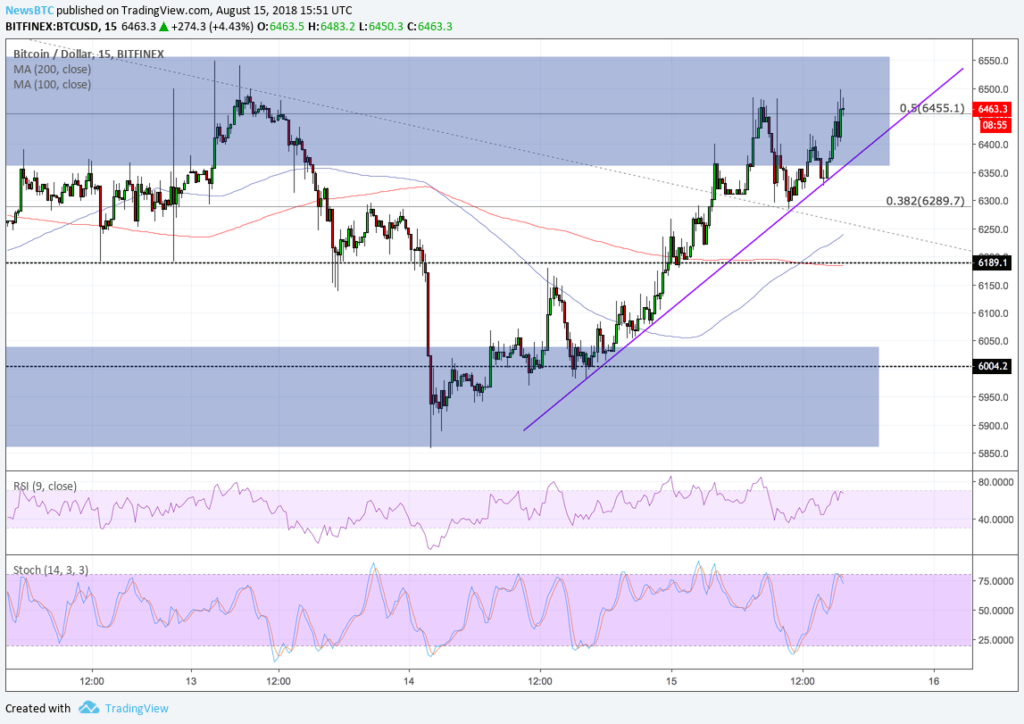
Coming to our intraday analysis! The latest price action has brought us inside a new range, which is defined by 6500-fiat as our interim resistance and 6289-fiat as our interim support. This is the range we will be watching for the rest of the US trading session.

We are first waiting for a pullback (sorry, bulls!). The 6500-6500 resistance area has rejected previous upsides three times in a row. So, our near-term probability, coupled with the overall bearish bias of the market, prompt us first wait for a pullback from resistance and then put a short towards 6289-fiat, our support. Meanwhile, a stop loss 3-pips above the entry position will ensure we don’t lose much in case the upside recovery extends.

We won’t be putting a breakout position until the price breaks above 6550-fiat. Should it happen, our primary upside target will be towards 6620. Like always, a stop loss 2-pips below will protect us in case the bears wake up on an uptrend.

Coming back to our range support at 6289-fiat, we will be first waiting for the prevailing consolidation to validate itself. Should the price hint a bounce back, we’ll put a long position towards 6500-fiat while keeping a stop loss 2-pips below the entry point. In case of a breakout towards the south, we will put a short towards 6189-fiat while protecting our trade by keeping a stop 2-pips above the entry point.

Featured image from Shutterstock. Charts from TradingView.

Follow us on Telegram or subscribe to our newsletter here.
Join CCN’s crypto community for $9.99 per month, click here.
Want exclusive analysis and crypto insights from Hacked.com? Click here.
Open Positions at CCN: Full Time and Part Time Journalists Wanted.

Advertisement


Published at Wed, 15 Aug 2018 16:38:45 +0000

bitcoin Analysis

Previous Article

Binance Adds Red Pulse! Which NEO Coins Are Next? | DBC, Qlink, TNC, Apex, ZPT

Next Article

Horse Passing Gas

You might be interested in …

BIP91: The SegWit Activation "Kludge" That Should Keep Bitcoin Whole

BIP91: The SegWit Activation "Kludge" That Should Keep Bitcoin Whole

bitcoin’s long-lasting scaling debate appeared to be heading toward a climax lately, with two proposals gaining significant traction. At one end of the fence there is Bitcoin Improvement Proposal 148 (BIP148), a user activated soft fork (UASF) originally proposed by the pseudonymous developer “shaolinfry.” On the other, there’s SegWit2x, an agreement forged between a significant number of bitcoin companies and miners.

The good news is that both of these proposals have a short-term solution in common: both plan to activate Segregated Witness (SegWit) this summer. The bad news is that the activation method of the two has differed, which could lead to a coin-split.

As of today, it seems this schism will be avoided — at least initially. The SegWit2x development team plans to implement BIP91, a proposal by Bitmain Warranty engineer James Hilliard that cleverly makes the two conflicting activation methods compatible.

Here’s how.

BIP141

The current implementation of Segregated Witness is defined by BIP141. This version is included in the latest Bitcoin Core releases, and is widely deployed on the bitcoin network. BIP141 is activated through the activation method defined by BIP9. This means that 95 percent of all blocks within a two-week period need to include a piece of data: “bit 1.” This indicates that a miner is ready for the upgrade. As such, SegWit would be activated if the vast majority of miners are ready for it.

Or that was the intention. So far, only some 30 percent of hash power is signaling support for the upgrade. There is a lot of speculation as to why this is the case, but it almost certainly has nothing to do with (a lack of) readiness.

That’s why other activation methods are increasingly being considered.

BIP148

BIP148 is a user activated soft fork (UASF), specifically designed to trigger BIP141.

On August 1st, anyone running bitcoin software that implemented BIP148 will start rejecting all blocks that do not include bit 1, the SegWit signalling data.

This means that if a mere majority of miners (by hash power) runs this software, they will reject all blocks from the minority of miners that does not. As a result, this majority of miners will always have the longest valid chain according to all bitcoin nodes on the network. Consequently, all deployed BIP141 nodes will see a chain that includes over 95 percent of bit 1 blocks, meaning SegWit would be activated on the network.

However, if BIP148 is not supported by a majority of miners (by hash power), bitcoin’s blockchain could split in two. In that case, there would effectively be two types of bitcoin, where one activated BIP148 and the other did not. This may resolve over time — or it may not.

SegWit2x

SegWit2x (also referred to as “SegWit2MB” or “the Silbert Accord”), is the scaling agreement reached by a numer of bitcoin companies and over 80 percent of miners (by hash power), drafted just before the Consensus 2017 conference.

For some time, the details surrounding SegWit2x were not very specific. As the name suggests, all that was really known was that SegWit was included in the agreement, and that it included a hard fork to double bitcoin’s “base block size” to two megabytes.

And, of course, SegWit was meant to be implemented using a different activation method. Like the original BIP141 proposal, SegWit2x was to be activated by miners through hash power. But where BIP141 requires 95 percent hash power support, SegWit2x would only require 80 percent. Moreover, SegWit2x readiness would be signaled using another piece of activation data: “bit 4” instead of “bit 1.”

This makes SegWit2x largely incompatible with BIP141, and especially with BIP148: Different nodes would be looking at different activation bits, meaning they could activate SegWit under different circumstances and at different times; and that would mess up SegWit-specific block relay policy between nodes, potentially fracturing the network.

BIP91

Now, it seems BIP91 has provided the solution.

BIP91 is a proposal by Bitmain Warranty (not to be confused with Bitmain) engineer James Hilliard which was specifically designed to prevent a coin-split by making SegWit2x and BIP148 compatible.

The proposal resembles BIP148 to some extent. Upon activation of BIP91, all BIP91 nodes will reject any blocks that do not signal support for SegWit through bit 1. As such, if a majority of miners (by hash power) run BIP91, the longest valid bitcoin chain will consist of SegWit-signaling blocks only, and all regular BIP141 SegWit nodes will activate the protocol upgrade.

Where BIP91 differs from BIP148 is that it doesn’t have a set activation date, but is instead triggered by hash power. BIP91 nodes will reject any non-SegWit signalling blocks if, and only if, 80 percent of blocks first indicate within two days that’s what they’ll do.

This indication is done with bit 4. As such, the Silbert Accord can technically be upheld — 80 percent hash power activation with bit 4 — while at the same time activating the existing SegWit proposal. And if this is done before August 1st, it’s also compatible with BIP148, since BIP148 nodes would reject non-bit 1 blocks just the same.

This proposal gives miners a little over six weeks to avoid a coin-split, under their own agreed-upon terms. With a SegWit2x launch date planned for July 21st, that should not be a problem… assuming that the miners actually follow through.

The post BIP91: The SegWit Activation "Kludge" That Should Keep Bitcoin Whole appeared first on Bitcoin Magazine.