
July 21, 2026

Capitalizations Index – B ∞/21M

Bitcoin Price Intraday Analysis 7/8/2018: BTCUSD Awaiting Breakout

Bitcoin price intraday analysis 7/8/2018: btcusd awaiting breakout

Bitcoin Price Intraday Analysis 7/8/2018: BTCUSD Awaiting Breakout


Btcusd bitcoin price
Advertisement

Opposite to what we expected in our previous analysis, bitcoin has not attempted to extend its bearish momentum, at least in the last 24 hours. The BTC/USD yesterday established an intraday low at 6856-fiat, which also acted as a support to a bullish correction phase. As a result, the pair has recorded around 2% gains at the time of this writing.

After the BTC/USD slumped below 7000-fiat, we were waiting for the pair to attempt a breakout above the said psychological resistance, before we put a long position towards the interim resistance at 7147-fiat. And thanks to the minor upside, we were able to achieve the targets today.

BTCUSD Technical Analysis
Bitcoin price intraday analysis 7/8/2018: btcusd awaiting breakout

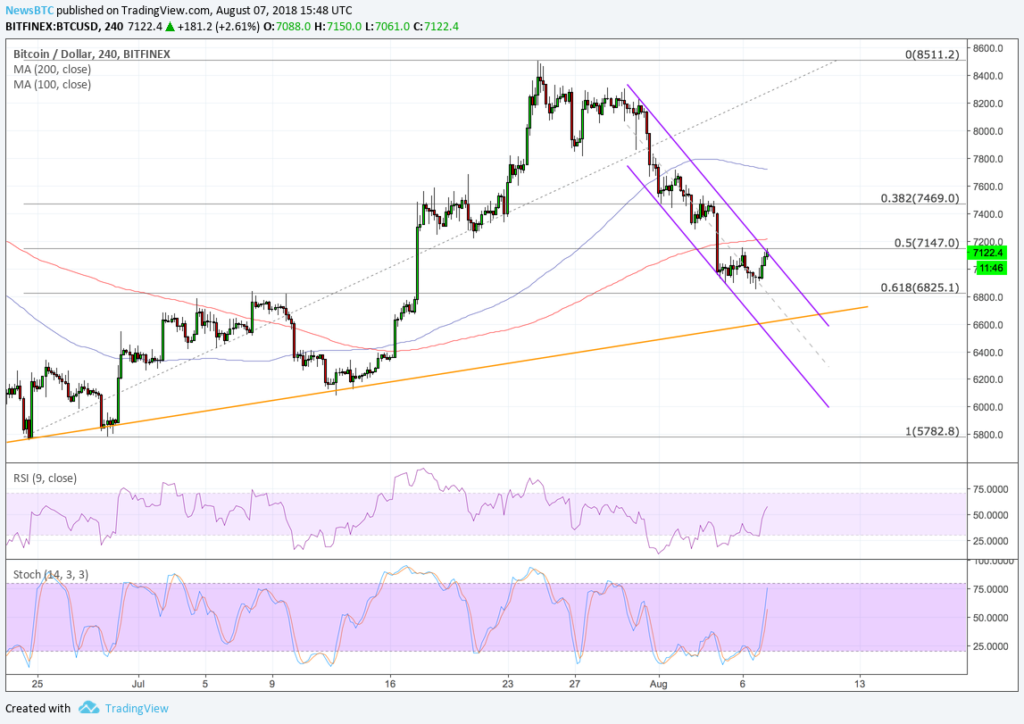
In medium-term, the BTC/USD is still locked inside a descending channel. The pair is now near its potential deflection point, while a break above it will confirm an extending bearish correction. The fact that the 100H MA is also above 200H MA is also enough to assume a potential upside breakout. However, a narrow gap between the two moving indicators points to a sluggish bullish momentum.

The BTC/USD, in the meantime, is trending below its 100H and 200H MA, with the pair close to jumping above the 200H MA in event of an extended upside move. Both the RSI and Stochastic indicators have moved north after spending time in their oversold areas, signaling the absence of selling positions.

Overall, the bitcoin market conditions have improved. But the medium-term bias continues to be bearish.

BTCUSD Intraday Analysis

We have just closed our long position towards 7147-fiat on a decent profit. As of now, we are waiting for the price to attempt a breakout, which automatically influences us to put our breakout strategy in place before anything else. That said, if the price manages to cross above 7147-fiat, our interim resistance for a very long time, then it would have us put a long position towards 7275-fiat, our primary upside target. A further break above the upside target would clear our position towards the 38.2 Fibonacci retracement level at 7469-fiat.

Not to forget, that our stop loss during the long positions will always be 2-pips below the entry point.

Looking the other way around – we also expect a pullback from the resistance of the prevailing descending channel. Should it happen, it naturally influences to switch to intrarange strategy. That being said, a pullback from 7147-fiat would have us put a short position towards 7000-fiat, our psychological support at this moment. A further break, and we’ll look to retest 6856-fiat as the new interim support. A stop loss a two-pips above the entry point will protect us from potential bias boomerangs.

Trade safely!

Featured image from Shutterstock. Charts from TradingView.

Follow us on Telegram or subscribe to our newsletter here.
Join CCN’s crypto community for $9.99 per month, click here.
Want exclusive analysis and crypto insights from Hacked.com? Click here.
Open Positions at CCN: Full Time and Part Time Journalists Wanted.

Advertisement


Published at Tue, 07 Aug 2018 16:42:17 +0000

bitcoin Analysis[wpr5_ebay kw=”bitcoin” num=”1″ ebcat=”” cid=”5338043562″ lang=”en-US” country=”0″ sort=”bestmatch”]

Previous Article

US DEA: Criminal Activity in Cryptocurrency Has Dropped 80 Percent Since 2013

Next Article

Bitcoin Price Intraday Analysis 7/8/2018: BTCUSD Awaiting Breakout

You might be interested in …

Does Regulation Slow Down or Accelerate Adoption?

Recently, many countries and cities have published new laws and legislations to regulate bitcoin. Does this help contribute to mainstream adoption, or is it merely a hindrance to it?


Regulation Slowing Adoption

New York was the first state in the USA to tighten regulation on bitcoin and other virtual currencies, via its BitLicense. This is issued by the New York State Department of Financial Services, and it regulates businesses which work with virtual currency.

The implementation of this law caused some bitcoin companies to cease operations in the state, while some others decided to go through the regulatory process to operate legally. However, to date, only 3 BitLicenses have been granted. Circle, Ripple and Coinbase are the only companies with the right to operate, and they must collect information on New York residents and report it back to the NYSDFS.

Other companies, like BitFinex and Kraken, decided to cease operations in the area and ban New York residents from using their services. They deemed the BitLicense to be too complicated to work with, and simply moving out of the area was the simplest option.

In other countries like China, regulation has been a bit harsher. Major exchanges were forced to introduce fees, freeze withdrawals and disable margin trading to comply with new regulation from the People’s Bank of China. Zhou Xuedong, director of the PBoC’s Business Administration unit, stated:

“There is a significant risk, one is the risk of customer funds security, the second is the risk of money laundering, the third is the risk of leveraged transactions.”

Ways Around Regulation

However, the bitcoin community has developed solutions to avoid regulation. Decentralized, peer-to-peer marketplaces exist, where users can spend and obtain bitcoins without adhering to any official regulation since the platform isn’t run by a third party.

BitSquare is a decentralized bitcoin exchange, where users can buy and sell bitcoins without proving their identity. OpenBazaar employs a similar concept and allows users to set up stores to sell their products.

There are also other platforms that aim to promote decentralisation. For example, Blockonomics.co provides a free, detailed bitcoin invoice services for freelancers and businesses, as an alternative to Coinbase or BitPay. This means that again, users can enjoy the same services without having to go through long verification processes.

Regulation Fueling Adoption

Contrary to popular belief, regulation doesn’t necessarily have to slow down adoption. In some cases, regulation could help bring cryptocurrency technology to the masses; an excellent example of this is Humaniq.

Humaniq is a new platform which aims to bring mobile banking services to those who reside in emerging economies. The platform is powered by blockchain technology, but they aim to be compliant with KYC/AML laws in the countries they will operate in.

However, users no longer have to go through a complicated verification process. Instead, the users’ identity can be verified by simply having them take a photo of themselves or by reading a short piece of text.

Africa mobile

This could mean a significant step forward for blockchain technology. Users would be able to access all of its advantages without too much trouble, which is very important for those who live in emerging economies.

Nonetheless, any person can use Humaniq; their ICO (Initial Coin Offering) begins today, April 6th, which is a great chance to contribute to the project if you haven’t yet already done so.

[Disclaimer: This is a sponsored article. Publication does not constitute an endorsement and should not be considered as investment advice. Bitcoinist is not responsible for any outcome that may result from investing in this ICO.] 

Do you think that cryptocurrency businesses should be regulated? If so, why? Let us know your thoughts below!


Images courtesy of Blockonomics.co, BitSquare, Humaniq, NewsBTC, CoinFox and The Houston Free Thinkers.

The post Does Regulation Slow Down or Accelerate Adoption? appeared first on Bitcoinist.com.