March 18, 2026

Capitalizations Index – B ∞/21M

Bitcoin Price Indicator Turns Bullish in First Since Early 2018

Bitcoin price indicator turns bullish in first since early 2018

Bitcoin Price Indicator Turns Bullish in First Since Early 2018

View

  • bitcoin’s two-week moving average convergence divergence (MACD) histogram has turned positive for the first time since early February 2018, signaling a longer-term bearish-to-bullish trend change.
  • While the MACD is a lagging indicator, the historical data indicates the previous bull market began following a positive crossover on the indicator.
  • In the short term, BTC’s hourly chart indicators have turned bearish, so a drop to $5,000 could be seen in the next day or two if crucial support below $5,200 is breached.
  • Prices may still rise to recent highs above $5,400 if the bulls can defend the that support level and drive price upwards.

A widely-followed bitcoin (BTC) price indicator has turned bullish for the first time in over a year, signaling a long-term bull reversal.

The moving average convergence divergence (MACD) histogram – used to determine trend changes and trend strength – has moved above zero on the two-week chart (15-days) for the first time since February 2018.

With the positive turn, the two-week MACD is the latest addition to the list of indicators calling a longer-run bullish reversal.

Experienced traders, however, may point out that the MACD is a lagging indicator. After all, the technical tool is arrived at by plotting the difference between the MACD line and the signal line, which are based on the backward-looking moving averages.

The indicator, therefore, tends to lag the price and has limited predictive abilities. Further, the longer the time frame, bigger is the lag. As a result, many would consider the bullish turn a result of the recent price rally rather than an advance warning of further gains.

It, however, gains credibility if we take into account the historical data, which shows the last positive crossover on the MACD, seen in August 2016, was followed by a 2.5-year-long bull market.

Two-week chart
Bitcoin price indicator turns bullish in first since early 2018

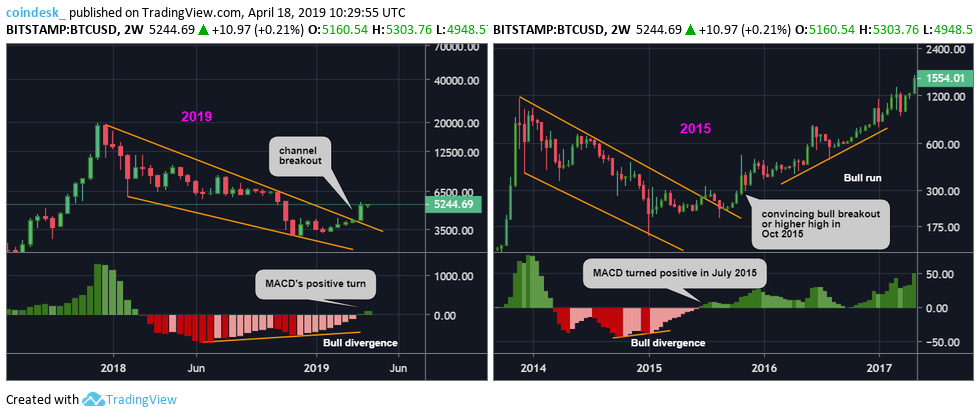
On the two week chart (left), the MACD histogram is printing positive for the first time for 14 months, after having charted a bullish divergence, or a higher low, in November.

Notably, the MACD created a similar looking bullish divergence 10 months before the long-term bearish-to-bullish trend change, as represented by the falling channel breakout, witnessed in October 2015 (right).

It’s worth noting that the indicator moved above zero four months before the bullish breakout and 12 months before the mining reward halving (which reduces the supply of new coins) that took place in July 2016. The MACD’s latest bullish turn is already accompanied by a falling channel breakout on the chart and has also turned positive 12 months before bitcoin’s third reward halving, due in May 2020.

With history possibly looking to repeat itself, prices may continue to create bullish higher highs and higher lows in the run-up to the halving event, as seen last time around.

In the short-run, though, BTC may have a tough time finding acceptance above the crucial 21-month exponential moving average, currently at $5,239, as discussed yesterday.

As for the next 24-hours, the cryptocurrency may suffer a drop to $5,000 if key support just below $5,200 is breached, validating the bearish indicators on the short duration charts.

Hourly chart
Bitcoin price indicator turns bullish in first since early 2018

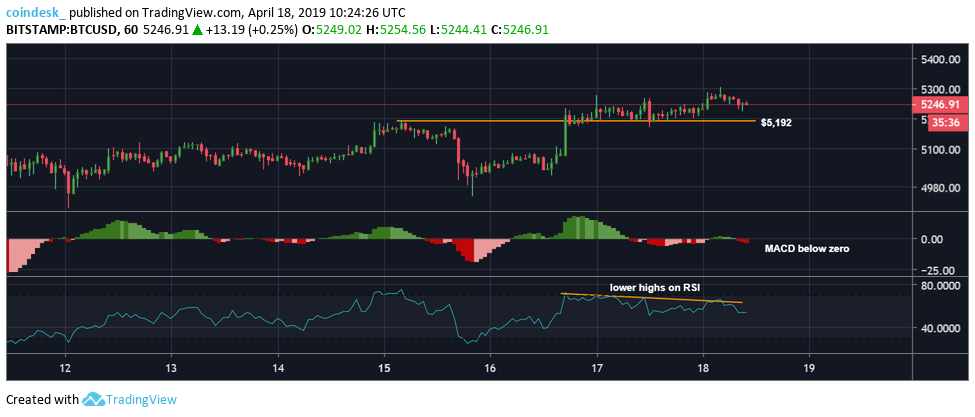
On the hourly chart, the RSI continues to produce lower highs in favor of the bears as opposed to higher highs, while the MACD has turned negative.

The price, however, is still holding above $5,190 – a level, which acted as strong support (see horizontal line above) yesterday.

The bearish indicators would gain credence if the support at $5,190 is breached, leading to a deeper drop.

Acceptance below $5,190 would boost the probability of BTC completing the right shoulder of a bearish head-and-shoulders pattern on the 4-hour chart with a drop to the neckline support, currently at $5,000.

The bearish case would weaken if a potential bounce from the support at $5,190 ends up clearing psychological resistance at $5,300. That could be followed by a retest of the recent high of $5,466.

As of writing, bitcoin is trading at $5,241 on Bitstamp, representing a 1 percent gain on a 24-hour basis.

Disclosure: The author holds no cryptocurrency assets at the time of writing.

Bitcoin image via Shutterstock; charts by Trading View

Published at Thu, 18 Apr 2019 11:00:16 +0000

Previous Article

Support open source Grin Atomic Swaps with Bitcoin and Ethereum

Next Article

Bitcoin: BARR Pattern suggests that BTC might have bottomed in 2018

You might be interested in …

Japan’s New Bitcoin Law Could Do More Damage Than NY BitLicense

According to IndieSquare Co-founder Koji Higashi, new regulations in Japan, which will make bitcoin an official form of payment (starting today April 1), may do more harm than good for the fledgling industry in the country.


Japan to Introduce Own ‘Bitlicense’

Following the disastrous demise of the infamous Japanese exchange, Mt. Gox and the arrest of its CEO Mark Karpelès, regulators in the country decided to introduce regulations for bitcoin.

Bitcoinist_Mt. Gox

The regulatory framework has been in the works for over two years. The first bill was submitted to the Diet in Japan (the legislature consisting of the Lower and the Upper Houses) last March, and the Payment Services Act and the Act on Preventing of Transfer of Criminal Proceeds were amended in May 2016. Now, new drafts for detailed regulations and guidelines have been approved.

The new law, which is now in place starting today (April 1), is meant to protect consumers and to help them distinguish safe, i.e. approved exchanges, from fraudulent operations.

The law also recognizes approved cryptocurrencies as a legal method of payment in Japan, preventing users from investing in so-called scam coins, fake digital assets, and IOU tokens.

Although praised by western and Japanese media alike, the new regulatory framework may pose serious problems for the Japanese bitcoin community, according to Koji Higashi, Co-Founder of IndieSquare and Community Director at the Counterparty Foundation.

profile-pic

In a blog post, Higashi outlines the major issues with what he calls “Japan’s Bitlicense” due to the similarities found between the two, saying:

I’d actually argue that this law may turn out to be more damaging to the Japanese industry in the long run than what Bitlicense has been to NY.

Why It Could Be Worse Than NY’s

The Bitlicense introduced in New York has been widely perceived by the community as damaging for bitcoin startups in the region due to the bureaucracy and high entry barriers for small startups. It resulted in several startups like ShapeShift and LocalBitcoins halting services for NY-based customers.

Now, Japan is doing the same, explains Higashi. “If you are not a fan of the excessive cost for legal and compliance fee for bitcoin startups, however, the new law in Japan is certainly not exciting news for you,” he notes. 

bitlicense

Among others, the requirements involve the submission of a 3-year business plan, segregated fund management, KYC/AML requirements, segregated fund management, frequent reporting to authority, and external audits.

Some experts estimate that the costs involved with becoming a compliant exchange could be as high as $300,000-$500,000 USD. Moreover, additional fees and paperwork will also apply to companies beyond trading platforms and will affect P2P decentralized exchanges as well.

Higashi:

It’s hard to say whether the regulation in Japan is more costly than the Bitlicense but I can say it’s expensive enough to put serious financial pressure on startups and may force them to go out of business completely in some cases.

Another issue with the new regulatory framework is that it will require virtual currencies to be accepted into an official list of approved coins. Although this system may protect users from being scammed out of their savings, it may end up damaging the reputation of coins that don’t make it to the list, which will most likely be a conservative one at best.

bitcoin in Japan

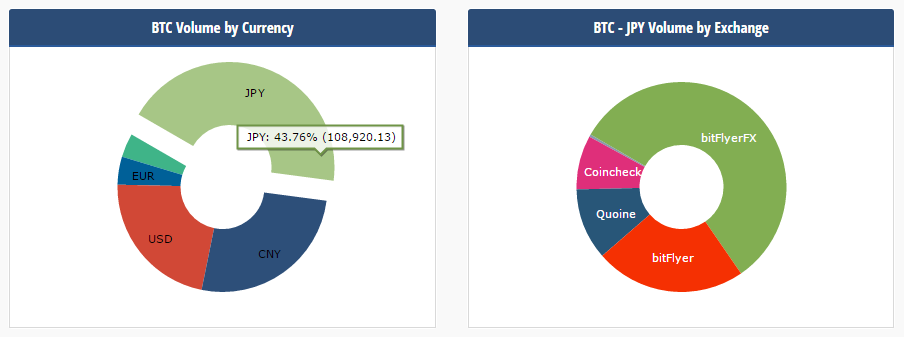
The new regulations may affect bitcoin startups negatively but are also likely to push adoption forward and to create a sense of trust for new users in the virtual currency space. Japan is the fastest growing country in the bitcoin market. For example, trading volume in Japan has recently surpassed that of China and the U.S.

bitcoinist_jpy_volume_09_feb

The country is experiencing growing interest in bitcoin from users, investors, and merchants. Blockchain is also a technological focus point both for companies and the government. The Japanese community is also one of the biggest investors in crypto-related crowdfunding campaigns and Initial Coin Offerings, according to Higashi. 

[Note: This article was originally published on February 9, 2017. It has been updated as today (April 1) is the first day Japan’s new cryptocurrency law comes into effect.]

Will the new regulations drive companies away from Japan? Or will it usher a new age for cryptocurrency adoption in the country?


Images courtesy of CryptoCompare, Shutterstock, Counterparty.io

The post Japan’s New Bitcoin Law Could Do More Damage Than NY BitLicense appeared first on Bitcoinist.com.

The magic always returns

The Magic Always Returns

The Magic Always Returns We have reached the target 3200 as expected. I think the time to retest 4000, 4150 W1 EMA200 and 4400 prev high in an upwards correction will come soon as more […]