September 1, 2026

Capitalizations Index – B ∞/21M

Bitcoin Price Analysis: Range-Bound Market Coiled for Next Move

Bitcoin price analysis: range-bound market coiled for next move

Bitcoin Price Analysis: Range-Bound Market Coiled for Next Move

For the better part of a month and a half, bitcoin [BTC] has been fairly range-bound and unable to establish new lows or new highs. There are some bullish and bearish setups on the horizon for bitcoin [BTC], so let’s check out both sides of the argument because currently the market is sitting in the middle of Indecisionville — the most immediate sign of which is this glaringly obvious head-and-shoulders bottom reversal pattern:
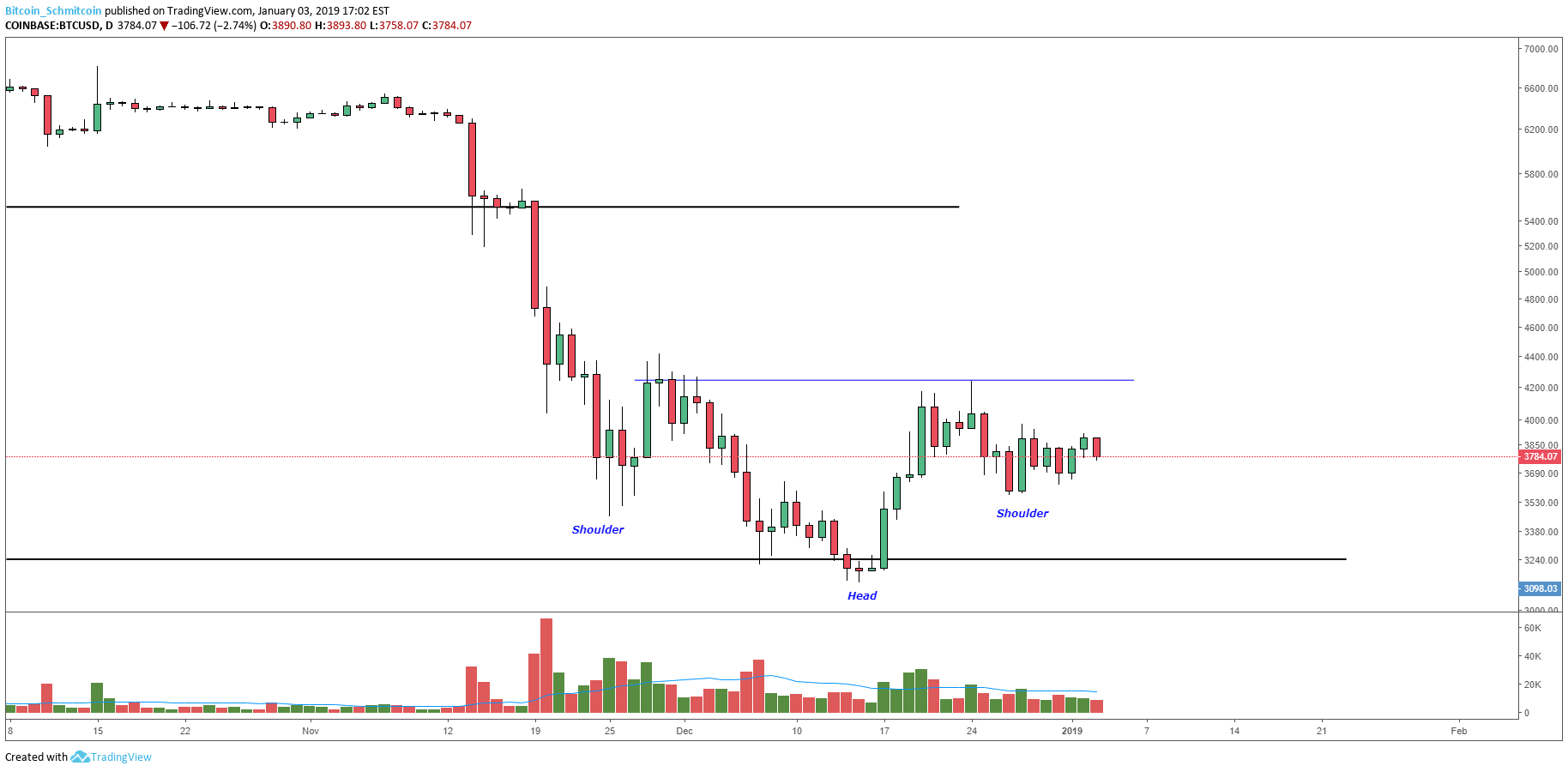
Figure_1 (3). Png

Figure 1: BTC-USD, Daily Candles, Head-and-Shoulders Bottom

This current pattern is nothing more than a setup at the moment, but it represents one potential outcome of this sustained consolidation. In order for this pattern to be confirmed, we need to see a daily candle close above the neckline (horizontal blue line). A breakout of this reversal pattern has a measured move of approximately $1,000 — a target of around $5,200. However, there are plenty of things that should keep the bulls wary for the time being. Until we close a higher high, the trend remains down.

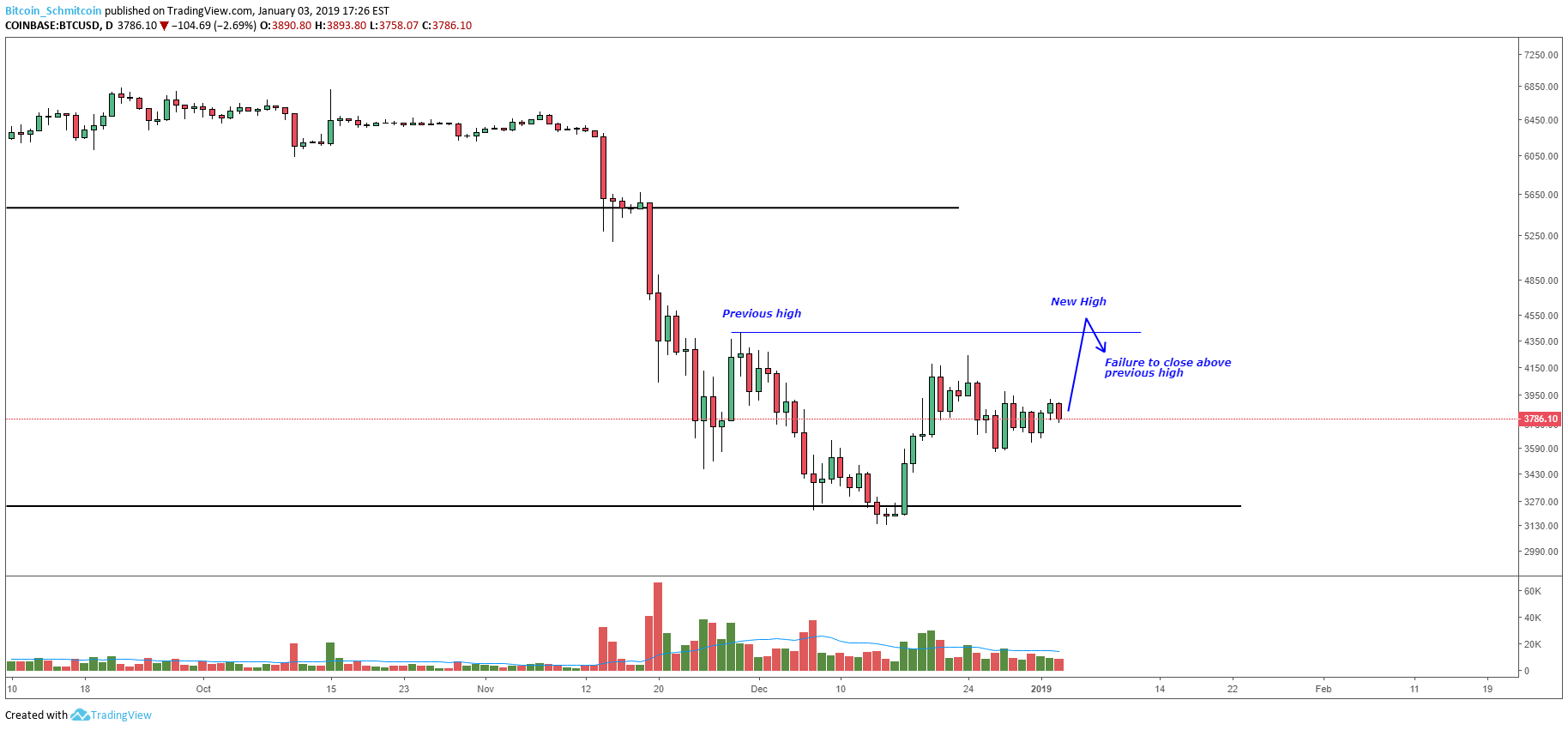
Another potential outcome for a swing high is a bull trap called a Swing Failure Pattern (SFP). Quite simply put, an SFP is an impulsive move to new highs that fails to close above the previous high:
Figure_2. Png

Figure 2: BTC-USD, Daily Candles, Potential SFP Setup

If the market moves above the previous high shown in the figure above, but fails to close above it, we could see an immediate rejection of the high; this could trigger a powerful reversal.

The whole point of an SFP is to engineer liquidity for big players. So, when the price breaks to a new high, it lures in plenty of breakout traders who are impatient. Once the price fails to close above the previous high, those traders are now trapped in underwater long positions that will then be used to push the price lower as they get stopped out or liquidated.

However, as previously stated, both of these possibilities are up in the air. At the moment, we are currently suspended in the middle of a trading range which is generally considered to be a no-trade zone, as it is fraught with bull and bear traps. Contrary to the two previous scenarios I’ve laid out, it’s entirely possible that we even visit the bottom of the range to retest support. We currently only have one real test of that support and we could potentially revisit the support in the low $3,000s.

Until bitcoin [BTC] makes a test of the upper or lower boundaries, there isn’t a whole lot we can do in terms of macro trend analysis. It’s at times like this that it is often advisable to prepare for a move and lay out a plan for both the bullish and the bearish scenarios — sort of like an if/then format: If bitcoin [BTC] moves above resistance and closes, then I will do “x,” and if bitcoin [BTC] moves above resistance but fails to close above the high, then I will do “y.” For now, we will have to wait and see how the market treats its next test of macro support or resistance.

Summary:

  1. bitcoin has been range-bound for almost 2 months and has yet to retest its established lows or established highs.
  2. Although it is currently in the middle of the range, there are a couple potential scenarios I outlined in this article. A massive inverted head-and-shoulders setup could push the price to the low $5,200s. However, a failure to close above the previous high could see a strong reversal of the trend to the downside of the range.

Trading and investing in digital assets like bitcoin [BTC] is highly speculative and comes with many risks. This analysis is for informational purposes and should not be considered investment advice. Statements and financial information on bitcoin [BTC] Magazine and BTC Media related sites do not necessarily reflect the opinion of BTC Media and should not be construed as an endorsement or recommendation to buy, sell or hold. Past performance is not necessarily indicative of future results.

Published at Thu, 03 Jan 2019 23:22:31 +0000

Previous Article

Entry Level Software Developer

Next Article

Proof of Keys Event Aims to Challenge Perceived Centralization of Cryptocurrencies

You might be interested in …

Ecc coin (ecc) -- why i bought 33,000 coins

ECC Coin (ECC) — Why I bought 33,000 coins

ECC Coin (ECC) — Why I bought 33,000 coins Vote for my dogecoin video: https://www.youtube.com/watch?v=c5y1aXeWek8 Bought ECC at .0033 yesterday for 33,000 coins and looking to sell at 10 cents. I believe this is one […]

Japanese Company Will Launch New Bitcoin Mining Operation With 7 nm Chips

GMO Internet Group Launches Massive Bitcoin Mining Operation With 7 nm Chips

GMO Internet Group, a Japanese provider of a full spectrum of internet services for both the consumer and enterprise markets, is launching a new bitcoin mining business utilizing next-generation 7 nanometer (7 nm) semiconductor chips. “[We] believe this new business has high potential for increasing corporate value in the future,” states the company.

Headquartered in Tokyo, GMO IG comprises more than 60 companies in 10 countries. GMO IG’s size and financial muscle, as well as the novel technologies it wants to leverage, will make it a serious entrant in the bitcoin mining industry, and one that could have a disruptive impact.

“We will operate a next-generation mining center utilizing renewable energy and cutting-edge semiconductor chips in Northern Europe,” GMO stated, emphasizing that they will invest in R&D and manufacturing of hardware including the next-generation mining chip. “We will use cutting-edge 7 nm process technology for chips to be used in the mining process, and jointly work on its research and development and manufacturing with our alliance partner having semiconductor design technology.”

The International Technology Roadmap for Semiconductors defines 7 nm semiconductor chip technology as the next technology iteration following 10 nm technology, which, in turn, follows the 14-16 nm technology that currently represents the state-of the-art hardware in the bitcoin mining industry. Commercial production of 7 nm chips is still in the development stage with GlobalFoundries, IBM, Intel, Samsung and Taiwan Semiconductor Manufacturing Company (TSMC) competing for market leadership.

According to a recent article in Android Authority, TSMC seems to be in the pole position in this race, having already showcased a preliminary 7 nm SRAM chip — not yet a full system on a chip (SoC) but an important milestone. Intel is said to be planning the upgrade of a manufacturing plant in Arizona to start building 7 nm SoCs. Samsung and GlobalFoundries are also striving to catch up.

According to Quartz, 7 nm technology would be four times more energy efficient than the current bitcoin mining industry standard. Therefore, once 7 nm chips are in use, all other miners will have to upgrade to stay in the game.

“It’s clearly the next generation of miners,” Diego Gutierrez, CEO of mining software developer RSK Labs, told Quartz. “The other [mining chip makers] will surely follow and create their own 7 nm chips if they are not already doing it. As [chip manufacturers] get the new technology, everybody can access it.”

“We believe that cryptocurrencies will develop into ‘new universal currencies’ available for use by anyone from any country or region to freely exchange ‘value,’ creating a new borderless economic zone,” notes GMO IG. “[bitcoin] can be regarded as a distributed system whose credibility is secured by mutual monitoring by network participants, as opposed to legal currencies which are a centralized system whose credibility is secured by the issuer. And management of a distributed system such as [bitcoin] requires a mining process.”

The entry in the bitcoin mining sector of these new Japanese players with relatively deep pockets is likely to be welcomed by those concerned about China’s dominance of the mining industry. For example, Chinese mining operator and hardware manufacturer Bitmain plays a dominant role in the $70 billion bitcoin economy. Its mining pools, Antpool, BTC.com and ConnectBTC, account for around 30 percent of all the processing power on the global bitcoin network, while the company is also the market leader for specialized mining hardware, including ASIC chips.

In related news, another large Japanese company, DMM, announced the launch of its own Virtual Currency Division, scheduled to begin operation of a virtual currency mining business “DMM Mining Farm” in October 2017. According to the company, which hasn’t released further information, DMM will operate one of the 10 largest mining farms in the world before the end of 2018.

The post Japanese Company Will Launch New Bitcoin Mining Operation With 7 nm Chips appeared first on Bitcoin Magazine.