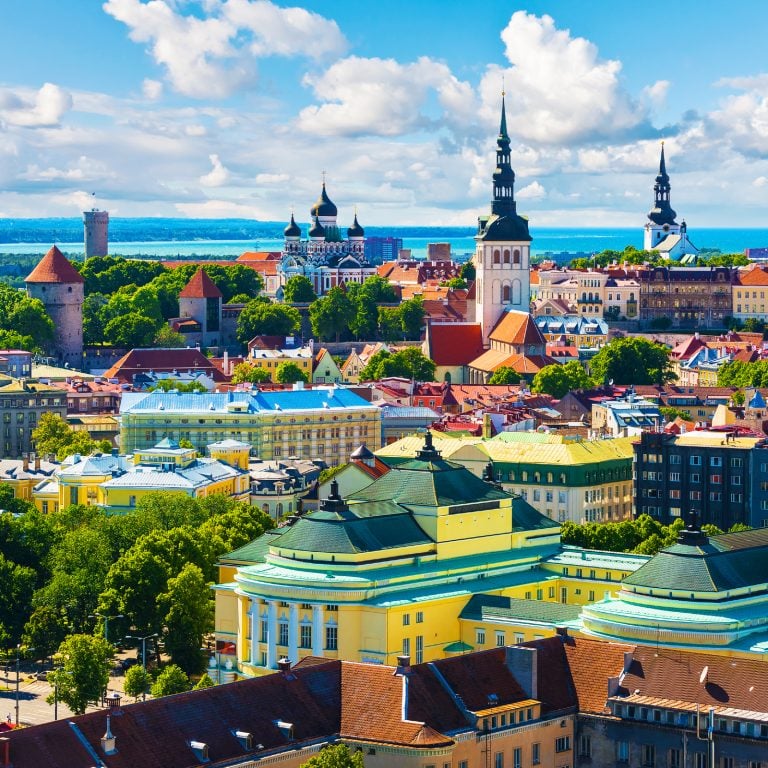
Cryptocurrencies are gaining popularity in the Baltic states where no comprehensive regulations have been introduced yet. Businesses from multiple sectors, including real estate, online trade, the hospitality industry, and even healthcare, are taking advantage of crypto payments. Some companies from the region are already offering their services globally.
Also read:
Apartments Sold for bitcoin
Cryptocurrencies are becoming more widely accepted in Lithuania, Latvia and Estonia, where buying a cup of coffee with bitcoin is nothing special these days. Cafes, bars, restaurants, hotels, souvenir shops, and even an orthopedic clinic, are now accepting cryptos, according to local media. It seems that the Baltic Tigers of the EU are becoming the “bitcoin Tigers” of Europe.

Crypto payments have been introduced in the real estate business by several companies selling land plots and housing units in the Baltics, Novaya Gazeta reports. Potential buyers will soon be able to purchase land and homes in the Auriai cottage settlement, which is currently under construction not far from Vilnius, the capital of Lithuania.
Crypto-priced real estate is also sold in neighboring Latvia and Estonia. The Latvian branch of Baltic Sotheby’s International Realty is offering penthouse apartments in Jūrmala for bitcoin. Recently, the Estonian realtor LAAM Kinnisvara announced it is accepting cryptocurrency for apartments in the town of Maardu, 15 minutes car drive from Tallinn. A third of the 44 units built by the company there have been sold already. The next bitcoin deal is scheduled to take place next week.
Cryptos Accepted For Clothes
 More than 30 locations in Vilnius accept crypto payments, in Tallinn they are 26, and in Riga – 21, according to Coinmap. bitcoin ATMs can be found in the capitals of Estonia and Lithuania, according to Coinatmradar. Most of the businesses accepting cryptos are from the hospitality industry – cafes, bars, restaurants, souvenir shops, several hotels. Other sectors, however, are quickly catching up.
About a month ago, the United Colors of Benetton franchisee in Lithuania announced it would accept cryptocurrencies. The stores of the fashion brand in Vilnius now take bitcoin, etherium, dash, NEM, and steem through a partnership with Coppay. The Belarus-based payments provider offers instant conversion to fiat at an exchange rate based on data from multiple markets. “Our employees like it because it’s simple and easy. No additional training was needed”, said Arturas Zuokas, co-owner of the company and former mayor of Vilnius.
By the way, Lithuania already has a platform similar to the one maintained by Coppay. The local company Coingate recently signed an agreement with a French developer of online payment solutions. Through this partnership with Prestashop, the Lithuanians plan to provide services to 80,000 merchants around the world.
bitcoin Still Unregulated
No comprehensive regulations have been adopted yet in neither of the Baltic states. Latvia has recently attempted to partially cryptocurrencies for taxation purposes. Authorities in Riga said that bitcoin could “function as a means of exchange”. As a result, 20% tax will be imposed on capital gains from deals with cryptocurrency.
 Estonia, arguably the most digitally developed Baltic country, has been mulling over issuing its own cryptocurrency. Tallinn is not giving up on the idea, despite the of the European Central Bank. Officials behind the project are still pushing for issuing “estcoin”, not as a crypto, but as a token. In any case, Estonia is resolved to proceed with its plans for a national coin.
The central bank of Lithuania, which was opposing cryptocurrencies for some time, has just with representatives of the crypto sector on a possible regulatory framework. “The blind denial, the reluctance to understand and work with the cryptocurrency world, leads us nowhere”, a high ranking official of Lietuvos Bankas said last week.
Do you think the Baltics can lead Europe in crypto adoption? Share your thoughts in the comments section below.
Images courtesy of Shutterstock.
Do you agree with us that bitcoin is the best invention since sliced bread? Thought so. That’s why we are building this online universe revolving around anything and everything bitcoin. We have a. And a. And a, a and real-time.
The post appeared first on .
Social networks are ripe for disruption from a new breed of decentralized platforms, or for existing ones to reinvent themselves by hitching a ride to the future.
From fraud to data breaches, all is not well in the social media world. Even before the Cambridge Analytica mess, Facebook chief executive was already talking about researching how to make use of encryption and cryptocurrency technology to “fix” Facebook.
Blockchain Disruptors
Maybe that got other social media properties thinking they should start doing the same, lest they get left behind or fall prey to disruptive new entrants.
Speaking of the new breed of social, we already have the likes of showing how monetizing user-generated content and curation can work. From the vantage of the network itself decentralization makes sense because it provides a much more secure environment for user data, where there is no longer a single point of failure susceptible to cyber-attack.
Also, the network becomes less reliant on blanket advertising and instead can make greater use of the more innovative approaches to selling advertising, such as rewarding users for interacting with ads.
At the same time the quality of responses can be increased if users have control over the types of ads they want to see and at all whether they want to see them. It would mitigate online advertising fraud and make them more relevant to those that see them, meaning less waste and greater impact for advertisers.
Ok, now let’s get to the meat.
Askfm to Launch ICO?
Q&A social networks are growing in popularity. Perhaps you have seen pop up in your Google search results or if you do a bit of coding and want to know why something isn’t working you are in the habit of heading over to .
Well, there is one that is even more popular than those two, with 215 million registered users called , the Q&A social platform of choice for a younger crowd – a demographic that is manna from heaven for advertisers. A huge 85% of its users are aged 25 and under and 65% are female and it attracts 10 million monthly unique each visit an average of 11 pages, showing a high level of engagement.
Askfm’s audience is mostly in Europe and Eurasia and it is looking to expand its footprint in North America and Asia. What better way to do that than to go far an ICO, assuming securities law can be successfully navigated.
There is a plentiful supply of evidence that backs up that supposition.
Here’s the Evidence
First off, there’s the domain names that askfm has been registering lately. There are at least two of them that are known about, and they are and . Now why would askfm Europe Limited register them if they were not at the very least thinking about the possibility of embarking on a token sale?
Perhaps they are just covering their bets. If that’s so, then why have they also decided to start advertising for on Crypto Job List? Scanning the job listings is a tried and tested method for ascertaining what a tech company might be up to in terms of future plans, and it is no different with askfm.
We’ve come across three listings, one of which is described as follows: “The client is a global social Q&A network with more than 200 million registered users. They are looking for a Blockchain Developer to join their team to help develop a new blockchain / cryptocurrency project globally.” The clue is in the first sentence: “a global social Q&A network”. The post is for a blockchain developer in Ukraine and was submitted on 14 March.
Then there is the parked website at ask-fm.pro, which greets the surfer with “askfm 2.0”.
That’s another strong hint of some good stuff to come. It indicates a second generation of the platform is about to land and when taken together with the evidence above, to all intents and purposes it confirms the rumour as valid.
The domain askfm.pro (no hyphen) has also been parked, but there is no landing page for that url. Companies often have to register a bunch of urls that they don’t intend to use in order to prevent other entities from taking them.
This is even more necessary for those planning an ICO, given the prevalence of fraudulent actors that set up websites with slight variations in address to lure in unsuspecting investors, so the two versions of the pro address could also be taken as evidence, likewise with the addresses including the letters “ico”.
The ICO space admittedly has its fair share of charlatans, then, but this shouldn’t detract from the fact that it is a legitimate form of fundraising.
ICOs are Not Just for Startups
One-time giant of film and photography , recently announced that it was launching a blockchain to help photographers manage their digital rights, and there will be an accompanying ICO. The delay in the Kodak ICO to include “accredited investor” verification should be taken as a good sign; the ICO is currently in pre-sale.
Also, there are persistent rumours that might be moving to an ICO.
Chief executive Howard Schultz is famously favourable to crypto, helping to fuel hopes of an ICO to support a token launch: “I personally believe that there is going to be a one or a few legitimate trusted digital currencies off of the blockchain technology.
And that legitimacy and trust in terms of its consumer application will have to be legitimized by a brand and a brick and mortar environment, where the consumer has trust and confidence in the company that is providing the transaction.”
As the top Q&A social media platform, with the sort of youthful user base that brands love to be associated with, an askfm token sale would be good for the company’s prospects, helping to infuse new life into its network. For the users themselves it offers the prospect of being able to make money from online activity such as the urge to answer the questions of random individuals.
Keep your eye out for the askfm crowd sale. Maybe go and sign up on the network so you will be among the first to know when they send out an email announcing as much.
The post appeared first on .