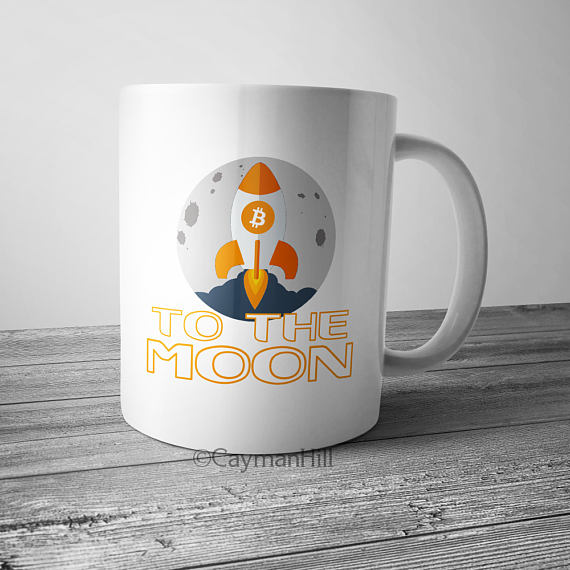
Bitcoin Mug To The Moon Rocket Coffee Mug BTC Crypto Mug Cryptocurrency Gift
Mug To The Moon Rocket Coffee Mug BTC Crypto Mug Cryptocurrency Gift
Start your day with this bitcoin Est 2009 coffee mug. The image is on the front and back of the mug. Having the image on both sides makes the mug suitable for left handed or right handed people.
MUG DETAILS:
Qty: 1 Mug
Mug Type: Ceramic
Size: 11 fl. oz
Finish: Glossy
Gift Box: No
Images are printed with professional sublimation ink. The image is then heat transferred to the mug sealing in the design. Sublimated mug images do not peel or crack like vinyl images do. These mugs are dishwasher and microwave safe, however hand washing is recommended.
PROCESSING DETAILS:
Each mug is made to order and ships within 24-48 hours of the order being placed. Orders placed on Friday, Saturday or Sunday will not ship until Monday. Please note that due to monitor and screen differences colors may vary slightly on the finished mug. Each mug is setup by hand so minor variations in placement may be noted when ordering multiples.
Looking for this image on a shirt? Please visit our Cayman Hill Apparel shop at the link below.
https://www.etsy.com/listing/570962040
Sold by CaymanHillDesigns
has announced a decentralized, open-source solution for unrestricted access to decentralized applications (DApps). Utilizing the Lambda Protocol, DApp developers can leverage existing browsers such as Chrome or Safari to open up their applications to millions of devices currently being used. The Lambda Protocol plans to launch with support for both the Ethereum and bitcoin blockchains, adding support for permissioned blockchains such as Hyperledger Fabric in the future.
The Lambda Protocol team, based in Singapore and Australia, is headed by CEO Taiyang Zhang. Team mentors include Santiment COO Dorjee Sun, KyberNetwork CEO Loi Luu and Liquidity.Network co-founder Arthur Gervais.
In an interview withbitcoin Magazine, Zhang explained that there are two main problems when it comes to DApps: centralized access points and lack of interoperability between browsers and wallets.
Currently, most browsers for the decentralized web are centralized. For example, Google Chrome extensions and iOS applications allow users to access and interact with DApps on the Ethereum Network. These DApp browsers are controlled by private corporations, and they all share a common weakness: a single point of failure. They can easily be removed at a corporation’s discretion, no questions asked.
Zhang compared this single point of failure to a hypothetical in which a portal to search the entire web is hosted on a single website.
All it takes is for an ISP/Government to block one website, which defeats a core premise of decentralization.
All decentralized applications require a cryptocurrency wallet to function. Because of this restrictive prerequisite, desktop users must either integrate a wallet into a browser such as Chrome or Firefox by installing an add-on or create a new wallet by installing a new browser.
Users seeking to access DApps on mobile devices face greater limitations. Native iOS and Android apps do not support third-party browser/extension embedding, and popular mobile web browsers such as Chrome and Safari do not support add-ons.
The Lambda Protocol
The Lambda Protocol is an open-source internet protocol. “Our goal is to allow users to access the decentralized applications of the future in the browsers of today,” said Zhang.
To facilitate this access to DApps, the Lambda Protocol plans to develop a decentralized messaging layer. This messaging layer has the capability to connect browsers such as Chrome and Safari to cryptocurrency wallets such as Ledger Nano S, Trezor, imToken and Jaxx.By utilizing the Lambda Protocol, DApp developers can open their applications to the millions of devices and applications that users currently use.
Conversely, users can connect to DApps via the Lambda decentralized protocol. For example, users can trade bitcoin on decentralized exchanges using hardware wallets without downloading additional software. And they can use decentralized applications on mobile devices without downloading additional applications.
Previously, it was impossible to access any DApps without downloading software that acts as a centralized point of access. But with the Lambda Protocol, users are offered a frictionless, decentralized entry point to the “Web 3.0.”
How the Lambda Protocol Works
DAP (Decentralized Application Particle) tokens fuel the Lambda Protocol. Zhang described the protocol’s basic structure from three standpoints: developers, users and relayers:
“Developers utilizing the Lambda Protocol pay DAP tokens to request a user’s wallet to sign a transaction. Users sign transactions, which are then broadcast to the network. Relayers (users who facilitate the execution of a transaction) earn DAP tokens by broadcasting and generating a proof.”
The amount of DAP required for an individual transaction varies and is calculated dynamically. A staking and rate-limiting mechanism is employed to ensure developers are only charged for on-chain transactions.
The Lambda Protocol plans to launch its testnet in Q1 of 2018.
Fixing Blockchain: Startup to Clamp Down on Illicit Activities and Welcome Consumers For the everyday consumer, cryptocurrencies and blockchain are still shrouded in mystery. User interfaces that are difficult to understand represent a major barrier […]
IBM’s New ‘World’s Smallest Computer’ is Built for Blockchain Pini Raviv · March 30, 2018 · 1:00 pm Cryptocurrencies are all over the news these days, but we also hear a lot about the underlying […]