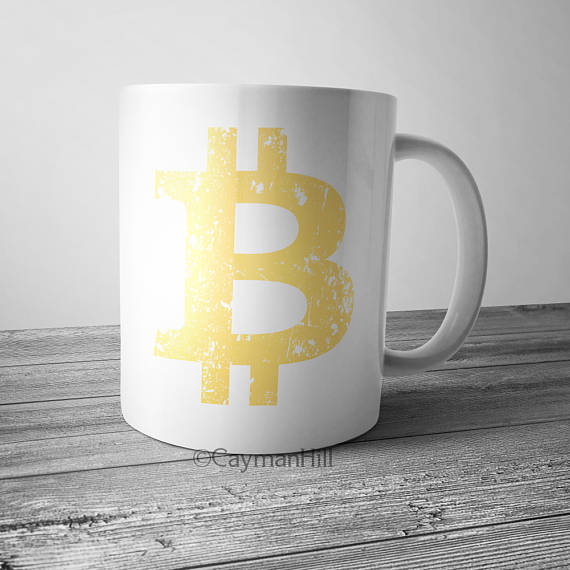
Bitcoin Mug BTC Symbol Coffee Mug Cryptocurrency Mug Bitcoin B Crypto Coffee Cup
Mug BTC Symbol Coffee Mug Cryptocurrency Mug bitcoin B Crypto Coffee Cup
Start your day with this bitcoin Symbol coffee mug. The image is on the front and back of the mug. Having the image on both sides makes the mug suitable for left handed or right handed people.
MUG DETAILS:
Qty: 1 Mug
Mug Type: Ceramic
Size: 11 fl. oz
Finish: Glossy
Gift Box: No
Images are printed with professional sublimation ink. The image is then heat transferred to the mug sealing in the design. Sublimated mug images do not peel or crack like vinyl images do. These mugs are dishwasher and microwave safe, however hand washing is recommended.
PROCESSING DETAILS:
Each mug is made to order and ships within 24-48 hours of the order being placed. Orders placed on Friday, Saturday or Sunday will not ship until Monday. Please note that due to monitor and screen differences colors may vary slightly on the finished mug. Each mug is setup by hand so minor variations in placement may be noted when ordering multiples.
Looking for this image on a shirt? Please visit our Cayman Hill Apparel shop at the link below.
https://www.etsy.com/listing/585724861
Sold by CaymanHillDesigns
China's State Electricity Firm Eyes Blockchain for Internet of Energy China State Grid Corporation, the country’s state-owned electricity utility monopoly, is looking to blockchain technology to advance its plans for an “Internet of Energy.” In a […]
According to a by researchers from the University of Tulsa and Tel Aviv University, the massive increase in the bitcoin price in late 2013 was caused by suspicious trading activity on the now-defunct Mt. Gox bitcoin exchange. The study, which is titled “Price Manipulation in the bitcoin Ecosystem,” indicates that 600,000 bitcoins were acquired by agents who did not pay for them, and the bitcoin price rose by an average of $20 on days when the suspicious trading activity took place.
“Based on rigorous analysis with extensive robustness checks, we conclude that the suspicious trading activity caused the unprecedented spike in the USD-BTC exchange rate in late 2013, when the rate jumped from around $150 to more than $1,000 in two months,” the study states.
At the center of the study is the infamous Willy bot that was first publicized back in May of 2014.
The paper details the data used for the study, identifies the suspicious trading activity and notes that these sorts of manipulative practices may still be possible today, especially in the altcoin markets.
The Data Used for the Study
This study regarding price manipulation in the bitcoin markets is based on that included the trading activity on Mt. Gox from April 2011 to November 2013. The researchers behind the study then supplemented that data with more information from .
“We performed additional sanity checks of the data utilizing publicly available historical Mt. Gox trading data from bitcoincharts.[com],” reads the report. “We are confident that the data are high-quality.”
Suspicious Trading Activity
In the leaked data, the report notes that there are suspicious accounts in which the country and state fields are filled in as “??” Many red flags are then found upon further inspection of these accounts.
In the case of one account dubbed “Markus,” the report states that no trading fees are paid and the prices on trades are seemingly random.
“In the end, we have concluded that Markus did not actually pay for the bitcoins he acquired; rather, his account was fraudulently credited with claimed bitcoins that almost certainly were not backed by real coins,” states the report. “Furthermore, because transactions were duplicated, no legitimate Mt. Gox customer received the fiat currency Markus supposedly paid to acquire the coins.”
According to the study, Markus acquired a total of 335,898 bitcoins in the 225 days the account was active.
Another entity noted by the study is known as “Willy”; however, Willy controlled many different accounts. According to the study, Willy appeared roughly seven hours after Markus became inactive.
The data cited by the report indicates that Willy would purchase 10–19 bitcoins at a time until an amount equal to $2.5 million worth of bitcoins had been purchased. Willy would then make a new account and repeat the process.
The study notes that there are indications that the owner of the Willy accounts was a Mt. Gox insider. For example, Willy was able to trade while the Mt. Gox API was offline, and the user ID numbers used by Willy were high for the time period they existed.
The study on price manipulation in the bitcoin ecosystem indicates that Willy acquired 268,132 bitcoins in exchange for $112 million. Much like Markus, Willy did not actually pay for his bitcoins.
“Hence, together, these unauthorized traders ‘acquired’ around 600,000 bitcoins by November 2013,” says the study. “Perhaps unsurprisingly, this is very close to the number of bitcoins (650,000) that Mt. Gox claimed to have lost when it folded in early 2014.”
According to the study, Markus accounts for 12 percent and Willy accounts for 6 percent of the total trade volume on the four major bitcoin exchanges on the days they were active.
In addition to the possibility of an inside job, the study also notes that an early bitcoin adopter could have artificially driven up the bitcoin price via a security vulnerability on the exchange in an effort to increase the value of his or her own holdings.
“We do not know for sure which, if either, of these scenarios reflect what actually happened,” says the report. “But that is largely beside the point. Our goal is to demonstrate that these fraudulent trades did in fact significantly impact the price of bitcoin.”
, former Mt. Gox CEO Mark Karpeles admitted to operating the Willy bot in a Japanese court on Tuesday.
Altcoins Open to Manipulation
The researchers behind the study indicate that the importance of price manipulation in digital asset markets will increase as this technology continues to go mainstream. The study indicates that many altcoins are open to this same kind of price manipulation right now.
“Similar to the bitcoin market in 2013 (the period we examine), markets for these other crytocurrencies are very thin,” says the report. “Our analysis suggests that manipulation is quite feasible in such settings.”
CEO during a recent talk where he compared altcoins to pump-and-dump penny stocks. “With altcoins, [pump-and-dump schemes] are super easy,” said Lingham.
“Regulators may want to begin taking an active oversight role as the bitcoin ecosystem becomes more integrated into international finance and payment systems,” concludes the study.
Atonomi Token faces class-action lawsuit; might be forced to return $25 million for offering unregistered security Stephen Palley, a prominent lawyer in the crypto community posted a tweet thread detailing the Federal Class Action lawsuit […]