
November 10, 2026

Capitalizations Index – B ∞/21M

Bitcoin Mixing Concept Payjoin Makes a ‘Huge Mess’ for Blockchain Surveillance

Bitcoin mixing concept payjoin makes a ‘huge mess’ for blockchain surveillance

Bitcoin Mixing Concept Payjoin Makes a ‘Huge Mess’ for Blockchain Surveillance

Bitcoin mixing concept payjoin makes a ‘huge mess’ for blockchain surveillance

Privacy

On Jan. 24, Adam Gibson, author of Waxwing’s Joinmarket blog, wrote about an interesting Coinjoin concept called Payjoin. The protocol further obfuscates the ownership of UTXO inputs during a Coinjoin transaction mixing cycle. According to Gibson, the Payjoin technique is “another nail in the coffin of blockchain analysis.”

Also read: Mystery ₿itcoin Miners Are Altering Mining Pool Dominance

Payjoin ₿itcoin UTXO Mixing Method Improves Coinjoin’s Privacy Technique

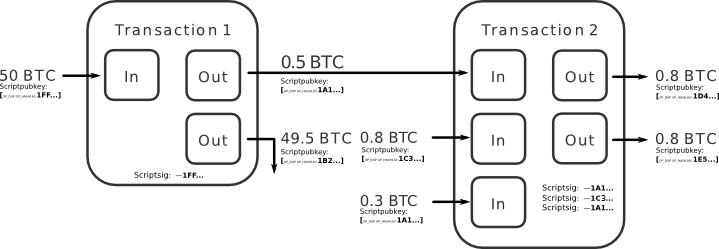
Over the past few years, blockchain analysis has kicked into high gear as law enforcement and governments have begun heavily funding companies that offer this service. On the opposite side of the spectrum, cryptocurrency privacy advocates have been building applications that make ₿itcoins more fungible. One way of adding privacy to ₿itcoin core (BTC) and bitcoin cash (BCH) transactions is a method called Coinjoin. The practice combines multiple payments from multiple entities into a single transaction. This technique makes it difficult for blockchain analysts to find each derivation point and the identity of the spenders. The Joinmarket project uses the Coinjoin method and allows users to mix their coins and keep control over their private keys throughout the process. The application also incentivizes people to add liquidity to the market by providing users with the ability to charge fees. However, Gibson notes that a traditional Coinjoin transaction is susceptible to looking different to typical unmixed transaction.
Bitcoin mixing concept payjoin makes a 'huge mess' for blockchain surveillance
A Coinjoin BTC transaction.

This is because a Coinjoin uses precise and multiple equal-value outputs, which essentially showcases an anonymity set. Repeated mixing rounds create a much larger anonymity set, but they are still noticeable by a trained blockchain analyst. Essentially the Payjoin concept allows Bob to create an “obfuscation of ownership of the inputs without it looking different from an ordinary payment” with his customer Alice. Gibson’s research details that he’s not entirely sure who came up with the Payjoin idea, but he’s seen it mentioned in a blog post written by Matthew Haywood last summer and a ₿itcoin Improvement Proposal (BIP) published by developer Ryan Havar.

Payjoin’s Four Advantages

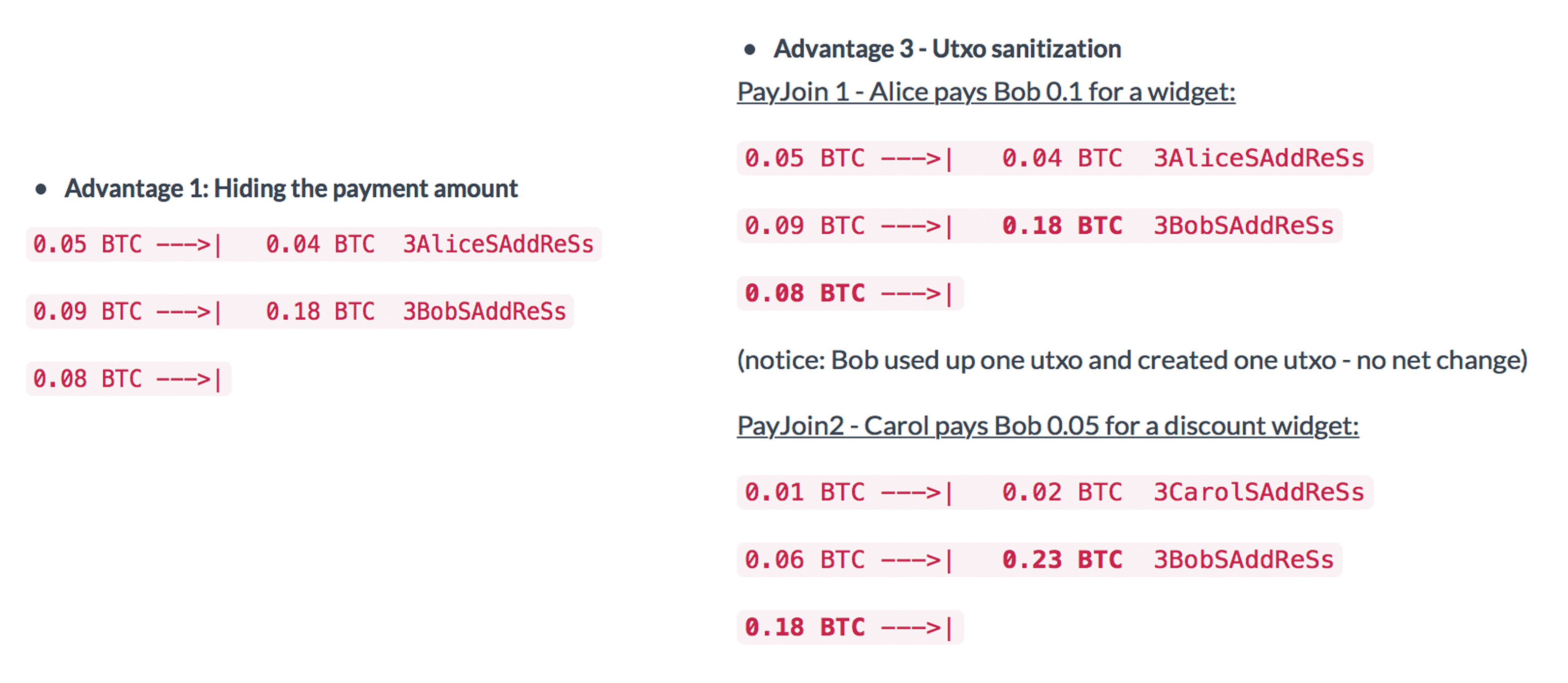
Gibson’s study also emphasizes that there are four fundamental advantages to the Payjoin concept. The first is hiding the payment amount and Gibson states that blockchain analysts see this as “a huge mess.” Advantage two is breaking heuristics and doing so without flagging that breakage has occurred. “This is enormously important, even if the breakage of the assumption of common input ownership on its own seems rather trivial (especially if Payjoin is used by only a few people), with only two counterparties in each transaction,” Gibson remarked.
Bitcoin mixing concept payjoin makes a 'huge mess' for blockchain surveillance
Two advantages of using the Payjoin method.

The next benefit is Unspent Transaction Output (UTXO) sanitation and Payjoin bolsters this action by making each payment that comes in consume the UTXO of the last payment. The last advantage is hiding out in a large crowd, which basically makes anonymity sets “indistinguishable from ordinary payments.”

“Let’s say 5% of payments used this method — The point is that nobody will know which 5% of payments are Payjoin — That is a great achievement because it means that all payments, including ones that don’t use Payjoin, gain a privacy advantage,” explains Gibson’s post.

The author conceded:

This is another nail in the coffin of blockchain analysis — If 5% of us do this, it will not be safe to assume that a totally ordinary looking payment is not a Coinjoin.

Gibson explains that right now there are only two services providing this type of Coinjoin solution: Samourai Wallet’s Stowaway, and Joinmarket 0.5.2 which was just released. Gibson has published a demonstration of Payjoin in his prior blog post and notes that while helpful in a peer-to-peer fashion, both Stowaway and Joinmarket are not ready for large scale merchant automation.

What do you think about the Payjoin concept? What projects do you see improving cryptocurrency fungibility? Let us know what you think about this subject in the comments section below.


Image credits: Shutterstock, Waxwing’s blog, en.bitcoin.it/wiki/Coinjoin, and Pixabay. 


Want to create your own secure cold storage paper wallet? Check our tools section.

Published at Tue, 29 Jan 2019 00:03:25 +0000

Previous Article

Bitcoiners Increasingly Dumping Bitcoin for Gold Investments in 2019

Next Article

Bitcoin Core 0.17.1 Released

You might be interested in …

Eos beautiful equilibrium - break coming!

EOS Beautiful Equilibrium – Break Coming!

EOS Beautiful Equilibrium – Break Coming! Hello my dear EOS traders, hope you’re having a nice weekend! 😉 EOS/USD is inside a beautiful equilibrium between the ranges of 1,8 & 2,1 Dollars, which will see […]

Terrae game journal |03| introducing the marketplace

Terrae Game Journal |03| Introducing the marketplace

Terrae Game Journal |03| Introducing the marketplace Since this approach speaks by itself, I would like to briefly introduce to you to what focus we have taken by design. Let’s start with the resources; you […]

Cybersecurity Firm Reports All Fortune 500 Companies Exposed on the Dark Web

Cybersecurity Firm Reports All Fortune 500 Companies Exposed on the Dark Web

Every Fortune 500 company has some level of exposure on the dark web, with technology and telecommunications firms ranking at the top of the list, according to a report published by Denver-base OWL Cybersecurity at the end of May, 2017.

The dark web, unlike the surface web — the internet most people know of and use every day — can’t be indexed using traditional search engines, such as Google or Bing. The cybersecurity company has built a database updated with “10 to 15 million pages per day, from more than 24,000 domains on the Tor network alone, as well as other darknet networks.” With the darknet content indexed and searchable in 47 different languages, OWL claims their dark web database is the “most comprehensive one of its kind in the world.”

In the study, the OWL picked each and every company from the 2017 Fortune 500 list and assessed them with an overall darknet footprint. OWL uses a specific algorithm for the purpose, rating postings on the dark web based on their potential for criminal use.

“To compile our Darknet Index, we ran each member of the 2017 Fortune 500 through the OWL Vision database. We focused on specific darknets for matches on each company’s website and email domains and then further adjusted the results based on computations of ‘hackishness,’” the report reads.

When valuable information is either stolen or hacked, the data is often offered for sale on the dark web, OWL stated. On dark web marketplaces and forums, criminals exchange illegal products and data — mostly sourced from hacks and breaches — for cryptocurrencies, such as bitcoin. Therefore, the cybersecurity company measured the exposure of the Fortune 500 firms by analyzing their presence on the darknet.

According to the researchers, in some instances, “private data for sale may have come from a breach at a Fortune 500 company, but it may not be identified as such.” OWL explained, for example, that multiple instances of credit card information up for sale on the dark web can come from various sources, including banks or retailers; however, information on the source of the compromised data is not always available or provided.

OWL ranked the Fortune 500 companies by their Darknet Index score — calculated by the cybersecurity firm’s algorithm — and also included the firms’ rankings on the Fortune 500 lists. Ranked by DARKINT (darknet intelligence), technology companies lead the list, with Amazon holding the top spot, but with telecommunications firms right alongside it.

The cybersecurity firm pointed out some key takeaways from their analysis. The researchers emphasized that all Fortune 500 companies have a presence on the dark web since “every single company in the Fortune 500 had a positive Darknet Index score.” OWL explained Amazon’s top ranking with the fact that the firm has a “massive internet presence and possesses a significant amount of customer data.”

The researchers were surprised by the comparatively positive rankings of financial firms, which are frequent targets of cybercriminals. OWL indicated that the financial industry’s significant investment in cybersecurity measures in recent years was the reason for the success. Other sectors in which the firms invested “heavily” in cybersecurity also had lower Darknet Index ratings, the researchers added.

OWL expects that by publishing such statistics in their report, they can help companies improve their cybersecurity. The cybersecurity firm enables companies with compromised data to monitor the stolen or hacked information on the dark web.

“Today, in an age where data loss is virtually inevitable, it is critical to look at the darknet as a key part of a complete cybersecurity program, enabling organizations to swiftly detect security gaps and mitigate damage prior to the misuse of data.”

The post Cybersecurity Firm Reports All Fortune 500 Companies Exposed on the Dark Web appeared first on Bitcoin Magazine.