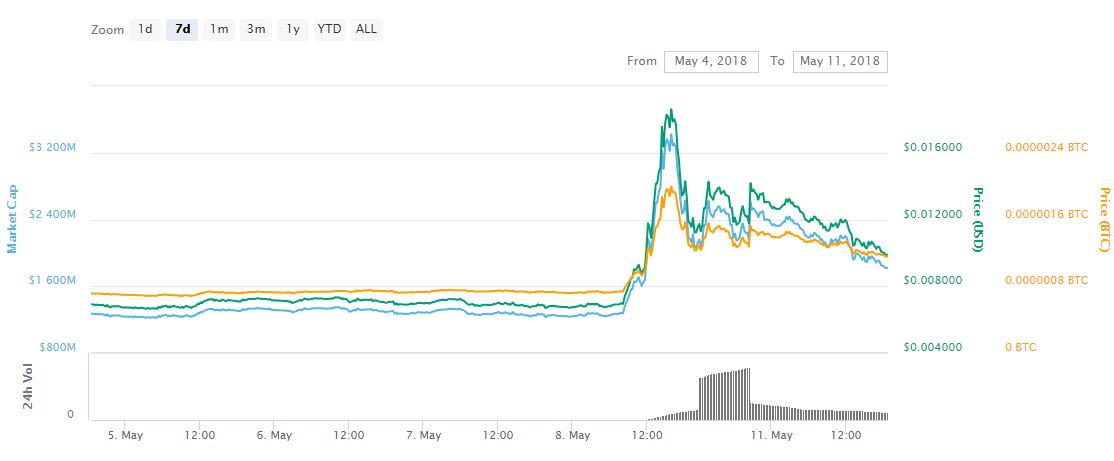
Friday proved to be tough for the bitcoin investors as the world’s largest cryptocurrency hit its new 2018-low. According to the one-day chart on CoinMarketCap, slipped below $3300 making a low of $3280.23 on Friday, December 7. The overall crypto market seems to be weak at this moment with volumes drying up.
After making a new low yesterday, bitcoin has recovered by $100. It looks like yesterday’s price slip was a knee-jerk reaction to the SEC VanEck bitcoin ETF approval to Feb. 2019. At the press time, bitcoin (BTC) is trading at $3401, down by less than 1% with its market cap going below $60 billion. Also, it still continues to dominate more than half of the overall cryptocurrency market.
Last week, bitcoin made a post the confirmation of arriving by first-half of 2019. The cryptocurrency surged to over $4000 on November 29 but somehow failed to hold up those levels for much time.
Even earlier this week, it made a to $4000 trying to make a new base there. But again it failed to show enough strength and lost 15% since then. The most imminent question in the minds of the investors is where is bitcoin heading now?
Mid-Term Forecast for bitcoin
Last week on December 2, independent crypto analyst Willy Woo presented some interesting charts giving a mid-term forecast for bitcoin. Woo predicts the “final capitulation for bitcoin and a decisive end to the 2018 bear market.
Be aware the above scenario is contingent on a bounce upwards to test low 5000s. Currently the short term price action is consolidating into a wedge with hidden accumulation (according to the OBV indicator), this suggest there is more probability of an up move from here.
— Willy Woo (@woonomic)
In his further series of tweets, Woo said:
“…We can expect more range bound sideways action, followed by final capitulation, and an end of the bear market earlier, around Q1 2019. If capitulation has indeed happened then we would be in an accumulation phase right now. But the key signs of this have not happened.”
Experts’ Opinions on bitcoin
A number of crypto-market analysts have been speaking on bitcoin over the last few months. Largely, most of the bitcoin loyalists and enthusiasts also continue to believe in its long-term future despite this year’s price crash. CoinCorner’s co-founder and CEO, Danny Scott, Express.co.uk: “If we look back over bitcoin’s short 10-year history, it has experienced many price fluctuations – something that is to be expected given that the industry is still very young. He further adds:
“It’s widely known that bitcoin has allegedly ‘died’ more than 300 times to date. This ‘death’ refers to predictions from critics that bitcoin won’t survive the changing price movements – yet it hasn’t died on any of those occasions and, instead, has continued to gain mass adoption.”
Danny Scott gives a further sneak-peek into the historical price movements of bitcoin saying:
“There have been a number of sizeable price movements over the years which have typically gone unnoticed by anyone except those within the industry. For example, in 2013 we saw the price drop 49.88 percent in just 14 days, which is a bigger drop than the one we have experienced over these last two weeks. By looking at bitcoin’s historical price movements, we can all clearly see that price movements such as the most recent in November, are nothing out of the ordinary for the bitcoin industry.”
Mati Greenspan, a senior crypto analyst at eToro, believes that bitcoin for some time will show price movement between $3000-$3500. He said: “I’m hoping there will be a Santa Claus rally especially now that we’re looking at the entire year as one defending triangle on the charts and we’ve now broken out of the triangle and hopefully bitcoin’s got it out of the system now.”
Bigger Price Fall Still Ahead Says Bloomberg Analyst
Earlier this week, an in-house analyst at Bloomberg, Mike McGlone predicted some more bloodbath happening. McGlone believes that “bitcoin is caught in a strong selling trend”. Thus he bitcoin dropping more than 50% from the current levels to make a low of $1500. He said:
“[This trend] is its most pronounced since the sell-off it underwent mid-year, when the price tumbled from about $9,300 in May to around $6,600 in. July, according to the Directional Movement Index. If that plunge is an indicator of how things might play out, then bitcoin could be in for a continued rout. “There’s little to prevent fading bitcoin prices from reaching the continuous mean of $1,500. A rush to the exits among investors seems to be in place.”
McGlone also points to the bitcoin Cash split last month which went out on a pretty ugly note. The two resulting camps were battling out to gain dominance over the network making things murkier. He adds:
“The hard fork was a key trigger that signaled the technology is way too nascent. You had these dicey characters threatening to destroy each other and institutions said ‘It might be best if we stay away from this for a while.”
Not just bitcoin, but a majority of the altcoins are more still today except for Ethereum. Yesterday, Ethereum’s core developer team the launch of Constantinople hard fork in mid-January bringing the much-awaited upgrades to the long-time ailing cryptocurrency. In response, has made 4% recovery since yesterday, at the press time.

Social media platform Honest Cash has activated 200 new users and added a few new features, according to its creator Adrian Barwicki. News.bitcoin.com reported on its initial launch during the last week of November, when the blogging platform started with the first 100 registrants.
Also read:
Honest Cash Sees 7-10% Daily Growth
 Since the bitcoin Cash (BCH) network hard fork a few weeks ago, a new social media platform called Honest Cash was launched for BCH proponents. Similar to blogging platforms like Medium or Steemit, the application gives registered users the ability to create a unique profile tethered to a BCH wallet and post written content in short or long form. Initially registered users could only post written text, but since then, Barwicki has added the ability to upload photos and videos as well. This means the Honest Cash community of users can reward good content by tipping not just writers, but vloggers, graphic artists, reporters, and more with bitcoin cash.
Barwicki has been registering users by invite-only after people sign up with a valid email address and had approved 100 users during the week news.bitcoin.com tested the platform. On Friday, the developer that the team activated 200 more users and they have only 50 slots open for the rest of the trial period. Moreover, looking at the data, Honest Cash has grown 7-10 percent a day and that’s not including the waiting list Barwicki detailed on Twitter.
“Another 200 accounts have just been activated on Honest Cash,” the founder emphasized.
190 stories have been published, 150 are being written, 120 tips/upvotes were given since two days ago and we have an elite retention rate of over 50% — Is something growing like this on BSV?
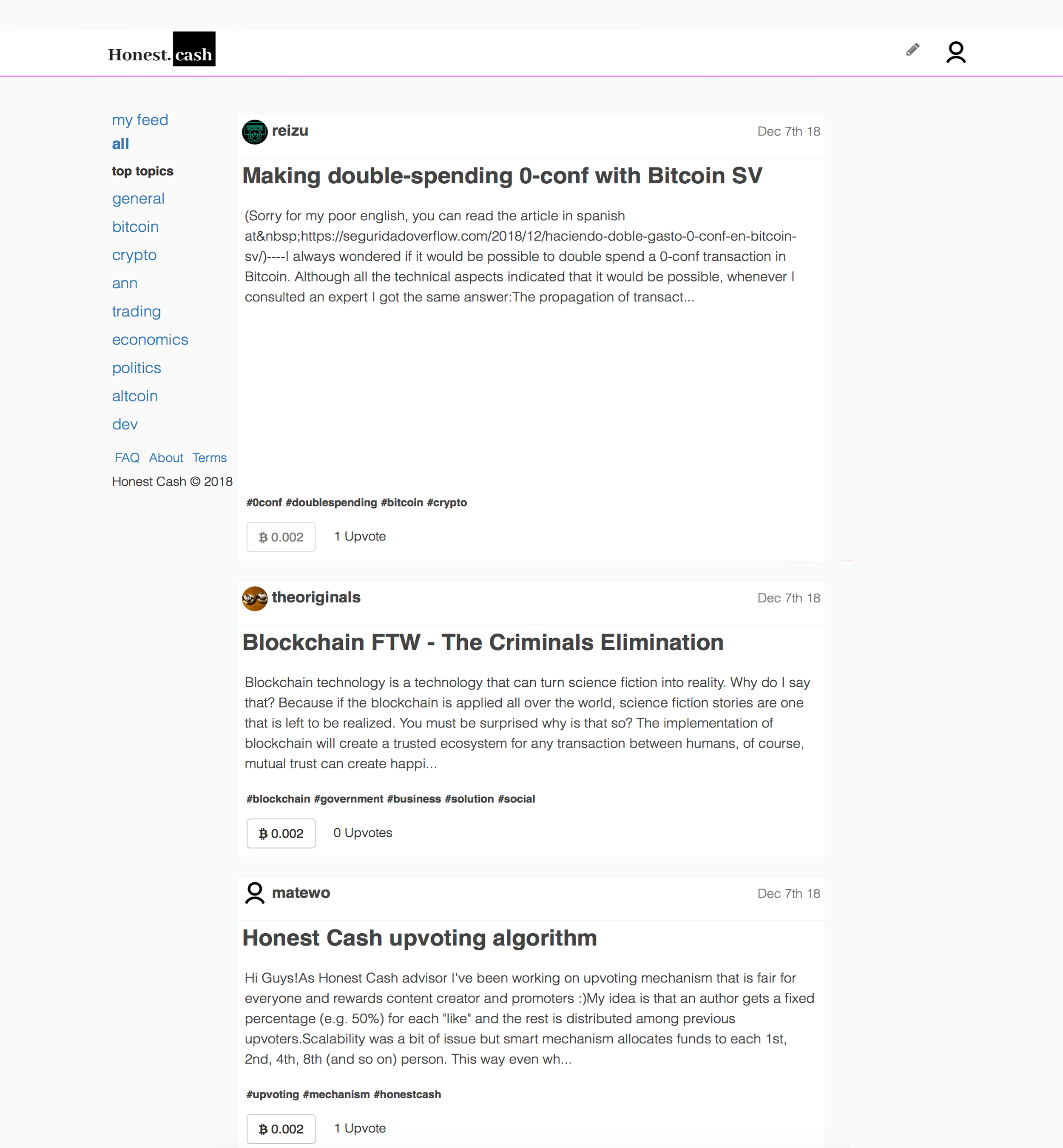 The Honest Cash news feed.
New Native Wallet and the First Uncensorable Post
While scrolling through the Honest Cash front page, the feed consists of subjects like bitcoin, cryptocurrencies, trading, economics, and politics which shows the platform is growing. Users can now follow other users and unique content creators can grow a list of followers too. Additionally, the Honest Cash application allows individuals to tether their Twitter profile or Reddit account to the platform. When news.bitcoin.com tested the platform in November, you could tether a third-party wallet to a profile. But now Honest Cash has its own native client which can generate a new wallet. Users can also import existing keys with custom HD derivation path support.
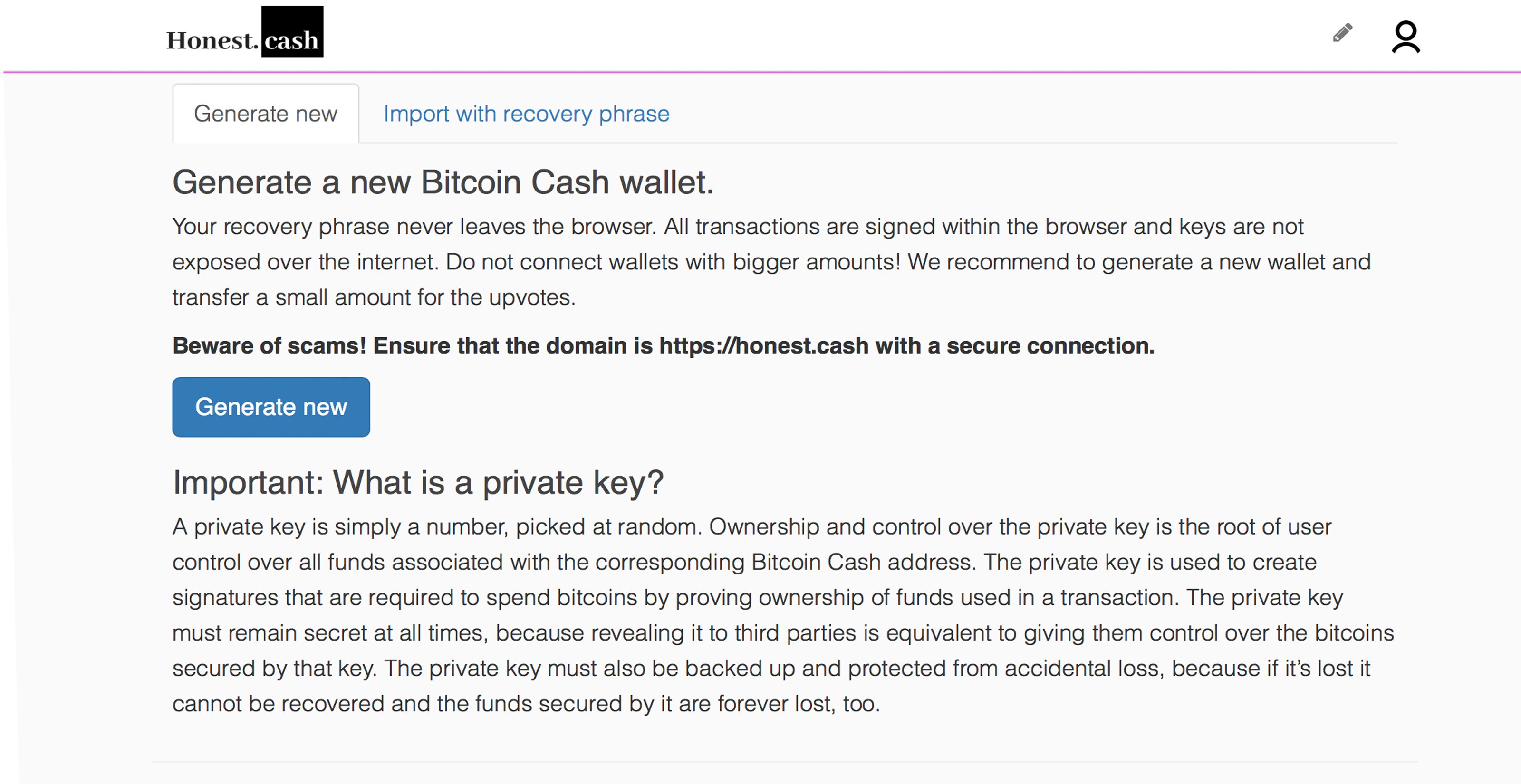 Honest Cash can now generate a new BCH wallet or connect to an existing wallet with a recovery phrase.
Recovery phrases never leave the browser, explains the Honest Cash website, and with all the transactions signed, the software never exposes keys over the internet. However Honest Cash recommends not attaching a wallet with a large amount of BCH, as only a small amount of funds is needed to tip and upvote. Furthermore, five days ago the first uncensorable post was recorded on the Honest Cash platform with a little help from the bitcoin Files platform.
“It cannot be removed, censored or amended. It is saved in the history of mankind for all times — Be honest,” the post with the bitcoin file hash.
What do you think about the Honest Cash platform? Let us know what you think about this subject in the comments section below.
Images via Shutterstock, Honest Cash, and Pixabay.
At .com all comments containing links are automatically held up for moderation in the Disqus system. That means an editor has to take a look at the comment to approve it. This is due to the many, repetitive, spam and scam links people post under our articles. We do not censor any comment content based on politics or personal opinions. So, please be patient. Your comment will be published.
The post appeared first on .
The Satoshi Revolution: A Revolution of Rising Expectations
Section 5: Saving the World Through Anarchism
Chapter 11, Part 8
Avoiding Fraud By Going Crypto-Anarchist
A transfer on the blockchain is a simplistic peer-to-peer contract, which memorializes the terms for those involved and is seen to be valid by the surrounding community through transparency. It is a voluntary exchange. The blockchain is also an instrument of enforcement that embodies the terms of execution, such as irreversibility, to which both parties have agreed; their agreement is expressed through the willingness to use the blockchain. Thus the blockchain expresses both requirements of libertarian law; it facilitates voluntary interaction and it acts as an instrument of enforcement.
–Wendy McElroy,
The late Samuel E. Konkin III (SEK3), the father of and an old drinking buddy of mine, used to answer his telephone with the salutation “Smash the State.” And, yet, his lifestyle did not include direct confrontations with authority. Whenever possible, SEK3 avoided or replaced the state in his daily life, because he knew that the most effective way to smash the state was to render it irrelevant. His lasting legacy to anarchist theory: Agorism is a peaceful revolution that is achieved by counter-economics, which SEK3 defined as “the study or practice of all peaceful human action which is forbidden by the State.” Counter-economics is a black market version of Ludwig von Mises’s praxeology—the study of human action that flaunts the state.
SEK3 would have reveled in the audacity of cryptocurrency, which both avoids and replaces state fiat because being a better currency is the surest way to destroy fiat. He would have declared crypto to be the “counter-economic currency”–the currency of agorism. But more than this. In a flash, SEK3 would have recognized crypto’s implications for justice, because it also avoids and replaces state law as the default position for contracts. The default position becomes the free market or agorism. I can see SEK3 take a swig of black beer and a drag on his constantly present pipe, before announcing that anarchy had arrived.
The message of anarchism never should have been “smash the state” or “convince everyone to become an anarchist.” Those are impossible ends. The message should be “free yourself” by decentralizing the power expressed by every decision into your own hands. To the extent you can act as though the state does not exist, it does not.
The Basis of a Free Society
The contract is the basis of anarchist law because it is tangible evidence of the consent of individuals, upon which a free society rests. That’s why it is essential to decentralize contracts under the direct control of participants. The blockchain is a self-executing transfer, with immutable and transparent terms that are dictated by the users rather than by the jurisdiction of a state; it can become a self-executing agreement through the addition of a smart contract. (Note: smart contracts are still a developing technology, but proof of principle is definitely there.) The blockchain is its own defense against fraud and theft, largely because it bypasses trusted third parties, who are the overwhelming causes of corruption.
A Brookings Institute article asks, “” Pointing to accountability and transparency, it presents a practical example of how the blockchain prevents fraud. “If a government decides to construct a road, it can now track how each dollar is being spent, identify all the users of the funds, and ensure that only those authorized to spend money do so on originally intended expenses within the permitted time. Fraud and corruption investigations that now take on average 15 months could be performed at the touch of a button and at a fraction of the cost.”
The blockchain is part of a growing push to minimize the need for lawyers and courtrooms. An article in Futurism, entitled explains another aspect of the trend—an automated service called LawGeex. “On LawGeex, users upload a contract and, within a short period of time (an hour on average), they receive a report that states which clauses don’t meet common legal standards. The report also details any vital clauses that could be missing, and where existing clauses might require revision. All of this is calculated by algorithms.” For a modest fee, algorithms can detect clauses that enable fraud or provide inadequate protection. It can vet smart contracts before they are coded.
The Lingering Reality of Fraud
Fraud is like violence. Both will always be present because some people will always choose them as options. As with violence, the goal in countering fraud is not to eliminate it, because that is Utopian. The goal is to drastically reduce it and keep it away from your life.
What is fraud? It is not merely “dishonesty”–a word that is sometimes used as a synonym. Nor is it a breach of contract, which can occur between well-meaning people who then usually come to a settlement. In an anarchist framework, aggression is defined as the usurpation of property—whether it is a person’s body or goods—without the owner’s consent. In crypto, the aggression is committed against goods or wealth. If it is taken through violence, such as in a mugging or a burglary, then it is straightforward theft. If it is taken through deception or stealth, then it is the type of theft called fraud. In fraud facilitated by a contract, there may be a bogus exchange of value; a person is assured that an expensive watch is a Rolex, for example, when it is a cheap knock-off. Or the exchange may happen on falsely-stated terms; the genuine Rolex is stolen property to which the seller has no title. The seller lies; the buyer believes; the contract of sale—explicit or implicit–is invalid because the values or terms were not agreed upon by both parties.
Before discussing fraud in crypto, it is important to note that the phenomenon may not be as common as many assume. The Australian Competition & Consumer Commission released a report on the level and types of scams that happened in 2017. Crypto-related fraud of the total. Each instance seems to draw media attention, however, because powerful forces use the accusation of fraud to call for regulation. Or, as a headline at Panda Security recently stated,
I also know that for every scam, there are countless examples of cryptocurrency and blockchain technology being used responsibly to create opportunities, grow economies, and do good in the world. We need to remember that cryptocurrency fraud is the exception, not the rule.
The attention to fraud is warranted, but the conclusion of a need for state involvement is not. Inviting in the state—the greatest trusted third party scam in existence—is dangerous folly. Instead, people need to focus on the correcting the unsafe user practices that are revealed by every scam. They should stop opening their wallets and crypto to thieves, statist or private.
Consider the 2017 “mybtgwallet.com” scam. The website claimed to be an online web wallet for bitcoin Gold, which was considered to be legitimate. Mybtgwallet.com offered users free bitcoin Gold wallets through which they could check their balances, and use the website for one day for free transactions. The scam link was lent credibility by appearing briefly on the official bitcoin Gold site—an act of incredible carelessness on the site’s part, to say the least. To take mybtgwallet.com up on its offer, users had to submit their private keys or recovery seeds. Of course, after they did so, the crypto in their wallets was forwarded to other addresses.
No one should have fallen for this scam but even some crypto veterans did. that “more than $3.3 million has been stolen as part of an elaborate scam that took advantage of bitcoin users seeking to claim their share of the newly created cryptocurrency bitcoin gold. At least $30,000 in ethereum,$72,000 in litecoin, $107,000 in bitcoin gold and more than $3 million in bitcoin were confiscated.”
What are the lessons of the mybtgwallet.com debacle?
Always assume a strange site might be trying to steal crypto. Extend trust only after due diligence.
Due diligence or not, never trust anyone with private keys or recovery seeds. This is equivalent to disclosing the combination of a safe or handing over title to your wealth. The keys and recovery seeds are the proof and control of ownership.
Immediately distrust anyone who asks for keys or recovery seeds.
Never enter your keys or seeds anywhere that is vulnerable to being copied or stored.
Always keep a paper version of both in a secure place.
In essence, maintain privacy. Thieves require personal data in order to loot.
If the preceding lessons are repetitive, it is because they bear repetition. Remember: when crypto leaves your wallet, it is gone forever. That should at least be the assumption. The transaction cannot be reversed, and there is no insurance company to make you whole (although the crypto community should sell this service). As it is, victims rarely receive back even cents on the dollar, as the Mt. Gox victims did after years and years of strenuous effort.
The Biggest Message of mybtgwallet.com
Avoid trusted third parties, however convenient or alluring they may seem. They are the major point of vulnerability for fraud and other theft.
Third parties may be necessary for some purposes, such as converting between cryptos. If so, use exchanges or other services that require as little trust as possible. Many do not require keys or personal information beyond the absolute minimum of an email address and user name; prefer them over centralized exchanges that strip away all privacy. In your account, keep the least amount of crypto possible for as short a period as necessary to accomplish your goal.
The trusted third party to avoid the most is the state. Unfortunately, when massive fraud occurs, even people who should assume some responsibility for the theft call, instead, for government regulation. There is an irony here. One reason fraud happens is because of the statist mindset with which people approach investing and all things monetary. They are accustomed to guarantees of safety from the state, and many believe the guarantees are real. Fiat money is backed by the state and, by law, it must be accepted as payment. Bank deposits are insured; in the U.S., the Federal Deposit Insurance Corporation insures up to $250,000. Law enforcement operates fraud divisions that record reports of theft. In short, the state makes people feel safer than they should, and they neglect the due diligence that is the responsibility of every individual. Protecting your property is part of self-defense. The world’s most fraudulent trusted third party—the state–is not a remedy. It is not a reason to relinquish self-defense. It is a reason to learn how to be comfortable and skilled in exercising it.
[To be continued next week.]
Reprints of this article should credit bitcoin.com and include a link back to the original links to all previous chapters
Wendy McElroy has agreed to ”live-publish” The Satoshi Revolution exclusively with bitcoin.com. Every Saturday you’ll find another installment in a series of posts planned to conclude after about 18 months. Altogether they’ll make up her new book ”The Satoshi Revolution”. Read it first.
The post appeared first on .

In this edition of The Daily, cryptocurrency exchange Binance has announced support for multiple accounts and we’ve got all the details. Elsewhere, digital asset exchange Huobi wants to launch a regulated platform for institutional investors under its Gibraltar license. Finally, we cover a warning about an unauthorized crypto brokerage that has been issued by regulators in several European countries.
Also read:
Binance Introduces Subaccount Feature
Binance, currently the largest cryptocurrency exchange by daily trading volume, has announced the launch of a subaccount feature for institutional clients. The upgrade will allow them to set up multiple trading accounts within an organization, providing them with improved control and asset audit tools.
Entities will be able to create up to 200 subaccounts, maintaining control over the movement of digital assets from their main account. They can also grant permissions for different access levels. Each subaccount will have its own API limits which will enable API users to trade with more freedom and capacity, the exchange detailed in a post on Medium.

Under the new arrangements, master accounts will be able to view all data and balances, transfer funds between accounts and exert managerial control. Both types of accounts can place orders, but subaccounts will be allowed to cancel only their own orders. The same applies to API features, where only master accounts will be able to delete keys.
assures customers that the new feature has been designed with security in mind. “Account login information has been properly subdivided to maximize security and minimize risk,” the trading platform noted in the announcement.
Huobi to Launch Regulated Exchange for Institutions
 Digital asset exchange , which was recently granted a Distributed Ledger Technology (DLT) license in Gibraltar, has announced plans to create a global platform for institutional customers. According to a press release, the DLT license allows the Singapore-based company to store and transmit cryptocurrencies on behalf of clients around the world. It also simplifies the exchange between fiat and digital currencies.
Lester Haoda Li, head of Global Institutional Business at Huobi’s London office, emphasized that well-designed regulatory regimes are a key part of the future for the cryptocurrency industry. He further explained:
Our Gibraltar DLT license will allow us to open a fully-regulated exchange for our Global Institutional clients and retail clients alike, so this is a big win for Huobi and a very positive step forward for our global strategy … Among other benefits, our DLT license will allow us to open doors to more institutional investors who were previously unable or unwilling to get involved in an unregulated sphere.
Gibraltar, a British overseas territory, has become a leading crypto-friendly jurisdiction in Europe. Its dedicated DLT regulatory framework entered into force at the beginning of this year. Huobi is among the first licensed crypto trading platforms. In November, the Gibraltar Financial Services Commission a DLT license to Gibraltar Blockchain Exchange (GBX), a subsidiary of the Gibraltar Stock Exchange.
Regulators Warn About Unlicensed Crypto Broker
 The Italian Companies and Exchange Commission, the authority regulating the securities market in Italy, has issued a warning against an online platform offering unauthorized crypto brokerage services. The regulator has ordered Solutions CM Ltd., the operator of the Originalcrypto.com website, to cease its activities that infringe the respective provisions of the Italian law.
The warning has been received and published by the Malta Financial Services Authority as well. Earlier this year, the Maltese regulator shared a similar notice issued by the Spanish National Securities Market Commission. According to the Spanish authority, Solutions CM is not authorized to provide investment services or to perform foreign currency transactions in the country.
What are your thoughts on today’s news tidbits? Tell us in the comments section.
Images courtesy of Shutterstock.
Make sure you do not miss any important bitcoin-related news! Follow our news feed any which way you prefer; via Twitter, Facebook, Telegram, RSS or email (scroll down to the bottom of this page to subscribe). We’ve got daily, weekly and quarterly summaries in newsletter form. bitcoin never sleeps. Neither do we.
The post appeared first on .