
April 26, 2026

Capitalizations Index – B ∞/21M

Bitcoin Fees Jump to Nearly 1-Year Highs – But Why?

Bitcoin fees jump to nearly 1-year highs – but why?

Bitcoin Fees Jump to Nearly 1-Year Highs – But Why?

The average fees required to send a bitcoin transaction are on the rise again.

After hovering steadily around the $0.50 mark over the last six months, data shows average fees hit their highest level in nearly a year in early April, according to data from Bitinfocharts. Since then, averages fees have swelled to around $1 to $2, a move that coincided with bitcoin’s price “break out” earlier this month.

Bitcoin fees jump to nearly 1-year highs – but why?

Graph via Bitinfocharts.com

bitcoin fees are required because there’s limited room in every block added to the bitcoin blockchain – a feature most blockchains face in order to fulfill its goal of giving users control over their money.

When the blockchain gets more popular, a user needs to compete with all the other people trying to get their transaction through. As such, a user needs to spend a bit more money on the fee to incentivize the miners securing the network to push through a transaction faster by prioritizing theirs over others.

What might be contributing this time around? As bitcoin blocks fill up with transactions, fees increase. And indeed, the number of transactions waiting in the mempool saw a sharp spike earlier this month.

As such, sources painted rising fees an inevitability, especially if interest in bitcoin continues to increase.

Seoul bitcoin meetup founder Ruben Somsen, who’s been outspoken about fees, told CoinDesk:

“As long as more people become interested in bitcoin, fees will inevitably rise.”

Inevitable fees

To an extent, this is simply how bitcoin works.

There’s limited space for transactions in the bitcoin blockchain. This is necessary to keep the bitcoin blockchain small enough so that as many people as possible can download all this data to run what’s known as a “full node,” the most secure way of using bitcoin as it gives users the ability to verify each and every transaction.

Even with a limited block size, it takes roughly 200 GB to store the full bitcoin blockchain, the size of a small laptop.

“Just like bitcoin is limited to 21 million, block space is limited to roughly 15 transactions per second (4MB block weight per 10 minutes),” Somsen said.

He added that this limit explains why fees can seemingly jump overnight.

“Users should be aware fees can rise abruptly, particularly because the difference between full and non-full blocks is like night and day. When blocks aren’t full, space is practically given away for free. Once they get full, users will have to outbid each other for it,” he said.

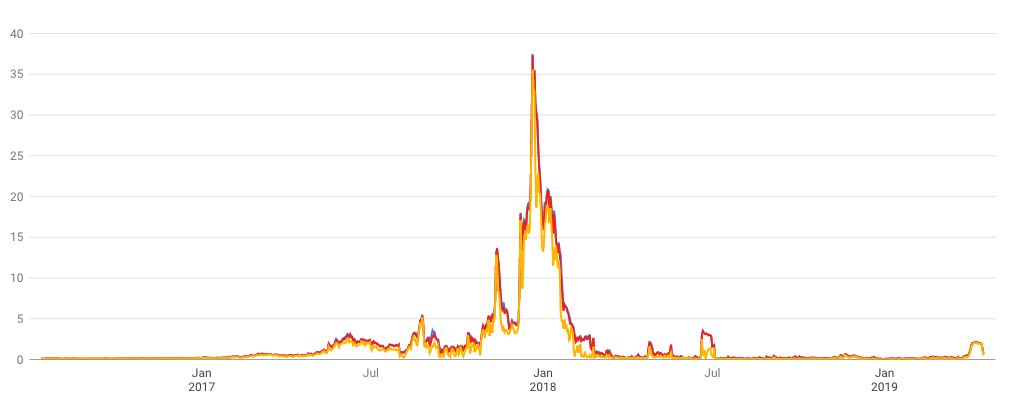
And while the recent spike in fees is notable, it’s important to note that average fees today are much (much) less than a couple of years ago, showing how high fees can go when hype drives new people to start using bitcoin.
Bitcoin fees jump to nearly 1-year highs – but why?

Graph via Bitcoinfees.info

Some cryptocurrencies, such as bitcoin cash, have tried to get around this hurdle by increasing the block size. And indeed, transaction fees are much lower for those using the blockchain.

But bitcoin developers argue this approach makes it more difficult to run full nodes, threatening the security of the network and the ability of individuals to truly provide checks and balances on the network.

Meanwhile, since the blockchain is smaller and has less computing power behind it, it’s less secure, as it’s less costly for someone to double-spend a transaction, thus corrupting the blockchain’s integrity.

“The concern I hear the most is ‘How can we get the world to use bitcoin without cheap fees?’ This question reveals a misunderstanding between the fundamental limitations of the system and the desired outcome. As much as we’d all like infinitely scaled blockchains with cheap fees, today this is unfortunately not possible,” Somsen argued.

When lightning strikes

Advocates are hopeful that in the long run, though, fees will be reduced by a new technology that’s in the works: the lightning network.

Today, the technology is still in beta (though that’s not stopping thousands of enthusiastic bitcoiners from using it anyway). As the technology advances, advocates hope that it will become the main way of making payments on the network (or at least small payments).

Lightning still has fees, but right now they’re very low. To get a transaction sent across the network, lightning fees are a fraction of what bitcoin fees are.

“Theoretically as it becomes more pricey to get a transaction included in the blockchain, user behavior will adopt to either make their transaction use more efficient or switch to other off-chain methods of transacting such as using lightning or something else,” Chaincode co-founder Alex Morcos told CoinDesk.

And other upcoming technologies could help, too. Segregated witness (SegWit), enacted in 2017, has helped to a degree by carving out more space in the blockchain, and pushing down fees a bit. Other technologies, such as Schnorr, could help as well.

But some experts guess that even lightning fees will eventually increase as well. Like that growing on-chain transactions will push up lightning fees as well. Obviously, only time will tell.

Bitcoin coins image via Shutterstock

Published at Thu, 18 Apr 2019 15:55:24 +0000

Previous Article

Binance CEO Makes First Transaction on Newly-Launched DEX Mainnet

Next Article

CoinReport A conversation with Jamie Burke, CEO & founder of Outlier Ventures, on state of blockchain investments, Big Tech’s future & way to build next Internet

You might be interested in …

New Crypto Meetup Group Started In Cleveland, Ohio Area

Crypto Cleveland Meetup Group https://www.meetup.com/Crypto-Cleveland/ If you’re interested in exploring the paradigm shift that is trustless, decentralized, public blockchain-based cryptocurrency-and-beyond systems, come meditate with us on deep thought. If that sounds like a bit too […]

Ether Price Analysis: Market Consolidation Provides Calm Before Next Breakout

Ether Price Analysis

Over the past few days, despite major swings throughout the crypto-market, ETH-USD finally appears to be displaying nice, reliable signs of market consolidation:

Figure_1 (1).jpgFigure 1: ETH-USD, 2-hr Candles, Bitfinex, Consolidation Pattern

Two key characteristics of market consolidation are decreasing volume over the course of a trend and decrease in price volatility. It should be noted that price consolidation can take many patterns and is not restricted to the convergent pattern (lower highs accompanied by higher lows) displayed above. For the sake of this article, we will focus on the convergent pattern displayed in our current market. To see the health of the overall market, let’s put this trend in the context of the weeks leading up to this pattern:

Figure_2 (1).jpgFigure 2: ETH-USD, 6-hr Candles, Bitfinex, Macro Fibonacci Retracement Values

Within the context of the macro trend, our consolidation pattern falls very neatly on the 60 percent Fibonacci Retracement values of the macro bull trend that brought us to our all-time high values. When looking at the health of this trend, the first thing that pops out is the large amount of supportive volume (shown in yellow) that has gone into shaping the current ETH-USD volume. The current volume trend far outweighs any of the previous volume trends throughout the life of the bear market and even throughout the life of the previous bull run that led to all-time high values.

If we zoom out even further, we can see our current volume is actually at the highest volume the market has seen since its last major consolidation period within the $40 values:

Figure_3 (1).jpgFigure 3: ETH-USD, 1-Day Candles, Log Scale, Bitfinex, Last Major Consolidation Period

The previous consolidation period (shown in yellow) resulted in a substantial Bull Pennant pattern that resulted in a bull run that doubled the market value of ETH-USD. Something interesting to note is our current consolidation pattern within the context of the entire market since the last consolidation pattern. If we look at the market moves post-consolidation as a massive bull run — which, technically, it is — we see ETH-USD is consolidating very nicely on the 50 percent Fibonacci Retracement values.

Although the price projections for our current consolidation period is substantially lower than the last major consolidation period, the important aspect to take away from Figure 3 is the magnitude of the volume the market has experienced over the past couple weeks. High volume leading into a consolidation period is a good sign that the market has found its bottom and is now gathering up support and investor confidence before a breakout.

There are two ways to view our current consolidation pattern:

  1. An agnostic (meaning it’s neither bullish-leaning nor bearish-leaning), symmetrical triangle;

  2. A Bull Pennant (a bullish continuation pattern).

For the sake of time, I won’t go into details regarding how to calculate the price targets of these patterns. Both symmetrical triangles and Bull Pennants are very commonly traded patterns and have a lot of literature to support their price targets. If this pattern turns out to be a symmetrical triangle and the consolidation breaks down, we can most likely expect a move down to the $180 range before any further upward movement is seen.

However, if this is a Bull Pennant, ETH-USD can most likely expect a ~$100 move upward, leading to a price target of approximately $330. It’s important to note that a price target of $330 would result in a 100 percent retracement since the beginning of our prior bear run. If the market breaks upward and we do see a $330 price target, a test of this 100 percent retracement value will be crucial to determine the future moves within the ETH-USD markets.

Summary:

  1. ETH-USD has spent days consolidating along $230.

  2. A breakout upward would most likely yield a $330 price target.

  3. A breakout downward would most likely yield a $180 price target.

Trading and investing in digital assets like bitcoin and ether is highly speculative and comes with many risks. This analysis is for informational purposes and should not be considered investment advice. Statements and financial information on bitcoin Magazine and BTC Media related sites do not necessarily reflect the opinion of BTC Media and should not be construed as an endorsement or recommendation to buy, sell or hold. Past performance is not necessarily indicative of future results.

The post Ether Price Analysis: Market Consolidation Provides Calm Before Next Breakout appeared first on Bitcoin Magazine.