bitcoin is looking increasingly heavy and could test the $10,000 mark in the next 24 hours, according to the technical charts.
Having failed to cut through resistance around $11,600, the cryptocurrency witnessed a below $11,000 yesterday. CoinDesk’s (BPI) closed (as per UTC) at $10,709 – its lowest for a week – and extended the losses to $10,435 today.
As of writing, the BPI is seen at $10,465 – down 9.5 percent from the high of $11,160 seen on Monday.
BTC’s peers are also trading on the back foot. EOS is down 11.74 percent on a 24-hour basis and is the biggest loser among top 10 cryptocurrencies by market capitalization, according to data source . Meanwhile, ether, Ripple’s XRP, litecoin and bitcoin cash have all depreciated by at least 7 percent.
Price chart analysis indicates that bitcoin’s 9.5 percent decline from the recent high has weakened the bulls and further losses could be in the offing.
Daily chart: Bullish trendline breakout failed
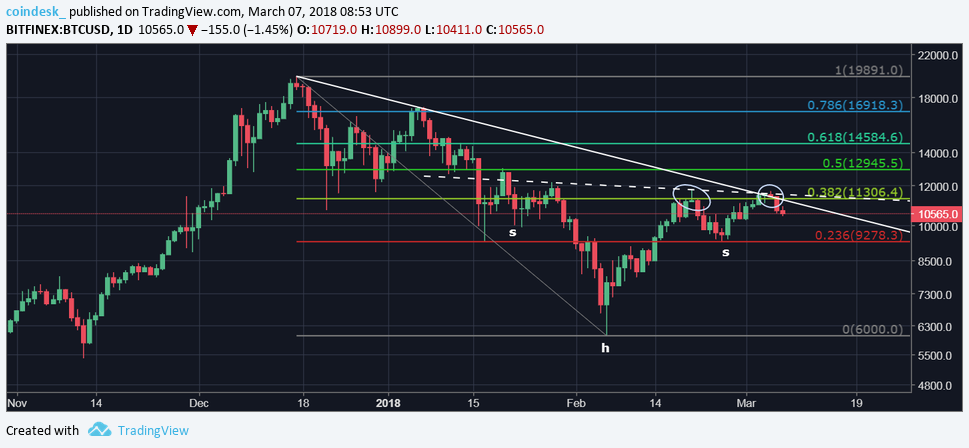
BTC closed above the descending trendline (drawn from the Dec. 17 high and Jan. 6 high) on March 4, indicating a bearish-to-bullish trend change.
However, the follow-through was hardly encouraging and the prices fell below the trendline yesterday, signaling a failed bullish breakout. Also, as seen in the above (prices as per Bitfinex), the break above $11,306 (38.2 percent Fibonacci retracement) was short-lived (marked by circles).
The cryptocurrency now appears to be creating a -like pattern with the neckline support of $9,280. 4 (Feb. 25 low), having also failed to take out the inverse head-and-shoulders neckline resistance.
Clearly, the price action indicates the rally from the Feb. 6 low of $6,000 has made a temporary top around $1,600. The story does not end here, as the candlestick pattern and the moving averages favor a further drop in prices.
Daily chart: Bear doji reversal and a close below the 10-day MA
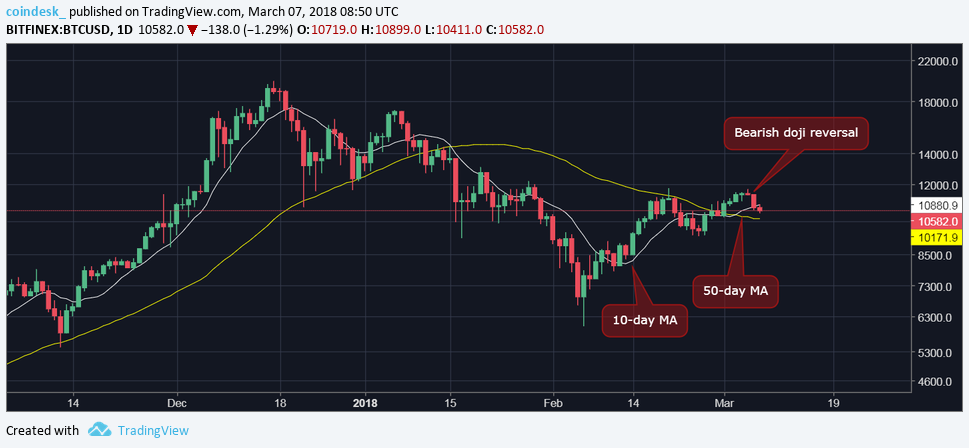
The above chart shows a bearish doji reversal, as represented by Monday’s inverted bearish “hammer” pattern (also known as a ) and Tuesday’s negative follow-through (drop below $11,000) – all of which suggests the tables have turned in favor of the bears.
Furthermore, BTC closed below the 10-day moving average (MA) yesterday, signaling bullish invalidation.
1-hour chart: MAs favor the bears
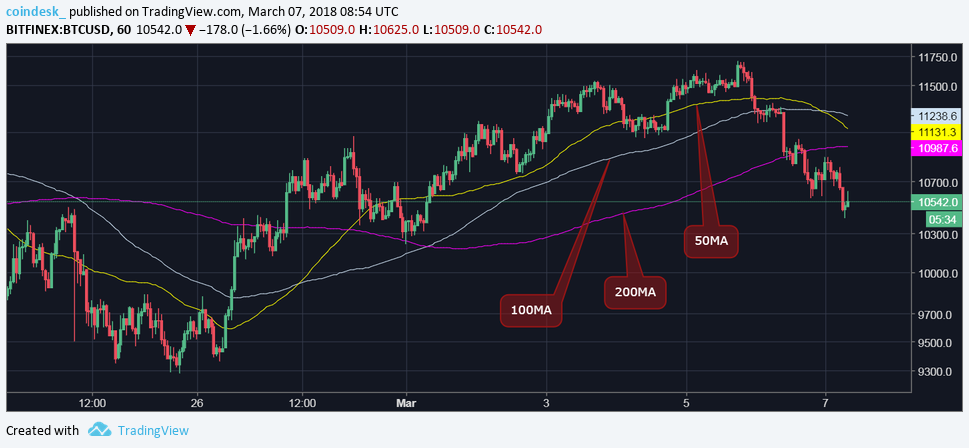
The chart above shows:
- A 50-MA and 100MA bearish crossover.
- The 200MA has shed bullish bias (is flatlined).
- The bias is clearly bearish.
View
- BTC looks set to test 50-day MA at $10,171 and could possibly extend the decline to $10,000.
- A daily close (as per UTC) below the 50-day MA would only add credence to the bearish setup detailed above (on the daily chart) and open the doors for a sell-off to $9,280 (Feb. 25 low) and $8,880 (200-day MA).
- On the higher side, a high volume break above the previous day’s high of $11,411 would indicate bearish invalidation.
- Meanwhile, a big move above $11,600 would signal a long-term bearish-to-bullish trend change and allow stronger rise to $17,000.
Disclosure: CoinDesk is a subsidiary of Digital Currency Group, which has an ownership stake in Ripple.
image via Shutterstock
The leader in blockchain news, CoinDesk is an independent media outlet that strives for the highest journalistic standards and abides by a . Have breaking news or a story tip to send to our journalists? Contact us at news@coindesk.com.
Disclaimer: This article should not be taken as, and is not intended to provide, investment advice. Please conduct your own thorough research before investing in any cryptocurrency.
Published at Wed, 07 Mar 2018 10:00:24 +0000
Markets[wpr5_ebay kw=”bitcoin” num=”1″ ebcat=”” cid=”5338043562″ lang=”en-US” country=”0″ sort=”bestmatch”]


