April 24, 2026

Capitalizations Index – B ∞/21M

Bitcoin Doing Better Than Iran’s Currency, All Rial Holders Will Lose 57% of Their Value

Bitcoin doing better than iran’s currency, all rial holders will lose 57% of their value

Bitcoin Doing Better Than Iran’s Currency, All Rial Holders Will Lose 57% of Their Value


Iran
Advertisement

The national currency of Iran, the rial, is expected to lose at least 57 percent of its value by the end of 2018 amidst a correction worse than that of bitcoin, and the holders of the Iranian rial are said to lose more than half of their savings stored in fiat.

Hyperinflation at 132 Percent

Due to an amalgamation of a variety of factors including strict sanctions imposed by the U.S. government on Iran, the national currency of the country has been on a steep decline since the beginning of 2018.

Since its all-time high at $19,500, the bitcoin price has fallen by 70 percent, replicating the correction it experienced in 2014. But, if the cryptocurrency market moves similarly to its correction in 2014, which was the worst correction in the market’s history, the price of major digital assets like bitcoin and ethereum would bottom out at a 75 to 80 percent drop.

Although the Iranian rial also experienced a substantial drop in its value throughout the past six months. the drop of the rial’s value was not as intense as the correction of bitcoin, and while the dominant cryptocurrency is expected to recover from the $5,000 region, the value of the rial is expected to decline by 57 percent based on mathematical data and its hyperinflation rate at 132 percent.
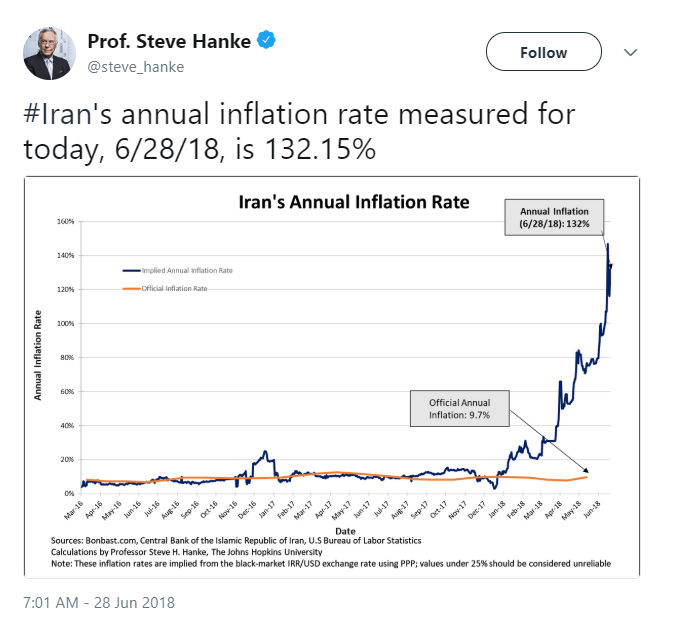
Bitcoin doing better than iran’s currency, all rial holders will lose 57% of their value

The inflation rate of the Iranian rial is not as harmful to the economy as the extreme hyperinflation rate of Venezuela at over 30,000 percent. The difference between the Iranian rial and the Venezuelan bolivar is that the former is still being used as a store of value and a medium of exchange within the country and amongst its allies, while the people of Venezuela have stopped using the bolivar due to its lack of monetary value.

Cryptocurrencies like bitcoin and ether, the native currency of the Ethereum blockchain protocol, have evolved into proper alternatives to failing national currencies. Even the government of Iran has expressed its intent and mid-term plan to utilize cryptocurrencies to transfer money amongst its allies, most notably Russia.

Mohammad Reza Pourebrahimi, the head of Iran’s Parliamentary Commission of Economic Affairs [IPCEA], said:

“[IPCEA has already] obliged the Central Bank of Iran to start developing proposals for the use of cryptocurrency. Over the past year or two, the use of cryptocurrency has become an important issue. This is one of the good ways to bypass the use of the dollar, as well as the replacement of the SWIFT system. They [Russia] share our opinion. We said that if we manage to promote this work, then we will be the first countries that use cryptocurrency in the exchange of goods.”

Possibility of Moving From National Currencies to Cryptocurrencies

It is possible for both governments and the people that suffer from failing national currencies to move onto cryptocurrencies that do not fall under the global financial network and cannot be censored by leading economies.

This year, the U.S. government strengthened its sanctions on Iran by preventing the country from transacting with financial institutions and entities outside of the country. The imposed control on Iran’s financial network led the value of the rial to plummet.

To avoid such sanctions, governments that oversee monetary systems that are not considered as reserve currencies could potentially utilize decentralized and public cryptocurrencies to transact money in the future, even at the risk of the market’s high volatility.

Featured Image from Shutterstock

Follow us on Telegram or subscribe to our newsletter here.
Join CCN’s crypto community for $9.99 per month, click here.
Want exclusive analysis and crypto insights from Hacked.com? Click here.
Open Positions at CCN: Full Time and Part Time Journalists Wanted.

Advertisement


Published at Fri, 29 Jun 2018 22:03:08 +0000

bitcoin Price News

Previous Article

‘Roger Ver Will Cry,’ Boasts Mysterious Bitcoin Cash Attacker

Next Article

Bitcoin Doing Better Than Iran’s Currency, All Rial Holders Will Lose 57% of Their Value

You might be interested in …

Who Created Ethereum?

Who Created Ethereum?

While working on a number of bitcoin projects, a 19-year-old programmer from Toronto, Vitalik Buterin, conceived the idea for Ethereum. Ethereum was intended to be a robust platform that allows developers to build blockchain applications. Buterin was inspired by some of the shortcomings he faced when trying to build applications on the bitcoin blockchain. He believed that the potential of blockchain technology was not limited to financial applications and quickly set out to create a blockchain that could support more common computations.

Vitalik Buterin was first introduced to bitcoin and cryptocurrencies in 2011. That same year he co-founded Bitcoin Magazine and wrote many articles explaining his views on the digital currency’s future. He later worked on Mastercoin and some alternate coins based on the bitcoin codebase. This work led him to believe the bitcoin blockchain was limited in scope.

The Ethereum white paper was released in 2013, and it documented a new open-source protocol for creating decentralized applications.   

Ethereum was officially announced on the Bitcointalk forum in 2014. In addition to Buterin, Ethereum was co-founded by Mihai Alisie, Anthony Di Iorio and Charles Hoskinson. Buterin also announced that he was working with developer Dr. Gavin Wood and Joseph Lubin. Wood soon released the Ethereum yellow paper, which covered the Ethereum Virtual Machine (EVM), the runtime environment that executes all of the smart contracts on the network. Lubin would go on to found ConsenSys, a venture studio focusing on decentralized applications.

The Ethereum Foundation held an ether crowdsale in July 2014 during which they sold 60 million tokens. 12 million ether (ETH) tokens were created so the Ethereum Foundation could expand its development and marketing efforts. The Frontier was the first release of the Ethereum network. It was released a year after the crowdsale and provided a bare-bones mechanism for developers to interact with and build apps on the network.  

Both the Ethereum network and community have grown substantially over the last year. The Ethereum Enterprise Alliance, an initiative working to connect the world’s largest companies to the Ethereum network, recently announced 86 new partners including Microsoft, Intel and BP. Similarly, a multitude of new blockchain projects leveraging the Ethereum blockchain have gained attention and capital.

Ethereum broke into the mainstream in early 2017 when the price of ETH increased by 1000 percent over the course of a couple months. This led to a similar rise in the price of alternative blockchain tokens, dubbed “altcoins.” A slew of new investors quickly entered the space as Ethereum was covered by large media outlets including CNBC, Reuters and Quartz. Investors and developers are awaiting the release of Metropolis, the next update to the Ethereum network promising to abstract a lot of functions and pave the way for user-friendly application designs.

The post Who Created Ethereum? appeared first on Bitcoin Magazine.

Sativacoin(stv): faucets e carteira pos.

SativaCoin(STV): Faucets e Carteira PoS.

SativaCoin(STV): Faucets e Carteira PoS. SativaCoin(STV) é uma Criptomoeda criada por algum entusiasta do tema abordado no nome da mesma à partir do código aberto do algoritmo X13. Links Mencionados no Vídeo: https://bitcointalk.org/index.php?topic=1626516.0 https://coinmarketcap.com/currencies/sativacoin/#markets https://cryptogods.net/nodes/sativacoin/ […]