April 3, 2026

Capitalizations Index – B ∞/21M

Bitcoin Developer and SegWit Inventor Proposes New ‘Taproot’ SoftFork

Bitcoin developer and segwit inventor proposes new ‘taproot’ softfork

Bitcoin Developer and SegWit Inventor Proposes New ‘Taproot’ SoftFork

Several new softfork proposals were posted by the bitcoin developer and SegWit inventor Pietr Wuille this week. Dubbed ‘Taproot’ the upgrade has almost no downside and will help facilitate the bitcoin lightning network that is increasingly being adopted.


Schnorr signatures

bitcoin protocol developer and SegWit inventor, Pieter Wuille, shared a new softfork upgrade proposal dubbed “Taproot” as a likely complement the Schnorr signature softfork upgrade he published to the developer mail list in July 2018.

The adoption of Schnorr signatures claims to give the network significant scalability and privacy enhancements as they will allow for a simpler method for signing transactions. The advantage of Schnorr signatures is that multiple people can create a public key and then sign it with one signature.

Pieter wuille

This method contrasts with the inefficient use of separate signatures in the current system. The result of such an implementation is a reduction in both space savings for the network as well as faster verification times.

Bitmex Research estimates that using Schnorr signatures could lead to a 13.1% space savings based on UTXO count alone if fully implemented.

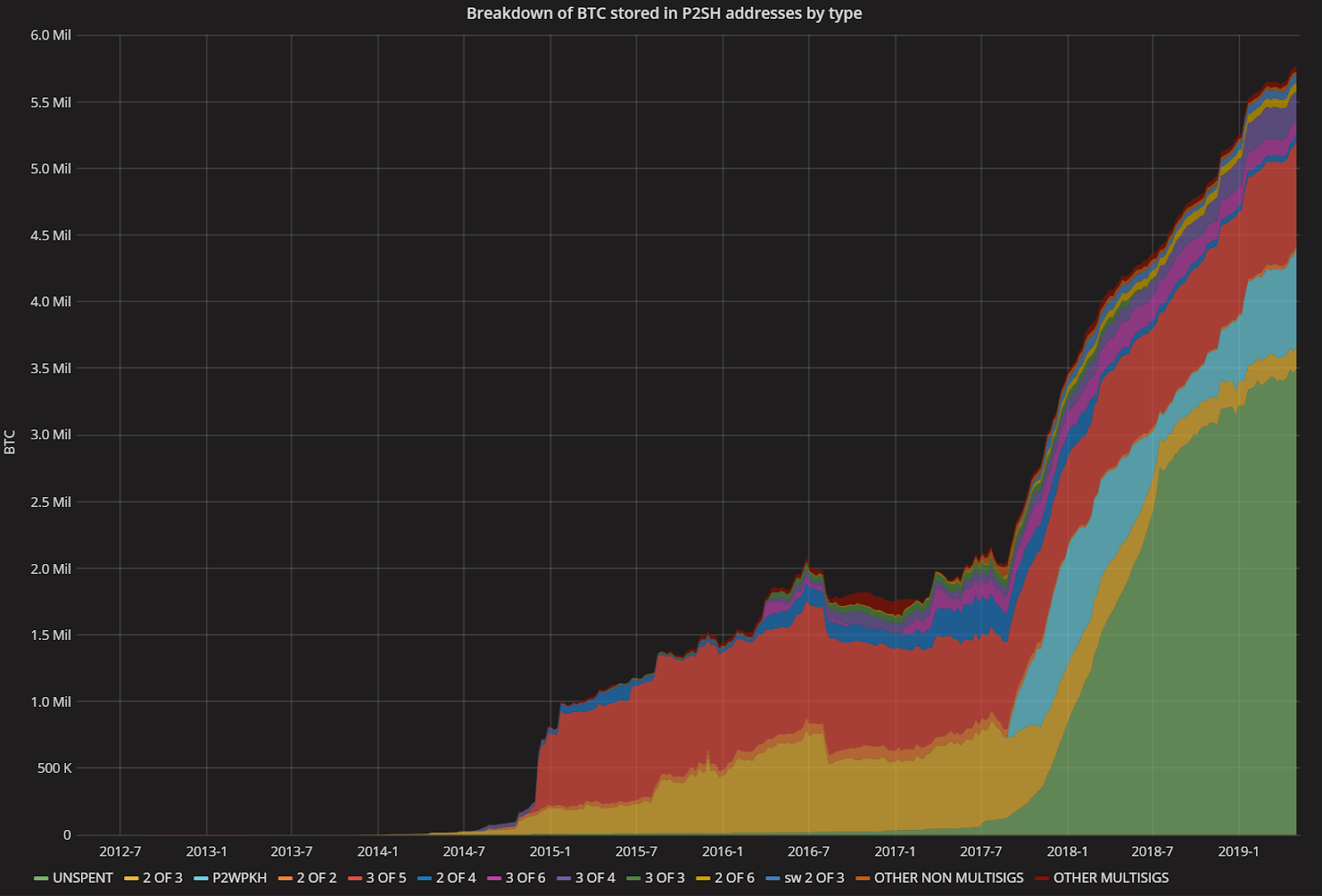
More importantly, multi-signature wallets are becoming popularized due to the rollout of the lightning network that relies on multiple signatures being used. Therefore, the 13.1% savings could compound rapidly as the adoption of lightning and other multi-signature wallets increases.

As proof, the graph below shows the growth of multi-signature wallets.
Bitcoin developer and segwit inventor proposes new ‘taproot’ softfork

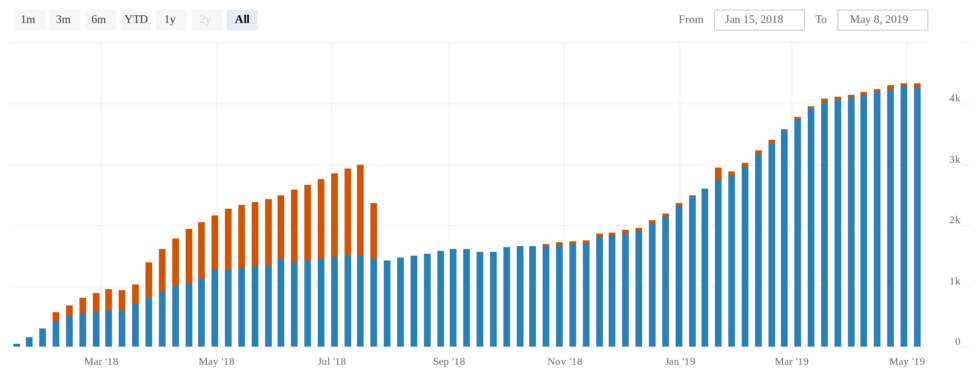
Moving in tandem with the lightning networks implementation, the number of nodes running on the new P2SH type addresses also shows a strong trend of adoption. Therefore, using both could be an important (and perhaps inevitable) step for the continued growth of the bitcoin ecosystem.
Bitcoin developer and segwit inventor proposes new ‘taproot’ softfork

It should be noted that the above graph only shows nodes with active channels, and therefore does not represent the total number of Bitcoin lightning nodes.

Merkelized Abstract Syntax Tree (MAST)

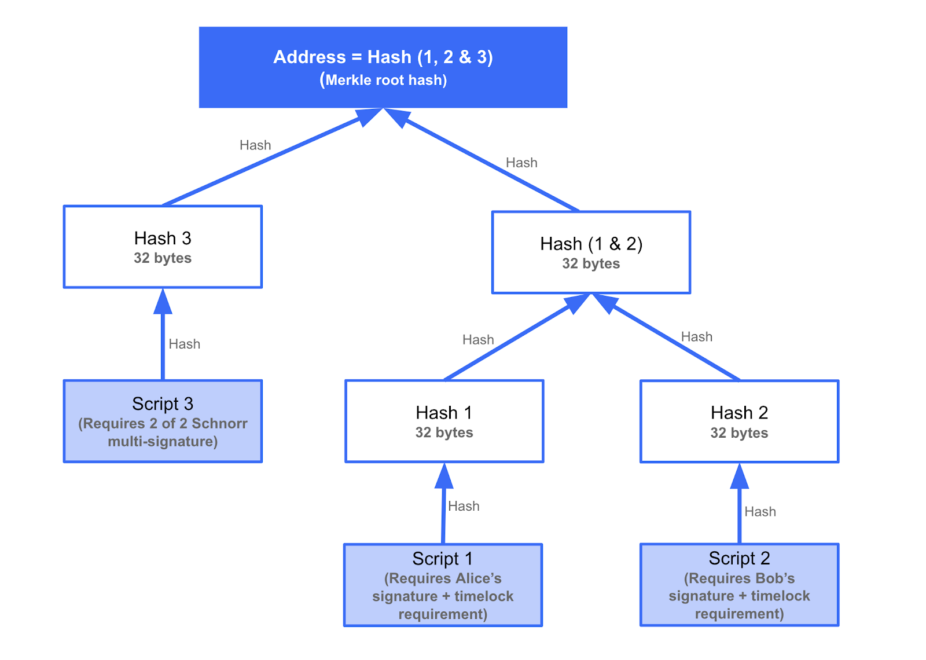
Another softfork idea proposed by bitcoin protocol developer Dr. Johnson Lau in 2016 to reduce blocksize was to structure transactions in a Merkle tree as seen below. Called MAST, the idea was introduced in a research paper titled “The art of making softforks: Protection by policy rule.”
Bitcoin developer and segwit inventor proposes new ‘taproot’ softfork

The Merkle tree would help improve the efficiency of the blockchain when used in conjunction with a Schnorr multi-signature hash. Thus, only one signature would be required for transactions. The Merkle tree would be an off-chain space saving solution.

One inefficiency of this model, however, is that it still relies on two hashes to operate, as well as exposing the network to potential privacy issues by third parties. It would also incur an additional 32 bytes of data for signing transactions.

Taproot

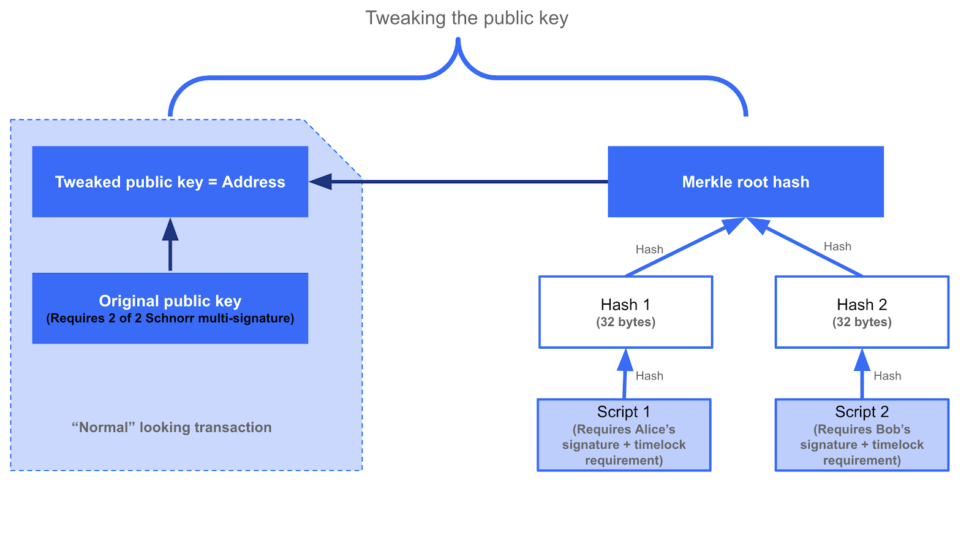
Solving the original Merkle tree’s inefficiencies and privacy concerns, Taproot was suggested. The idea came from bitcoin developer Gregory Maxwell in an email. The difference between the two systems is that in Taproot, only a single signature is required. This version also hides the fact that a Merkle tree exists.

The additional 32 bytes of data is also no longer needed while also emulating the network’s existing public key and signature structure except in a more optimized manner.Bitcoin developer and segwit inventor proposes new ‘taproot’ softfork
The proposed softfork implementations will help the lightning network scale with additional functionality and space optimization. Patience, however, will be key as this latest softfork upgrade could take some time to see the light of day despite there being “almost no downsides.”

What’s the most important upgrade out of these proposed? Share your thoughts below!


Images via bitcoinvisuals.com, Bitmex Research, Shutterstock

The Rundown

Published at Thu, 09 May 2019 06:30:44 +0000

Previous Article

WINBIX ICO (REVIEW) – The Articles –

Next Article

Bitcoin [BTC] reorg is never happening, claims Blockstream CEO after Binance shelves reorg idea

You might be interested in …

Guest Post: Understanding the Limits and Potential of Blockchain Technology

Guest Post: Understanding the Limits and Potential of Blockchain Technology

The promise of blockchain technology is coming to the forefront and capturing the imaginations of investors, entrepreneurs and innovators alike. But what many people do not know is how perilous the blockchain journey ahead still is. We live in a world of smoke and mirrors; enterprise investors must do their due diligence in navigating these choppy waters — making the right investments in the right blockchain technologies to unlock that promised potential.

To make the correct investments, we need to adopt a framework to evaluate them. Having a framework also means having the necessary inputs. What follows in this article are some of these key inputs.

If you are considering making technology investments, think about the end state: your vision. How will this technology fit within your existing technology infrastructure? You need to put on your far- and short-sighted glasses: First, what will the near future (1–2 years) of the blockchain ecosystem look like? Second, how will this blockchain technology integrate with your existing infrastructure? Does it complement your technology investments thus far? Does it mitigate or add to any burdens in your existing technological landscape? All of these questions should inform your purchasing decision.

As an integration consultant and a blockchain architect, my role is to help clients determine what is in the realm of possibility for them and what is not. Questions surrounding scalability, integration points, data interoperability and security are not easy questions to answer, but they must be considered. Some potential investors will be blinded by the sheer potential (or hype) of the technology and will completely ignore these realities. As appealing as blockchain technology is, it’s not for everyone. Some enterprise investors are not at the maturity stage to adopt it yet, and this is not an easy pill to swallow.

Blockchain is a nascent technology and much work is still being done in the areas of interoperability (e.g., ISO/TC 307, Ripple ILP, Hyperledger Quilt, etc.). These are challenges to consider. It is important to understand that, in order to realize the full potential of blockchain technology, some elements of integration with your legacy system are probably still going to be necessary. Consider also how your private blockchain can be integrated with public blockchains — we live in a less-than-perfect world where there are multiple blockchains. Will the blockchain be on cloud or on-premise? These are questions you’ll need to answer; in fact, these very questions will also serve as inputs to your technology adoption framework.

Bigger Picture

As blockchain technology speeds toward standardization (via International Standard Organization, etc.) and interoperability (Interledger Protocols, Hyperledger Quilt, etc.), we also need to ask ourselves if having too many standards will stifle innovation and whether integration and interoperability are antithetical to the core tenet of blockchain technology, which is decentralization, for which I have yet to find an answer.

Finally, the benefits of interoperable and integrated blockchains are many: improved governance, interoperability, process automation, further cost savings and perhaps even cross-chain atomicity (a dream for now, at least). But we must not allow the benefits to blind us to the reality.

I wish to end this article on a hopeful note. Despite the many challenges when it comes to adopting blockchain technology, these challenges are not unique to the blockchain. Every new piece of technology goes through phases of uncertainty and exploration: this one, too, shall pass.


This is a guest post by Nathan Aw. Views expressed are his own and do not necessarily reflect those of BTC Media or bitcoin Magazine.

The post Guest Post: Understanding the Limits and Potential of Blockchain Technology appeared first on Bitcoin Magazine.