
April 8, 2026

Capitalizations Index – B ∞/21M

Bitcoin Cash: Single Mining Pool Controls 50% of Hashrate

Bitcoin cash: single mining pool controls 50% of hashrate

Bitcoin Cash: Single Mining Pool Controls 50% of Hashrate


Bitcoin cash: single mining pool controls 50% of hashrate

bitcoin Cash mining centralization has reached a level where just one pool is controlling half of its hashrate, according to Coin Dance.

The crypto statistics service found that BTC.TOP mining pool, a China-based private entity, took over as high as 50.2% of the entire bitcoin Cash network at some point today. It contributed the hashrate of 679 Peta-Hash per second against other major competing pools including BTC.com (257 PH/s), ViaBTC (215 PH/s), AntPool (125 PH/s), and bitcoin.com (187 PH/s).
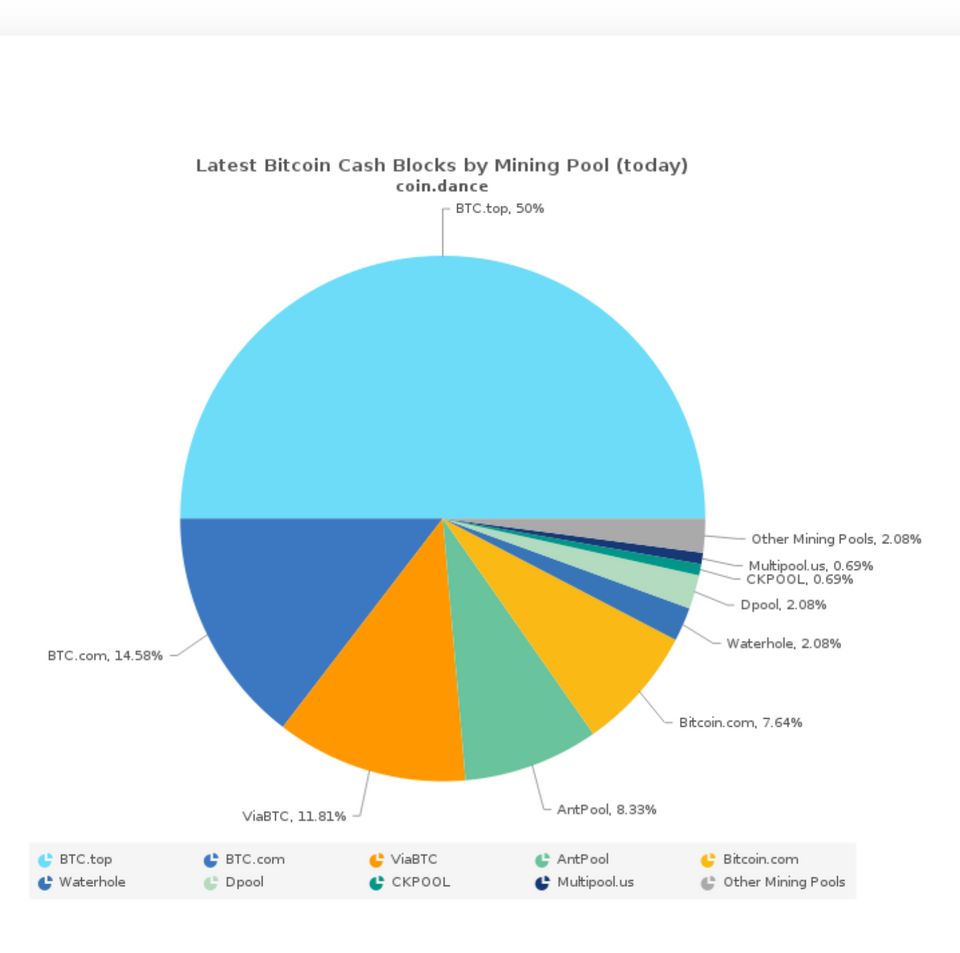
Bitcoin cash: single mining pool controls 50% of hashrate
Source: coin. Dance

bitcoin Cash and Centralization

The notable increase could have taken place due to variance but, at the same time, it threatens the bitcoin Cash network with a potential 51% attack scenario. The Roger Ver-led bitcoin project has been criticized before for failing a “stress test,” conducted at the behest of an anonymous developer(s) known as Bitpico. Evidence showed that 98% of all the Bitcoin Cash nodes were sitting on the same server rack which exposed the coin to seizures and security threats.

In early 2018, Alex Simons, the identity division chief at Microsoft, found that increasing block size such as those done by the bitcoin Cash team threatened decentralization more than second-layer scalability solutions like Lightning Network.

“While some bitcoin communities have increased on-chain transaction capacity (e.g. block size increases), this approach generally degrades the decentralized state of the network and cannot reach the millions of transactions per second the system would generate at world-scale,” he had said.

What’s Next for bitcoin Cash

The central aspect of any decentralized bitcoin project is its ability to guard the system against central control. In a worst-case scenario, malicious mining entities could combine their hashrate output to form a stable coalition. It could make them prevent transactions from getting confirmed; it could allow them even to reverse the confirmed transactions or spend one valid token twice by creating a new chain or by altering old blocks.

bitcoin Gold, for instance, suffered a 51% attack on its network in 2018 where attackers double-spent BTG tokens for several days. They eventually stole $18 million worth of bitcoin Gold tokens, according to the BTG/USD exchange rate at the time of the attack. In August 2016, two Ethereum-based crypto projects, Krypton and Shift, also suffered 51% attack on their networks.

In some cases, mining pools which unintentionally crossed the 50% hashrate barrier voluntarily reduced their computing power with the purpose of redistributing it to other mining pools. GHash.io, for instance, had exceeded 50% of the bitcoin’s computing power in July 2014 but reduced it back to 40% after facing a community backlash.

What BTC.TOP could do is what GHash.io had done in its time: let go of some of the computing power to reinject trust in the bitcoin Cash network. If it doesn’t scale back, the digital currency could suffer hugely as investors’ sentiment wears off.

Featured image from Shutterstock.

We are hiring full-time and part-time journalists based in the United States. Ideal candidates will have extensive knowledge of traditional markets and/or the cryptocurrency industry. Apply for a position here.

Advertisement

Published at Thu, 03 Jan 2019 01:35:16 +0000

Previous Article

DAPP DEVELOPMENT FOR ERC20 DISTRIBUTION – Tune Trade – Medium

Next Article

Ethereum [ETH], EOS and Litecoin [LTC] emerge as biggest winners among the top 10 club

You might be interested in …

Abra Closes $16M in Funding and Looks to Venture Into Consumer Product Space

Abra Foxconn

Abra, a mobile payment and digital currency platform that relies on bitcoin, closed $16 million in series B funding, led by Foxconn, the electronics supplier for Apple and other tech giants.  

Bill Barhydt, founder and CEO of Abra, made the announcement on October 23, 2017, at Money20/20 in Las Vegas, where he also outlined his vision for how consumer product companies will use bitcoin in the future.

Other investors in the round include Silver Capital and IGNIA, as well as previous investors Arbor Ventures, American Express Ventures, Jungle Ventures, Lerer Hippeau and RRE Ventures. Total funding to date for the company now stands at nearly $35 million.

“We believe that Abra represents the future of digital payments and banking,” Jack Lee, founding managing partner at HCM, the investment arm of Foxconn, said in a statement, adding that Abra could potentially usher in a new era of financial inclusion to billions of people.

In speaking with bitcoin Magazine, Barhydt explained that Abra plans to use the funds to expand globally and invest in future product development. “We have a lot of project announcements we will be making on a rolling basis,” he said.

Three-Part Vision

Though Barhydt did not offer exact details on what Abra’s new products will be, he did drop several hints in his three-part vision for how consumer products will implement bitcoin in the future.

The first part, he explained, involves cross-border and consumer payments, which he said has been Abra’s focus for a couple of years now.

The second part involves using bitcoin as an investment vehicle, in which smart contracts built on top of bitcoin’s ledger would enable more complicated if-then types of financial transactions — payments that go through only if specific conditions are met.

Abra already relies on smart contracts to hold fiat currency and manage bitcoin price fluctuations, Barhydt explained.

He went on to describe the third part of his vision: “A new model of consumer asset finance,” which he said is where consumer product companies like Foxconn enter into the picture.

It was an idea that he conceived while recently traveling to Africa. There, he saw how a company was leasing solar panels to people who were making regular micro-payments via M-Pesa, a mobile money transfer service.

“They give solar kits to people who use them only if they make a weekly lease payment from M-Pesa wallet,” he explained. If a borrower does not make the payment, a SIM card in the phone communicates with the battery in the solar panel, shutting it off.

His idea was to extend the concept to other consumer appliances, like refrigerators, flat-panel TVs and washing machines, that people in developing countries struggle to afford.

“Using this model of embedding this cellular technology combined with a bitcoin-based payment system like Abra, you now have a new model where people can do instant on-lease payments,” he said, calling it a “new trillion-dollar business” that can only be done on scale using something like bitcoin.

Continuing to remain tight-lipped about future product launches, Barhydt said, “Our goal is to be the best digital currency wallet in the world for the average consumer, starting with real cash and bitcoin, and we’ll see how it evolves from there.”


The post Abra Closes $16M in Funding and Looks to Venture Into Consumer Product Space appeared first on Bitcoin Magazine.