July 21, 2026

Capitalizations Index – B ∞/21M

Bitcoin Cash Price Analysis: Token breaks long-term resistance following bullish resurgence

Bitcoin cash price analysis: token breaks long-term resistance following bullish resurgence

Bitcoin Cash Price Analysis: Token breaks long-term resistance following bullish resurgence

The cryptocurrency market opened on February 9 to an incredibly bullish wave following weeks of sluggish movement. bitcoin Cash [BCH] experienced a bittersweet rise, as the coin pushed above the $2 billion-mark, and added close to $300 million to the market cap, but was surpassed by the ‘digital silver’ Litecoin [LTC], on the back of a remarkable 30 percent increase.

bitcoin Cash has seen a whopping 11.26 percent price increase against the US dollar in the past 24-hours and the coin’s market cap currently stands at $2.28 billion.

In terms of exchange dominance, LBank takes the top-2 spots, accounting for $39.58 million or 9.58 percent and $32.42 million or 7.85 percent in the BCH/BTC and the BCH/USDT trading pairs respectively. Taking the third spot is BW with 7.53 percent in the BCHABC/USDT trading pair.

1-hour:

Bitcoin cash price analysis: token breaks long-term resistance following bullish resurgence

The one-hour bitcoin Cash chart shows an incredible spike in the BCH price, as the collective market rose by $9 billion. bitcoin Cash saw a massive uptrend during the same stretching from $115.24 to $129.06, following the mid-week downtrend from $115.86 to $111.8.

bitcoin Cash’s immediate support level prior to the recent rise stood at $110.36, which now stands at $125.37, while the coin now poses an immediate resistance level of $129.25, capped off by the high of the bullish swing.

The Bollinger Bands point to a massive increase in volatility of the coin, and the Moving Average line shows a return of the bulls.

The Chaikin Money Flow indicator points to an increase in the money put into bitcoin Cash as the market looks bullish.

The Fisher Transform line shows a cross-over into a bullish swing as the Fisher Line has overtaken the Trigger Line in the BCH market.

1-day:

Bitcoin cash price analysis: token breaks long-term resistance following bullish resurgence

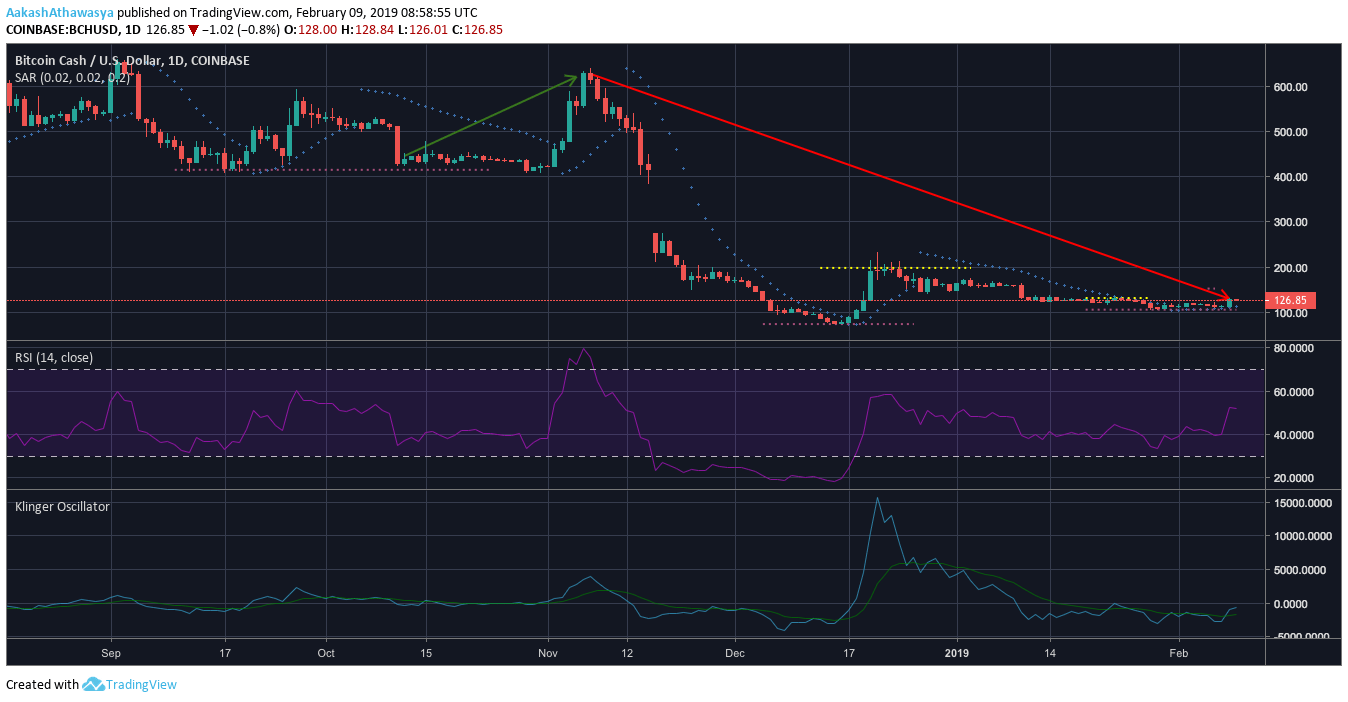
The one-day trend line of bitcoin Cash shows a string of stabilization after the coin’s post-hardfork bearish spree. The coin experienced a prolonged downtrend from $626.58 to $130.75.

bitcoin Cash has an immediate support level of $106.38, which the coin hovered close to in late-January. The immediate resistance level of the coin stands at $132.41, which the coin is just hovering below.

The Parabolic SAR points to a bullish swing for the coin, even in the long-run, as the dotted lines are aligned below the coin’s trend line.

The Relative Strength Index shows that investors are increasingly purchasing BCH as the market has switched to green. At press time, the coin’s RSI has shot up from 32.58 to 51.95.

The Klinger Oscillator shows that the bitcoin Cash market is bullish following the recent increase in the price.

Conclusion:

bitcoin Cash has been pushed up significantly by the collective market resurgence which has signaled a return of the BCH bulls in the short-run. In the long-run, the coin is inching closer to its resistance level of $130.75, as major indicators point to a bullish takeover for the coin after weeks of sluggish stable movement.

The post Bitcoin Cash Price Analysis: Token breaks long-term resistance following bullish resurgence appeared first on AMBCrypto.

Published at Sun, 10 Feb 2019 08:03:50 +0000

Previous Article

Blockchain Expo Crypto Soiree by CryptoArnie

Next Article

Canada’s Regulators Might Help Crypto Exchange QuadrigaCX’s Victims After All

You might be interested in …

Lombrozo: Bitcoin Core Developers May Never Use Miner-Focused BIP 9 Signaling Again

core-BIP9.jpg

One of the key points of contention in the politicization of bitcoin protocol development over the past couple of years has been the concept of miner signaling. While not intended to be a vote among miners to decide the future of the bitcoin network, Ciphrex CEO and Bitcoin Core contributor Eric Lombrozo pointed out that miners are now using the signaling process as leverage in the discussion over bitcoin scaling.

Lombrozo made the comments during a discussion with host Thomas Hunt and bitcoin developer Jimmy Song on Hunt’s Mad Bitcoins YouTube channel.

“This whole signaling thing is a huge problem that I think created a very terrible narrative,” said Lombrozo.

What Is BIP 9?

BIP 9 is a method of rolling out soft-fork upgrades to bitcoin. The short description of this process is that soft-forked changes will be enabled once 95 percent of miners have signaled to the network that they are ready for activation, using a trick called “version bits.”

“It was an arbitrary system created by developers in order to coordinate smooth soft-fork transitions,” said Lombrozo. “It was not designed to be a political system for voting on controversial issues ever — that was never the intention.”

Lombrozo also noted that, in the past, soft forks have been deployed on bitcoin without any special treatment for miners, and BIP 9 was supposed to solve some of the issues miners could face during the deployment of a soft fork.

“It was introduced for the courtesy of miners to be able to reduce their orphan rates and reduce the probability that they’re going to end up mining blocks that are actually invalid — that was the real motivation behind it,” said Lombrozo.

According to Lombrozo, the goal is still to get nodes upgraded and enforce the rules of the soft fork; BIP 9 was simply a technique to coordinate with miners.

The Ciphrex CEO added that there was nothing like miner signaling in the original version of bitcoin, and Satoshi Nakamoto never used miner signaling for the soft forks that he deployed on the network.

“It was a mechanism that was created way later,” said Lombrozo. “And once this mechanism was created, it was abused and turned against the developers to try to extort stuff. And now it’s being used against businesses to extort stuff from them.”

BIP 9 Does Not Work With Uncooperative Miners

According to Lombrozo, BIP 9 would not have been used for Segregated Witness (SegWit) if the contributors to bitcoin Core knew then what they know now.

“If we considered that there had been this kind of, like, contentious or adversarial situation, then BIP 9 would not have been used,” said Lombrozo. “We would not have used the signaling mechanism because it obviously does not work under those kinds of circumstances.”

In Lombrozo’s view, miners are now using the effective veto power that comes with the miner signaling process outlined in BIP 9 as leverage in the discussions around scaling bitcoin. He also believes bitcoin Core developers may deserve some of the blame for using BIP 9 in the first place.

“But at the same time, we only had the best of intentions at the moment,” added Lombrozo. “We thought we’d gotten through all these disagreements and it seemed like the miners were for it and going to support it … Obviously, the adversarial case needs to be considered because it’s just the nature of this network and the way that it works.”

Lombrozo suggested that miners also used miner signaling as a sort of “propaganda” tool with bitcoin Unlimited, even though there was no activation mechanism included in the code.

Never Use BIP 9 Again?

According to Lombrozo, miners now think they have some control over the protocol due to the use of the miner signaling process outlined in BIP 9.

“Miners started thinking, ‘Hey, maybe we have control over the protocol because of this whole signaling thing,’” said Lombrozo during his discussion with Hunt and Song.

Lombrozo claimed that “we’re never going to use BIP 9 to deploy anything almost for sure” if SegWit is not activated via the current BIP 9 deployment.

As an alternative, bitcoin Core could turn to BIP 8, which is a variation of BIP 9 from pseudonymous developer Shaolin Fry that eventually activates a soft-forking change whether miners have signaled for it or not. Miners can still activate the change before it is automatically locked-in on the network, but approval from miners is not required before that lock-in takes place.

Watch the full episode here:

[youtube https://www.youtube.com/watch?v=JTCB5bRGQj0?feature=oembed&w=480&h=270]

The post Lombrozo: Bitcoin Core Developers May Never Use Miner-Focused BIP 9 Signaling Again appeared first on Bitcoin Magazine.

The common tactics used to hack a cryptocurrency exchange

The Common Tactics Used to Hack a Cryptocurrency Exchange

The Common Tactics Used to Hack a Cryptocurrency Exchange Advertisement A lot of amateur cryptocurrency traders and retail investors are starting to lose interest in this booming industry because of the lengthy and painful decline […]